



Director: Alain Resnais
Screenplay: Jorge Semprún
Starring: Jean-Paul Belmondo, François Périer, Anny Duperey, Claude Rich, Michael Lonsdale, Charles Boyer
Country: France
Running Time: 120 minutes
Year: 1974
BBFC Certificate: PG
Of all the films to have emerged from the post-war era in France, those of Alain Resnais are among the most elusive and intriguing. Whether it is Night and Fog, Last Year at Marienbad or Je t’aime, je t’aime, each of his films bears the weight of time and its limitless impact on their often-illusory cast of characters. His reputation is as slippery as the most complex of his cinematic achievements. This imbues the viewing of a film likes Stavisky … which purports to be a record of the last months in the life of one of the most infamous con men in French history all the more compelling. The film is not at all what it seems.
Having heard of the film but knowing nothing about it, the film’s opening sequence was quite a surprise, as it concerns the arrival in France of the great revolutionary leader Leon Trotsky, exiled from Stalin’s Russia and in need of sanctuary. The great man is granted refugee status under strict conditions and the watchful presence of the French state. It is only then that we see our protagonist onscreen, Stavisky, portrayed by Jean-Paul Belmondo, descending as if from heaven in a gilded elevator into the heart of a luxury hotel. These two historical figures never meet, but their life stories are used by Resnais as counterpoints to each other. One is a great man in exile, with unimpeachable integrity yet someone we barely glimpse and never hear speak; the other is Stavisky, the arch swindler and forger at large amongst hordes of politicians, financiers and media barons, a man with money to burn who is charm personified; a man for whom lying is as effortless as breathing.
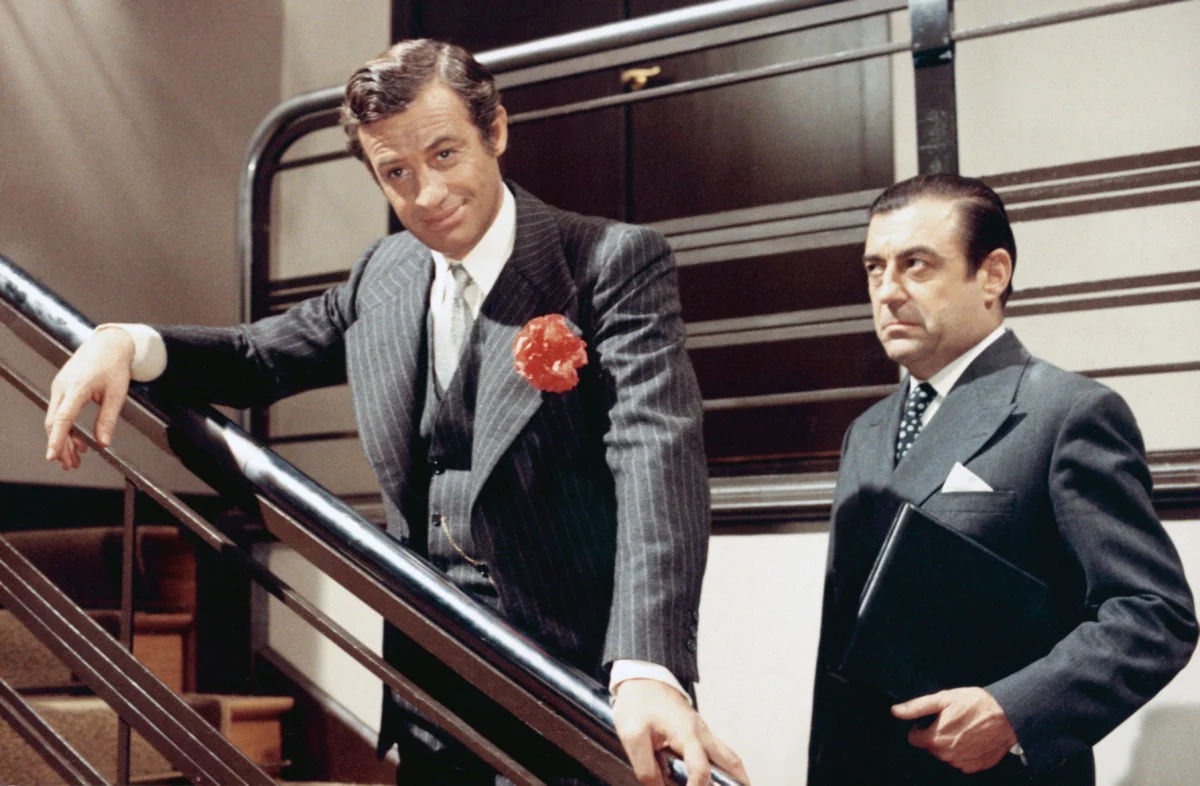
It practically goes without saying, but Jean-Paul Belmondo excels as Stavisky. With his physical swagger and ultra-cool smile, he fully embodies this larger-than-life character. As an actor, Belmondo’s supreme skills sometimes take a back seat to his physical attributes, but here he gives it everything he has. A scene where he rehearses a sales pitch to an empty boardroom whilst holding a candelabra is just one sublime moment amongst many to be found here. Resnais places Belmondo within an elite ensemble, including the likes of Charles Boyer and François Périer who all portray their various characters with consummate delicacy. It’s always a thrill to see the wonderful Michael Lonsdale in any film role, and here he is especially good as Stavisky’s devoted physician. It took me a while to recognise Claude Rich, who was the brilliant leading man in Je t’aime, je t’aime, here playing a ruthless detective hot on Stavisky’s trail. The film’s real revelation is Anny Duperey, the dazzlingly beautiful actress portraying Stavisky’s wife Arlette, making a name for herself early in her extraordinary career on stage and screen.

Filmed in locations around Biarritz, Resnais stages Stavisky… as a film that could have been made in the 1930s, using camera angles, lenses and narrative detail familiar from that era. However, these merely highlight the wider point that is being made; what is being recreated is an illusion, masking the very real and widespread corruption and criminality that our anti-hero is engaged in, with the political class and its functionaries all too willing to look the other way whilst the money flows into their pockets. The film teems with socio-political context (at one point a character refers to the writer Joseph Kessel, who would later write L’homme que j’ai connu about the Stavisky affair and its aftermath), setting the scene for what will follow. Every manicured fingernail and glittering glass of champagne cannot prevent the encroaching darkness that will soon engulf Stavisky.
INDICATOR LIMITED EDITION BLU-RAY SPECIAL FEATURES
– 4K restoration from the original negative
– Original mono audio
– Pour le Cinema location report (1974, 16 minutes)
– Extract from the French television programme, broadcast on the day of the film’s premiere at the Cannes Film Festival, featuring interviews with the director Alain Resnais, and actors Jean-Paul Belmondo and Charles Boyer.
– Cinema set report (1973, 5 minutes)
– Extract from the French news programme JT Aquitaine, broadcast during the film’s production, featuring behind-the-scenes footage and an interview with Belmondo.
– Interview with Anny Duperey (1974, 3 minutes) conducted for the French television programme Couleurs du Festival du Cannes on the day of the film’s premiere.
– Cannes Film Festival press conference (1974, 5 minutes). Resnais and Belmondo speak with journalists on the day of the film’s premiere.
– The Guardian Interview with Alain Resnais (1982): archival audio recording of the celebrated filmmaker in conversation at the National Film Theatre, London
– The Guardian Interview with Stephen Sondheim (1988): archival audio recording of the much-loved composer and lyricist in conversation at the National Film Theatre, London
– Original theatrical trailer
– Image gallery: promotional and publicity materials
– New and improved English translation subtitles
– Limited edition exclusive booklet with contemporary production reports by Jonathan Rosenbaum, an analysis of Stephen Sondheim’s score, an overview of critical responses, and film credits
– US premiere on Blu-ray
– Limited edition of 4,000 copies for the UK and US
Indicator has furnished this Blu-ray release with a host of outstanding special features. The location reports from French television are fascinating for their thoroughness and contextual detail. You get to see not one but two photographs of the real Serge Alexander Stavisky lying dead in the chalet in Chamonix, which lends a grisly air to proceedings, despite the charming nature of the interview content. The Cannes Film Festival press conference is a short but precious look at both Belmondo and Resnais side by side, with the director being abrupt and pointed in his response to the assembled journalists.
Although some of the audience’s questions are difficult to decipher, the interview with Resnais recorded at the National Film Theatre in 1982 is a genuine treat to listen to, with the director giving long and very considered responses to questions about his career. Most of the questions relate to his then most recent film Mon oncle d’Amérique (1980), but he does address Stavisky…as well as other topics such as May ’68 and censorship under De Gaulle’s government. He also spends a long time defending La Guerre est finie after it is brought to his attention that the film was shown as part of a festival of ‘right wing’ films at the NFT curated by the critic Alexander Walker. I love discovering this sort of period detail amongst special features.
The interview with the composer Stephen Sondheim is another superb audio experience. Despite having little knowledge of his life and works, I really hearing Sondheim speak eloquently about his career. He clearly has the audience in the palm of his hand. He refers to his work with Resnais on Stavisky with such verve and admiration that you can tell this was a very special collaboration for him. The interviewer describes Sondheim’s music as ‘an exquisite score for an exquisite film’ and I can only wholeheartedly agree. Also, Sondheim is the only person on the special features who draws specific attention to the subplot involving Trotsky, and its importance to the film itself.
Jonathan Rosenbaum’s essay in the accompanying booklet is a brilliant example of contemporary writing illuminating a film in the present day. His report from the studio filming and on-set interview with Resnais about the then un-named film make for a brilliant piece of reportage. The essay about the collaboration between Resnais and Sondheim is another slice of historical journalism that conveys the admiration these creative forces had for each other. The final essay about the varying critical reactions to the film are yet another set of archival treaures. Stavisky… is a film ripe for critical reassessment, and this spectacular Blu-ray release will ensure that will soon become a reality.