


 Marcell Jankovics always had a talent for art and grew up with artists on both sides of his family but, through observation, he believed it wasn’t a robust career choice, so decided to go to university to train to be an architect instead. Thankfully, for the film community, he wasn’t accepted (reportedly due to political reasons) so his career went in a different direction.
After working in manual labour for a short while, he fell into filmmaking when a colleague gave him an in-road. Jankovics got a job at Hungary’s Pannónia Filmstúdió, which produced animated shorts and adverts. After quickly working his way through the ranks and directing a well-received animated advert for India Air, he made Pannónia’s, and in fact Hungary’s, first feature-length animation, Johnny Corncob (a.k.a. János vitéz). It was very popular in its home country and set Pannónia to become a widely respected studio producing high-quality animated features.
Jankovics followed up Johnny Corncob with a couple of award-winning shorts, getting an Oscar nomination for Sisyphus (1974) and bagging a Palme d’Or for The Struggle (a.k.a. Küzdők) (1977). He then spent the next couple of years working on his most famous feature film, Son of the White Mare, released in 1981.
Son of the White Mare didn’t perform quite as well as Johnny Corncob, perhaps explaining why Jankovics didn’t make as many features afterwards. However, it was critically acclaimed and greatly revered among animation enthusiasts.

This admiration proved strong enough to inspire Los Angeles studio Arbelos Films to restore Son of the White Mare and give it a new lease of life in the US, where it had been unavailable for decades.
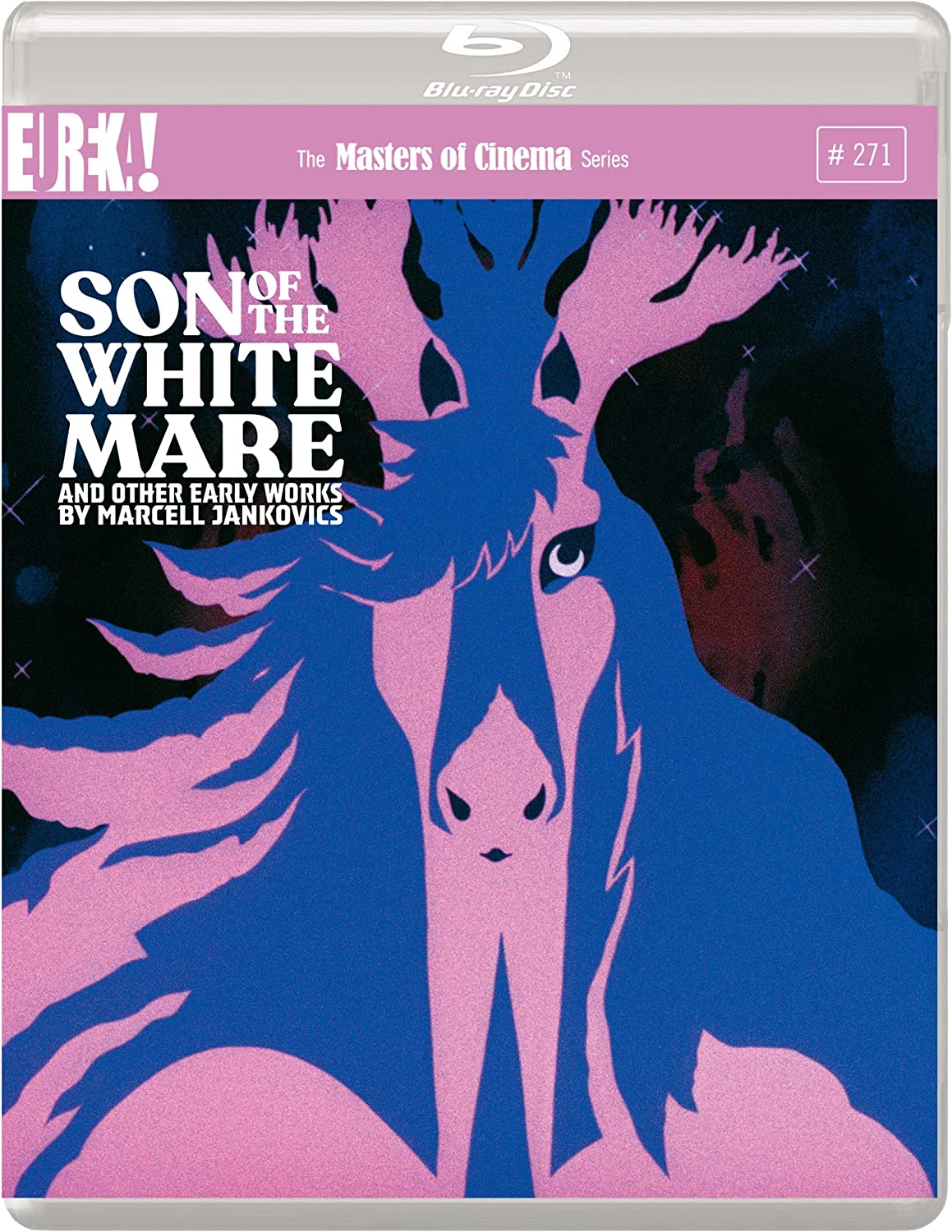
Now, Eureka are taking this restoration and releasing Son of the White Mare alongside Johnny Corncob and a handful of short films on Blu-ray in the UK.
After reading Blueprint: Review writer Andrew Goulding’s praise of the two features in his ‘100 Non-Disney, Non-Pixar, Non-Ghibli Animated Features’ list (see here and here), I’ve been eager to see them. So, it didn’t take much to talk me into reviewing this new Blu-ray from Eureka. My thoughts follow.
Johnny Corncob (a.k.a. János vitéz)
Director: Marcell Jankovics
Screenplay: Marcell Jankovics, Tamás Sipos, Péter Szoboszlay
Based on a Poem by: Sándor Petöfi
Starring: György Cserhalmi, Anikó Nagy, Erzsi Pártos, Antal Farkas, Gábor Mádi Szabó, György Bárdy
Country: Hungary
Running Time: 74 min
Year: 1973
Johnny Corncob was made to mark the 150th anniversary of poet Sándor Petófi’s birthday. It’s based on his epic poem ‘János vitéz’ (which is also the Hungarian title of the film) and tells the story of the titular character, Johnny Corncob (voiced by György Cserhalmi). He’s a young shepherd who falls madly in love with Iluska (Anikó Nagy).
However, their ‘free love’ gets the pair in trouble, most notably with Iluska’s evil stepmother (Erzsi Pártos) who disapproves of the pairing. Johnny, then, is kicked out of town but uses this banishment as an excuse to seek his fortune, so he can come back a rich man and give Iluska the future she deserves.
This sets us up for a series of adventures that take our hero through a journey of tragedy, war and magic.

Whilst the episodic narrative is that of a fairly standard fairy tale or rather a collection of them, it’s all brought to another level by the film’s visual style. The characters seem simple, initially, with minimal details, largely flat colours and a grotesque look (in the distorted and exaggerated sense of the word, not ugly). However, the way they move and interract with one another and their backgrounds is much more unusual. It’s a look that’s clearly inspired by The Yellow Submarine but has enough of its own personality to not feel like a lazy copy.
The influence of Jankovics’ work can, in turn, be seen in the films of Cartoon Saloon (Wolfwalkers, The Secret of Kells and Song of the Sea) and Genndy Tartakovsky (Samurai Jack, the original Clone Wars mini-series and Primal).

The style really comes into its own in the film’s psychedelic montages and musical numbers. Jankovics mesmerises with the way he cleverly fuses, blends and transforms backgrounds, objects and characters, creating a bold, fluid dance of colour and form.
I also liked the rather grand, beautifully orchestrated score that accompanied the film, composed by János Gyulai-Gaál. As mentioned previously, there are a few songs too. These are very much a product of their time, but if you’re into early 70s psychedelic prog rock you’ll enjoy them.
Overall, Johnny Corncob is a spellbindingly beautiful fairytale, a true feast for the senses, telling a classic story with great visual invention.
Film: 


Son of the White Mare (a.k.a. Fehérlófia)
Director: Marcell Jankovics
Screenplay: Marcell Jankovics, László György
Based on a Poem by: László Arany
Starring: György Cserhalmi, Vera Pap, Gyula Szabó, Ferenc Szalma, Mari Szemes
Country: Hungary
Running Time: 86 min
Year: 1981
Son of the White Mare (a.k.a. Fehérlófia) is based on an Hungarian folk tale which had been written in narrative poetry form by László Arany.
It opens with a white mare escaping from some dark force before giving birth to a son, later named Treeshaker (a.k.a. Fanyüvő, voiced by György Cserhalmi). This moniker comes after the ghost of his forefather tells him to continue to nurse from his mother until he’s strong enough to shake the mighty tree, in which they live, out of its roots.
By the time he is a young man, the son can indeed perform this incredible physical feat and, after his mother dies, he heads off to defeat the evil terrorizing the world. This evil comes in the form of three dragons, who were unleashed by the forefather’s three sons and their three wives.
Treeshaker can’t tackle the dragons alone though, so seeks to find his two brothers, Kőmorzsoló (Stonecrumbler) and Vasgyúró (Ironrubber) along the way. The three of them unite and embark on a perilous quest to save the world.

It’s hard not to just repeat what I wrote about Johnny Corncob, in saying how this is another fairytale brought to vivid life through sumptuous visuals. However, I felt this was an improvement over that already impressive film.
For one, the visual style is even more mind-blowing. The character and background designs are more unique, often avant-garde in look and less indebted to Yellow Submarine. Colours are strikingly well used and there’s a beautiful use of shapes, movements and symbolism from the natural world. The dragons have a notably darker, less appealing man-made look, with one seemingly inspired by early digital imagery.
There’s a strong sexual undertone here too, from the magnificent birthing sequence near the start of the film to some rather suggestive placement and uses of Treeshaker’s sword.

The film has an overall dreamlike quality, aided by its unusual, sparse soundtrack. There’s no lush score or 70s prog here. Instead the music is often more drone-like and used subtly in the background.
So, even more stunningly beautiful than Johnny Corncob, Son of the White Mare mixes experimental, abstract imagery with sexual symbolism and deceptively simple character designs to make a psychedelic marvel. Its folk/fairy tale narrative might not offer much new but its style is simply breathtaking.
Film: 

Son of the White Mare and other early works by Marcell Jankovics is out on 14th November on Blu-Ray in the UK, released by Eureka as part of their Masters of Cinema series. The films look great. There’s an aged feel, through being able to see the textures of the artwork, and the colours look gorgeous – not overly saturated but rich and natural. They sound great too.
LIMITED EDITION SPECIAL FEATURES
– Limited Edition O-Card slipcase (The first print-run of 2000 copies ONLY)
– 1080p presentation on Blu-ray from a director-approved 4K digital restoration
– Johnny Corncob (János Vitéz) – Jankovics first animated feature, and the first ever Hungarian animated feature film, is also presented here in 1080p from a director approved 4K digital restoration
– Sisyphus – short film
– The Struggle (Küzdők) – short film
– Dreams on Wings – short film created as a commercial for Air India
– Optional English Subtitles
– Brighter Colors – extensive interview with Marcell Jankovics from the Hungarian National Film Archive, filmed in 2020
– Making of János Vitéz – archival featurette from 1973
– The Director Talks – featurette with Jankovics produced by the Hungarian National Film Archive
– PLUS: Collector’s Booklet featuring a new essay by film writer Rich Johnson
Johnny Corncob is, of course, the biggest bonus here, though I’ve treated the release as a boxset really rather than seeing Johnny Corncob as a ‘special feature’.
Equally as welcome are Jankovics’ early short films. Dreams on Wings shows the director developing his bewitching techniques of ‘morphing’ objects and scenes into one another. It forms the basis of this whole short and is highly effective. It’s cleverly designed and executed and looks gorgeous.

Sisyphus is a powerful, symbolic short that uses sparse line paintings and intense voice work to great effect. Jankovics claims the film was about making Johnny Corncob, symbolising the arduous task of getting it made and trying to get it sold. Hanna-Barbera bought the US rights and made changes, largely to the soundtrack, but never released Johnny Corncob, which was a huge blow to the director and the studio.
The final short, The Struggle, was inspired by something Jankovics experienced whilst getting Son of the White Mare off the ground. An artist he respected and worked with for a number of years moved to “the other side” and became a producer. The short uses a simple but clever concept and, once again, quite a sparse visual approach to symbolise the life and soul artists put into their work.
‘Brighter Colours’ provides a dense, fascinating account of Jankovics’ career and how the films in the set came about. It’s a vital piece for anyone wanting to understand where the films are coming from.

‘The Director Talks’ is a similar, shorter piece, running swiftly through Jankovics’ career (taken from the same interview, I believe). It contains more film clips, making for a livelier watch, but the longer piece is preferable due to telling a more fleshed-out story. There is some different material here though, so it’s still worth having as an addition.
Although it’s only short, I also appreciated seeing the archive ‘Making of János Vitéz’. It briefly sets up the background of the production and gives a glimpse behind the scenes of the making of the film.
I didn’t receive a copy of the booklet prior to writing my review unfortunately (which might explain why my write-up isn’t as detailed as I’d have liked) but Eureka usually do an excellent job with them.
So, whilst I would have liked a commentary and maybe a little more outside analysis, the inclusion of Johnny Corncob and the short films, on top of the excellence of Son of the White Mare itself, make this an easy recommendation. Watch and be blown away.
Disc/Package: