



Director: Jacques Rozier
Screenplays: Jacques Rozier, Michèle O’Glor, Alain Raygot, Lydia Feld
Starring: Jean-Claude Aimini, Stefania Sabatini, Yveline Céry,
Danièle Croisy, Caroline Cartier, Françoise Guégan, Bernard Menez,
Pierre Richard, Maurice Risch, Jacques Villeret, Luis Rego,
Yves Alfonso, Lydia Feld, Rosa-Maria Gomes, Jean Lefebvre, Jacques Petitjean.
Country: France
Running Time: 111 mins/161 mins/145 mins/136 mins/120 mins
Year: 1962/1971/1976/1986/2001
BBFC Certificate: 15
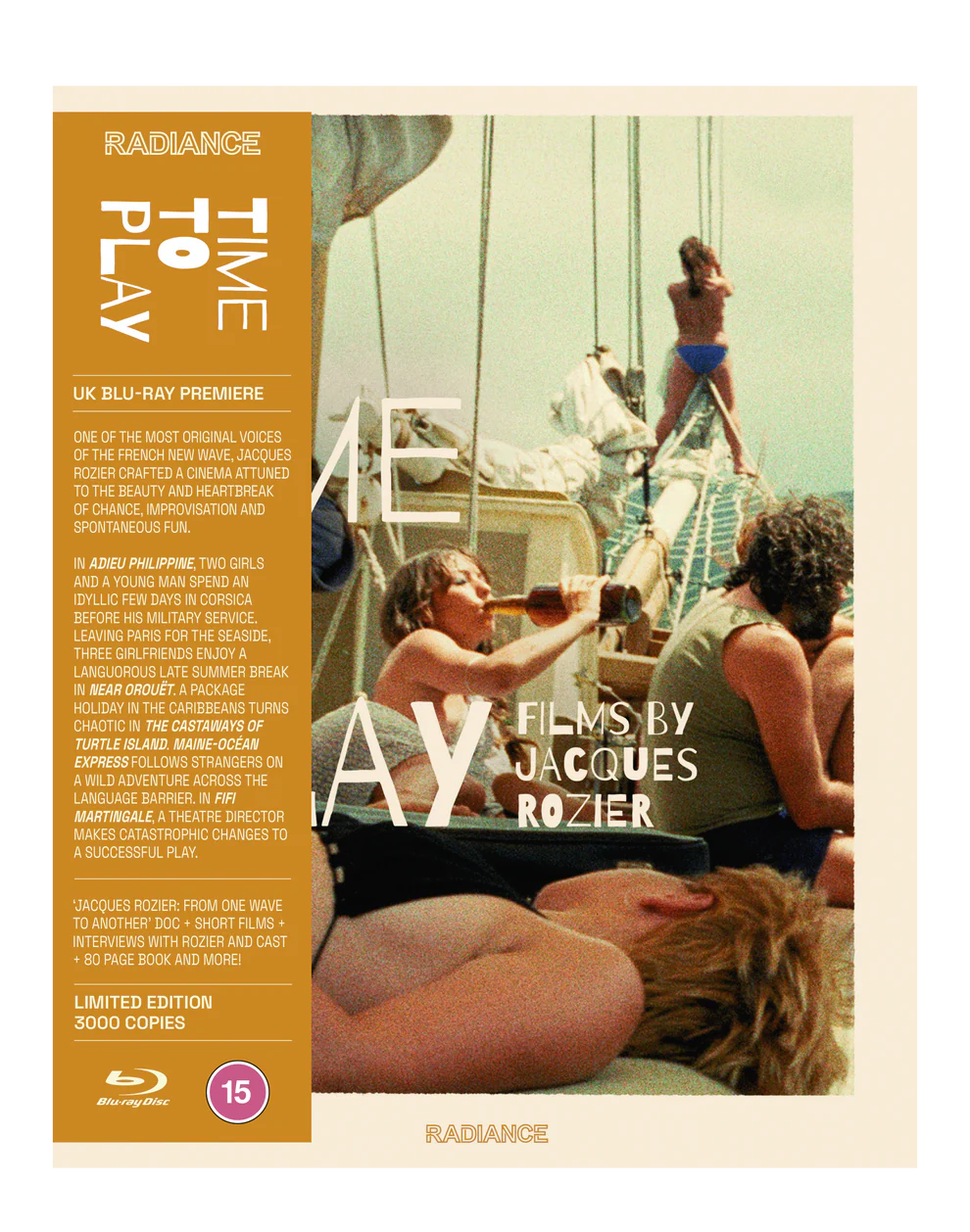
Often cited but rarely seen, the films of Jacques Rozier are missing pieces of the puzzle, not just of the French New Wave, but also of post-war French cinema. A gregarious creator with as many idiosyncrasies and obsessions as his friends and contemporaries Jean-Luc Godard and Francois Truffaut, Rozier’s slim filmography spans four decades and many different genres. Key to each of them is a joyful adherence to comedy, a regular cast of talented ensemble actors, and a genuinely playful countenance that is the hallmark of a deeply underappreciated film- maker. Radiance Films have assembled Time to Play – Films by Jacques Rozier, a limited edition box set that gathers all five of Rozier’s feature films alongside a plethora of short films and special features, and is due for release on the 20th April. This has been one of my most anticipated Radiance releases of the year, and here are my thoughts on its contents.

Adieu Philippine (1962)
The film begins with a stark message about the Algerian War being in its sixth year, providing a political context for everything that we will see, and casting a pall over the film before we even meet our protagonists. Michel (Jean-Claude Aimini) works as a technician and stagehand for a TV station. By chance he meets Juliette (Stefania Sabatini) and Liliane (Yveline Céry) at the studios and invites them onto the stage floor to watch proceedings; a performance of musicians led by Maxim Saury, whose music actually scores the film we are watching. From this chance encounter emerges a story of love, longing and youth that takes many delightful and unexpected pathways.
Adieu Philippine displays Rozier’s formal sense of film daring alongside unfettered, natural performances from all three of its lead actors. Jean-Claude Aimini’s coltish presence and pensive attitude give Michel a gravity and magnetism that works beautifully alongside Sabatini and Céry’s light, easy-going portrayals of Juliette and Liliane. A sense of ambiguity pervades their budding alliance: are they just friends, lovers, or neither? Somehow you know that this will end in tears for all of them, but not in the way you imagine. The film’s playful manner and joyous satires of the older generation are critically juxtaposed with the looming threat of the wider world and its attendant demands. The thrills of Paris and its nightlife are contrasted by the baking hot climate of Corsica, where the trio find themselves on holiday almost by accident. The film threatens to break out as a caper movie when the trio discover that crooked film producer and swindler Pachala (a brilliant comic turn by Vittorio Caprioli) is on the island. They hunt for him, but that dramatic thread is soon dropped for some picaresque adventures that include the now celebrated dance sequences involving Céry and Sabatini. The deep well of melancholy that engulfs these young people as the film reaches its conclusion as each of them, profoundly altered by their time together, head towards uncertain futures. Adieu Philippine is one of the most emotionally resonant rites of passage films as well as being one of the great cinematic debuts in film history.

Near Orouët (1971)
It would be nearly a decade before Rozier would return to the cinema, completing his second full-length film over a few years. Near Orouët begins in the metropolis of Paris, where two friends, Joëlle (Danièle Croisy) and Caroline (Caroline Cartier) are bored secretaries tired of their office jobs, and the attentions of their department head Gilbert (Bernard Menez), desperate for their summer holidays to begin. Together with their friend Kareen (Françoise Guégan), they head to a tiny village in the eastern Vendée region of France where Kareen’s parents own a dilapidated ‘villa’ overlooking the sea. Filmed in a documentary manner akin to early reality television, Near Orouët is a surprising depiction of young people at leisure, with three friends electing not for heat and light but for refuge and respite from the drudgery of their jobs and unwanted male attention. The villa’s turret adds a surreal, fairytale edge to proceedings as the trio adapt to their frugal but welcoming environment, and we as viewers slowly become immersed into their private space. The nuances of Caroline (who bears a startling resemblance to the great French actress Bulle Ogier), Kareen and Joëlle as friends and as women become clear as the film progresses; their foibles, their desires and their affection for each-other are clear for us to see. There are few films that resound with so much laughter as Near Orouët. Rozier skilfully displays just how much France has changed with a series of comic contrasts: the village fishermen are slack-jawed in amazement at the sight of these impeccably chic young women in their midst. And then there is Gilbert, one of the great comedic creations by Bernard Menez. A man so clueless that May ’68 might as well have not occurred, his feeble pursuit of Joëlle compels him to gatecrash their holiday. His pleading, hangdog manner leads to all sorts of escapades, including concocting one of the all-time worst meals in film history in a dinner scene worthy of Bunuel. With its diaristic framing and windswept locations, Near Orouët is cinema as its most languid.

The Castaways of Turtle Island (1976)
This time, a mere five years would separate Rozier from the big screen. In The Castaways of Turtle Island, Pierre Richard stars as Jean-Arthur Bonaventure, a travel agent who dreams up a new kind of holiday: a “Robinson Crusoe” style castaway experience that will shake up the traditional tourist market. Enticed by the potential for new markets and profits, his superiors send him on a fact-finding mission to uncover new locations. This slim premise, dreamt up by the clearly ill-named Bonaventure, leads predictably to utter disaster. How that disaster unfolds is the key to the film’s unerring sense of charm and wonder. With his tousled hair, unkempt appearance and “what me?” demeanour, the brilliant comic actor Pierre Richard excels as the hopeless travel agent, forever letting his mouth run away with him, leading himself and then later his motley crew of intrepid holiday makers further and further into unknown territory in a tragicomic parody of Werner Herzog’s Aguirre, Wrath of God. The film cleverly satirizes the notion of the alienated traveller who desires an authentic experience, and it also critiques the conceit that there is no land left to “conquer” for the tourist industry. Caroline Cartier returns as one of the travellers whose description of the “holiday” for a magazine is a conscious modern echo of Daniel Defoe’s famous novel. From the opening bizarre sexual encounter to the disintegrating fortunes of these would-be Robinson Crusoes, The Castaways of Turtle Island is a carousel of absurdity. Filmed in a freewheeling manner and on a barebones budget in Guadaloupe and the Dominican Republic, it bombed at the box office that year, but the virtues of the film are more than evident in this spectacular restoration.

Maine – Ocean Express (1986)
Yet another decade would pass before Rozier’s return to the cinema. The Castaways of Turtle Island displays all Rozier’s ingenuity, verve and wit. With Maine-Ocean Express however, those qualities are in very short supply. For a filmmaker who is renowned for conjuring magic literally out of nothing, this film for me is where the charm completely wore off. The premise is simple: Brazilian model Dejanira (Rosa-Maria Gomes) just makes it onto her train to Nantes but soon falls foul of two ticket inspectors (Bernard Benez and Luis Rego), who squabble over fining her over her unstamped ticket. A lawyer, Mimi de Saint-Marc (Lydia Feld) comes to her aid, and a standoff of various misadventures and miscommunications ensues. Charm is an elusive quality in cinema, and whatever held it in place for Rozier’s other films was completely absent throughout my viewing of this one. A series of set pieces within thoroughly ordinary locations – a provincial courtroom, a sailor’s bar, a village hall – fails to set the mood, and the filming style rarely rises above a commonplace sense of shot-making. As the pair of sour-faced ticket inspectors, Benez and Rego try their best to deliver some sparks of characterisation, but they’re overshadowed by Yves Alfonso’s blustering sailor Petitgas, a caricature in the worst sense of the word, whilst Feld and Gomes fail to make much of an impression at all. However, I am in the minority: Maine-Ocean Express is one of Rozier’s best loved films and won the Prix Jean Vigo in 1986. Bernard Menez describes it as his favourite of work with the director. But I unfortunately found no way to warm to this curiously uninvolving film, which is clearly the weakest of the set.

Fifi Martingale (2001)
Fifteen years would elapse before Rozier made what would be his final film, and after my experience with Maine-Ocean Express, I did fear the worst. Thankfully, my fears were more than allayed: Fifi Martingale is a delightful set of tall tales by one of the great masters of comedy. A theatre with a box office hit plays to packed audiences and critical acclaim – until an arrogant new director decides to make wholesale changes to the production. This simple premise blossoms into a sublimely silly comedy of ego, error and hubris, aided in no small part by a trusted cast full of wizened veterans who do their best to upstage each other at every opportunity. In one of the funniest deadpan performances you could ever wish to see, the great Jean Lefebvre stars as Gaston, the last and perhaps greatest of Rozier’s gallery of incorrigible rogues, alongside Yves Alfonso and Lydia Feld (credited here as ‘Fifi Vonderfeld’). Alfonso and Lefebvre’s scenes together reminded me of Charlie Chaplin and Buster Keaton’s interactions in Limelight. The last section of the film, where the cast manage to somehow keep the play afloat despite all the real time calamities is a wonderful testament to Rozier’s abilities as a director – triumphing in the face of adversity. Fifi Martingale is a raucous, sentimental and warm-hearted statement.
There are an extensive set of special features accompanying these films:
BLU-RAY LIMITED EDITION BOX SET SPECIAL FEATURES
- 4K restorations of Near Orouët and Maine-Ocean Express
- 2K restorations of Adieu Philippine, The Castaways of Turtle Island, and Fifi Martingale
- 2K restorations of the short films Blue Jeans (1958, 24 mins), Paparazzi (1963, 22 mins), Le parti des choses (1963, 11 mins), and Lettre de la Sierra Morena (1983, 22 mins)
- Uncompressed mono PCM audio for Adieu Philippine and The Castaways of Turtle Island, original mono DTS-HD audio for Near Orouët and Maine-Ocean Express and 5.1 DTS-HD Master Audio for Fifi Martingale
- Film scholar Catherine Wheatley and UK arthouse distributor Robert Beeson on the reception of the French New Wave in the UK (2026, 26 mins)
- Archival French trailer for Adieu Philippine (1962, 7 mins)
- Interview with Adieu Philippine star Yveline Céry (2024, 11 mins)
- Interview with Jean-François Stévenin, assistant director on Near Orouët (2008, 9 mins)
- Interview with frequent Rozier collaborator, actor Bernard Ménez (2008, 19 mins)
- Interview with The Castaways of Turtle Island star Jacques Villeret (2008, 7 mins)
- Jacques Rozier: From One Wave to Another – a feature length documentary by Emmanuel Barnault tracing Rozier’s unusual career and his lasting influence, rich in interviews and footage of the director at work; exclusive to this Limited Edition (2024, 63 mins)
- Newly improved English subtitle translation for each film
- Reversible sleeves featuring newly commissioned artwork by Time Tomorrow
- Limited edition 80-page book featuring new writing by Caitlin Quinlan, plus writing by and interviews with Rozier
- Limited Edition of 3000 copies, presented in a rigid box with full-height Scanavo cases and removable OBI strip leaving packaging free of certificates and markings
Interviews: the various cast and crew interviews provide great anecdotes and insights into the type of person that Jacques Rozier was, and attest to the deep affection that all of them still carry with them. However the pick of the bunch is the interview with Yveline Céry, who is self-effacing in her description of her young self onscreen in Adieu Philippine, and wistful in her appraisal of her brief time as an actress, and a path not taken. It is extraordinary to learn that her co-star Jean-Claude Aimini never made another film after this.
Short Films: Blue Jeans (1958) acted as the blueprint for Adieu Philippine, a tale of two penniless young men “cruising for girls” (as Jean-Luc Godard accurately described it in his review at the time) on the French Riviera, trying and failing to interact with women in any meaningful way. A wry commentary undercuts their predatory attempts at seduction, and what was at time an affectionate study of youthful folly now seems completely out of date. Paparazzi and Le parti des choses (1963) are invaluable documentaries about one of the great cinematic sensations of the 1960s, Jean-Luc Godard’s film Le Mepris and its star, the pop culture icon Brigitte Bardot. Granted unprecedented access to the film’s production in Capri, Italy, Rozier captures those outside of the ferment of celebrity, daring to break through using ever more invasive tactics (these photographers do themselves no favours at all here), and the subject of all the attention, Bardot herself, She is fully at ease in front of Rozier’s camera – and that of Jicky Dussart, official on-set photographer – but presents a cold facade for the prying lenses of the paparazzi. Made for television, Lettre de la Sierra Morena (1983) is a jovial, tongue-in-cheek tirade against the problems of French film production and financing, using the conceit of Don Quixote and Sancho Panza, and starring a host of regulars familiar from Rozier’s filmography.
Trailer for Adieu Philippine: less of a conventional trailer than a short promotional reel for Adieu Philippine, it includes Francois Truffaut interviewing the giddy young stars interspersed with footage from their respective auditions. This trailer is a remarkable artefact.
The contributions by film scholar Catherine Wheatley and distributor Robert Beeson on the subject of the French New Wave’s impact in the UK are a superb addition to the set, and delve right to the heart of who were considered New Wave directors, the actual lifespan of the New Wave itself, and the availability of these films upon their release. They describe a febrile era where films were hotly anticipated for months on end before their release, how these releases were confined to certain cities and cinema chains, and how mistranslations of film titles might have led British cinephile astray. I must respectfully disagree with Catherine Wheatley on one point: if Agnes Varda can (rightfully) be regarded as a New Wave director despite not being included at the time, then I feel confident in classifying Louis Malle as a New Wave director as well. To back up my point, Bernard Menez namechecks him as a New Wave director in his interview.
Emmanuel Barnault’s feature-length documentary Jacques Rozier: From One Wave to Another is the absolute standout special feature. All manner of famous names from the world of French cinema are on hand to pay fulsome tribute to this most engaging of filmmakers. Every aspect of his storied career are dutifully covered, from his early admiration of Italian neorealist cinema to his pioneering years working in television – the footage from the “DIM DAM DOM” are incredibly avant-garde for the time – to the chaos surrounding the filming and funding of later projects. There are many things that leapt out at me but just two will suffice: firstly, the recurrence of mentions of other directors in these sorts of documentaries fascinate me, and here we get two references to Maurice Pialat, whose lacerating relationship drama We Won’t Grow Old Together is mentioned by Francois Truffaut in relation to Near Orouët (an interestingly odd comparison), and then by Rozier himself as he recalls turning down a part on Pialat’s superb thriller Police because he didn’t want to be beaten up by Gerard Depardieu! Wise move. Secondly, the documentary is a testament to arts/culture programming, as we see Rozier age in footage right from the beginning of his directorial career, right up until the mid 1990s as a gleeful eminence grise. The smile never seem to leave his face.
Sadly the limited edition book accompanying this box set wasn’t available for me to review.
Even by Radiance’s dauntingly high standards, the label has outdone itself with Time for Play. This box set finally allows UK cinephiles to feast on these strange and wonderful films, further enhancing the reputation of Jacques Rozier in the eyes of an entirely new audience. It is without question one of the very best releases of the year so far.