


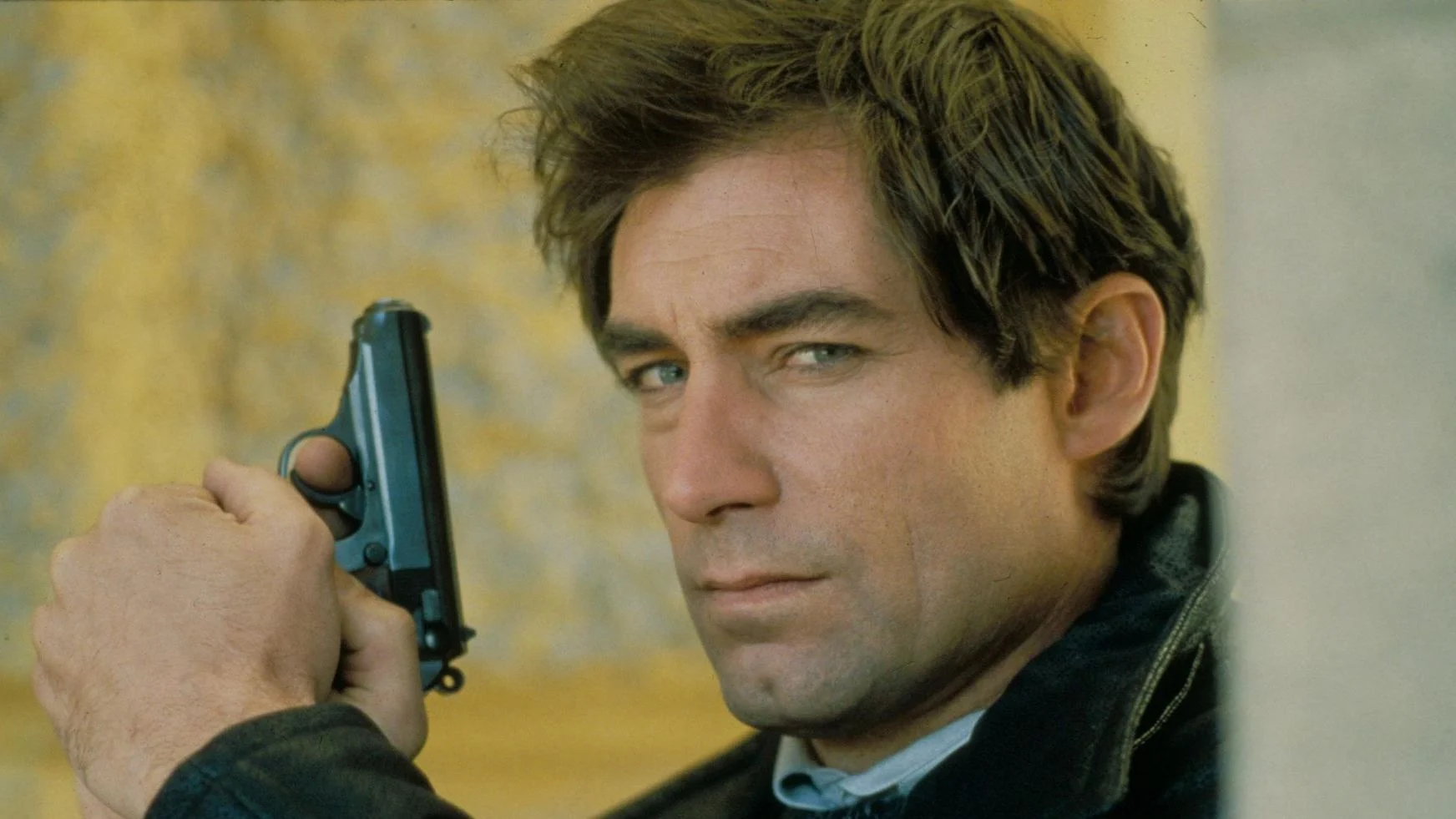
I have a confession that might get my James Bond fan card revoked: I don’t think Timothy Dalton was a particularly good 007. That opinion probably wouldn’t have seemed unusual thirty years ago. Today, however, Dalton is regularly praised as an underrated Bond who was simply ahead of his time. Has the pendulum now swung too far?
1987’s The Living Daylights was the debut for the Welsh-born actor. Unlike Roger Moore’s tongue-in-cheek approach to the role of Bond, Dalton wanted to bring back some of the grit and seriousness associated with Ian Fleming’s character and the earlier Sean Connery films. Dalton made no secret of the fact that he went back to Fleming’s books when preparing for the role. He wanted to base his interpretation on the character Fleming had created rather than simply copying the actors who had played Bond before him.
You might have commonly heard from fans that Timothy Dalton is the “closest” to the literary version. However, I think that claim is substantially overstated. In the books, especially the earlier ones, Bond has a lot of inner turmoil. Fleming allows us into his head, where Bond can be harsh, judgemental, angry and sometimes cruel. Dalton chose to bring much more of Bond’s inner turmoil to the surface. And that is one of the most profound differences between him and the literary version, because Fleming’s Bond can still appear smooth and easy-going on the outside. He was not constantly radiating the negativity that could be going on inside his head. It was a good creative decision to try to show the audience what was going on inside Bond’s mind. But that came at the expense of some of the character’s other qualities.
The two movies Dalton made, The Living Daylights and Licence to Kill, did not really allow him to explore many of Bond’s other literary personality traits and pleasures, either. Fleming’s Bond enjoys the good things in life. He has a fondness for scrambled eggs, fine food and various alcoholic drinks. Not just his famous vodka martinis. He enjoys gambling and has an enthusiasm for powerful cars. Fleming even acknowledged that food and wine had become trademarks of the character.
Some of those things are certainly present in Dalton’s films. But they rarely feel like defining parts of his personality. The emphasis is overwhelmingly placed elsewhere.
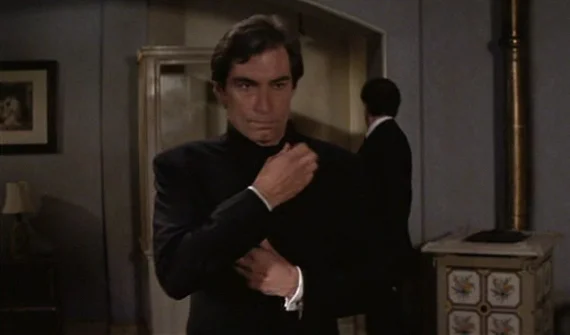
What Tim did manage to capture was Bond’s romantic side. He treats Kara in The Living Daylights as more than just another conquest. He seems to have genuine affection for her, and the film allows their relationship to develop considerably more than many previous Bond romances. Contemporary reviews even remarked upon Dalton’s unusually monogamous Bond.
That does not mean his Bond completely stopped womanising. He has a brief encounter with a woman on a yacht at the beginning of The Living Daylights and presumably spends the night with Pam at the end of Licence to Kill.
But Dalton’s Bond is noticeably more emotionally exposed than many of his predecessors. In The Living Daylights, there is a scene where his associate Saunders is brutally killed. Bond is overcome with rage and, while searching for the killer, accidentally draws his gun on an innocent mother and her child.
Yet many fans seem to refer to Dalton’s Bond as “cold.”
Well, not really, is he?
A couple of other common arguments made by fans of Dalton’s portrayal are that he was supposedly “ahead of his time” and that he remains “underrated.”
Here is the thing. Bond had already been played seriously before. Sean Connery had brought danger and toughness to the character, while George Lazenby’s On Her Majesty’s Secret Service had already shown a much more vulnerable and romantic Bond. Dalton certainly pushed the character further towards realism, but the idea of a serious or emotionally vulnerable 007 did not begin with him.
The claim that Timothy Dalton is still “underrated” as James Bond does not have much evidence behind it today, either. Maybe that was true at one point. Many years ago. But there are countless 007 communities online now where Tim receives a generous amount of praise. Recent Bond fan discussions even acknowledge that calling Dalton underrated has itself become a popular opinion among fans.
And yet the label persists. Dalton was still being described as the “most underrated James Bond actor” in articles published as recently as 2026. At some point, surely we have to question whether him being underrated is still true. Particularly when one of the main arguments supposedly in his favour, that he was uniquely faithful to Fleming, can easily be disputed.
I think it is safe to say that Timothy Dalton deserves praise for playing a James Bond who was perhaps the most human up to that point. He showed anger, frustration, vulnerability and genuine affection. Dalton himself clearly understood that Fleming’s Bond was a contradictory and deeply human character. But many of the other traits explicitly described in the books were either less prominent or absent altogether. If we say that Dalton is the most accurate Bond simply because he emphasised the darker and more troubled aspects of the character, then we are using very narrow criteria.
Dalton deserves credit for what he brought to Bond. But being different, darker and more human does not automatically make him the definitive Fleming interpretation. Perhaps the most underrated thing about Dalton today is that some of the original criticism was justified.