


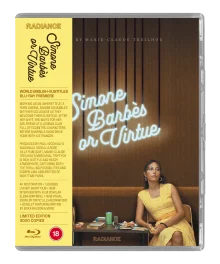
Director: Marie-Claude Treilhou
Screenplay: Marie-Claude Treilhou, Paul Delahaye
Starring: Ingrid Bourgoin, Paul Delahaye, Martine Simonet
Country: France
Running Time: 77 minutes
Year: 1980
BBFC Certificate: 18
There are films that amaze and captivate you, that show you just how magical cinema can be, and that continue to stay with you long after you’ve watched them. Simone Barbès or Virtue is most definitely one of those films. Written and directed by Marie-Claude Treilhou, the film displays a demi-monde all but lost to history; that of the porn cinema, it’s worn-out employees and its multitude of paying customers. The cinema in question is the four screen Mille Colonne porn cinema on the Rue de la Gaite in Montparnasse, rechristened here by Treilhou as the Cine-Vog, a deceptively bright but ultimately shabby establishment where Treilhou worked alongside Ingrid Bourgoin, the incomparable actress who portrays our onscreen anti-heroine Simone Barbès.

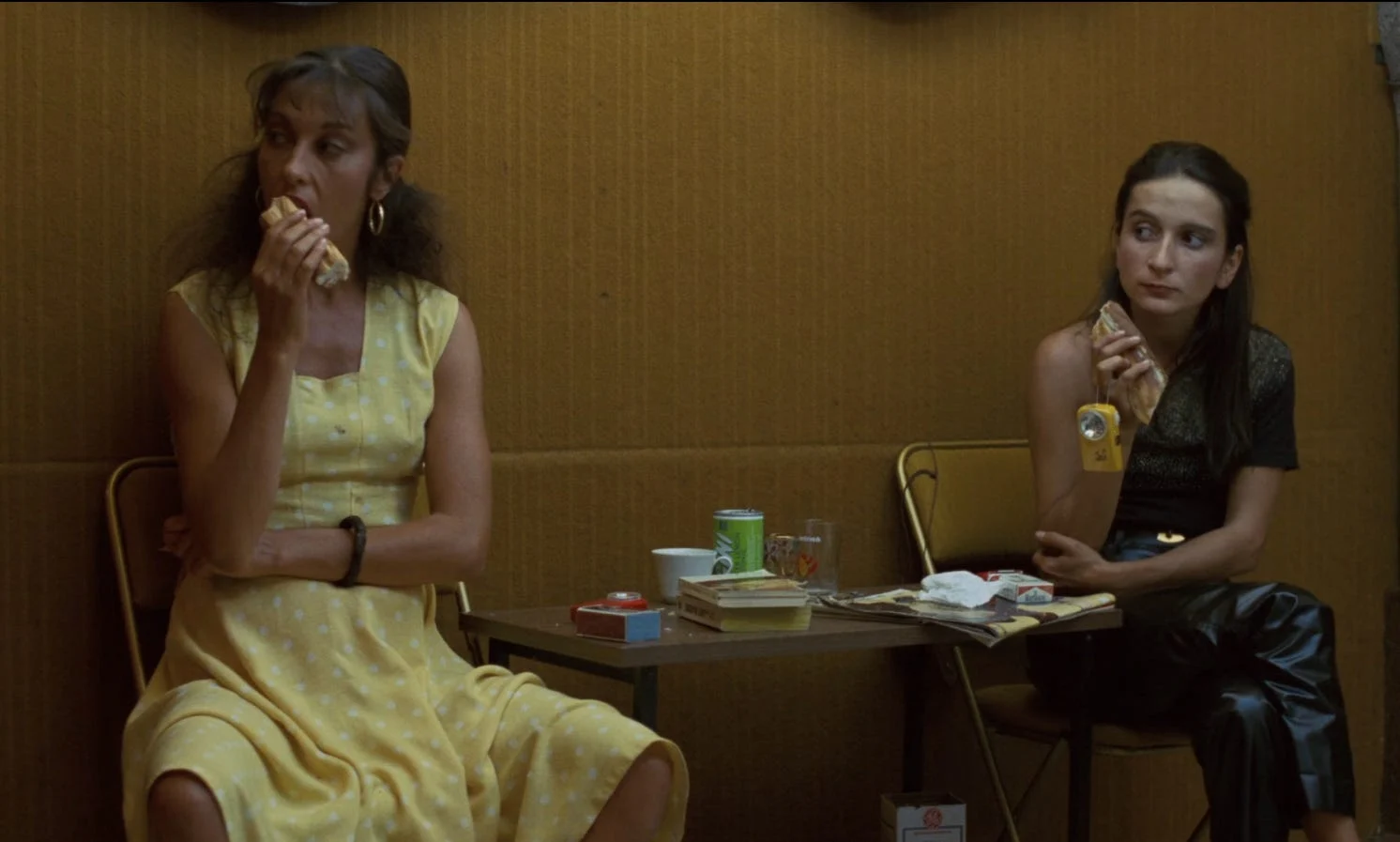
Simone is one of the all-time great screen characters of the past half century, a no-nonsense and quick-witted presence in the cinema’s crumbling foyer, tearing up tickets and the customers various foibles with unerring confidence. The moment a hulking man dares to question her, the diminutive Simone well and truly puts him in his place. The first section of the film, where Simone and her co-worker Martine (Martine Simonet) bicker and try to eat amidst the torrent of ticket-tearing is a brilliantly staged workplace comedy. The specifics of the job are rendered with such empathy and warmth that they illumine the strife of every workplace. Simone’s regular trips to a radiator to warm herself up reminded me of a job where I did exactly the same thing. The special features inform the viewer that 24 million tickets were sold at porn cinemas in 1974, a colossal amount even set alongside mainstream tickets sales in France. The prevalence of men watching these films is emphasized by sheer number we see passing both in and out of the Cine-Vog. The pale lighting from the neon yellow eyes that hover over Martine and Simone adds another layer of surveillance and voyeurism to a pair who protest that their job is to avert their own gaze from the customers, despite the protestations of a porn director played by Noël Simsolo (who coincidentally appeared in Walerian Borowczyk’s La Marge).
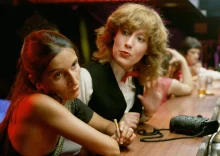
In the film’s second section we see Simone finish her shift and head to a lesbian bar in order to meet up with her girlfriend. It is here that the film moves beyond its origins, and becomes something truly extraordinary. The neon red interior is both a safe space and place where emotions can run wild, where ‘Amazonian women’ stage a theatrical sword fight to disco-inflected classical music, and a cabaret trio named Le Monocle entertain the clubs’ disparate clientele with inimitably mannered songs. Simone waits impatiently for her girlfriend to finish her shift and takes everything around her, from the crazed dancing to the halting love affairs given away by looks and smiles in hidden corners. A young punk in red leather trousers (Josse from the obscure French punk band 12°5) rips through a show-stopping number called ‘Everyone’s A Feminist’, and the barman quotes poetry by Racine.
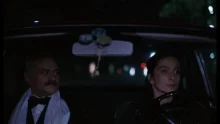
In this film everyone is a performer, a fact reinforced by the third act where Simone walks the streets of Paris and is ‘picked up’ by a well-dressed man driving a Volvo, played by the veteran writer and actor Patrick Delahaye (who also appeared in Bertrand Blier’s Les Acteurs). This pick-up attempt is swiftly repurposed by Simone as he outwits the driver, instead taking the wheel and driving him around instead. This sweetly mournful section of the film is yet another subversion of the norm, where a predatory man has his expectations dashed and his pride punctured by a woman in supreme control. Even her sense of kindness acts as a wound to the man’s ego. Patrick Delahaye is absolutely perfect in this role. He brings real gravitas and vulnerability to his character. At just 77 minutes, Simone Barbès or Virtue is a cinematic gem that encompasses so many elements but also defies easy categorization. An outsider feminist film made before the AIDS crisis ravaged the LGBTQ+ community, it couldn’t be further away from the trends emerging in mainstream French cinema of that time. It is one of the great character studies in independent cinema history.
BLU-RAY LIMITED EDITION SPECIAL FEATURES:
- 4K scan and restoration by Cosmodigital
- Uncompressed mono PCM audio
- Lourdes l’hiver – short film by Marie-Claude Treilhou (1981, 9 mins)
- The Virtues of Simone Barbès – new visual essay by film critic Lillian Crawford (2026, 15 mins)
- New interview with film scholar Elena Gorfinkel (2026, 24 mins)
- Archival French TV interview with star Ingrid Bourgoin (1980, 5 mins)
- Newly improved English subtitle translation
- Reversible sleeve featuring original and newly commissioned artwork by Time Tomorrow
- Booklet featuring writing by Erika Balsom and archival writing
- Limited edition of 3000 copies, presented in full-height Scanavo packaging with removable OBI strip leaving packaging free of certificates and markings
The special features on the disc are among the most informative and illuminating that Radiance have produced this year. Treilhou’s short film Lourdes l’hiver is a bitter slice of marital discord, as an elderly couple briefly lose track of each other and then argue about that all the way to a train station. I felt sorry for their dog being dragged around in the rain. The visual essay by Lillian Crawford (now there’s a fabulous cinephile nom de plume!) is an outstanding contribution, weaving in contextual information and the film’s status within queer cinema, as well as socio-philosophical themes and important background about Diagonale, the film’s production company led by the extraordinary Paul Vecciali. Crawford also reveals that the character of Simone Barbès returned to the cinema as played by Vanessa Paradis in Yann Gonzalez’ film Un couteau dans le cœur in 2018, in which Ingrid Bourgoin plays a small role as a barmaid. You can’t keep a great character down.
The interview with Elene Gorfinkel is full of terrific detail about both the film and its director; we learn that in an interview Marie-Claude Treilhou referred to Bourgoin as a ‘perpetual fireworks display’, which is an apt description of her lead actress. We see more than a glimpse of that in the archive clip of Bourgoin interviewed on French TV by a supercilious man whom she manages to cut down to size without ever moving her hand from her head. Her withering expression is a great sight to see.
The booklet accompanying this limited edition blu ray release wasn’t available for me to review.