


Director: Nadine Trintignant
Screenplay: Alain Corneau, Nadine Trintingant
Starring: Jean-Louis Trintignant, Bernadette Lafont, Juliet Berto, Michel Bouquet
Country: France/Italy
Running Time: 100 minutes
Year: 1973
BBFC Certificate: 15
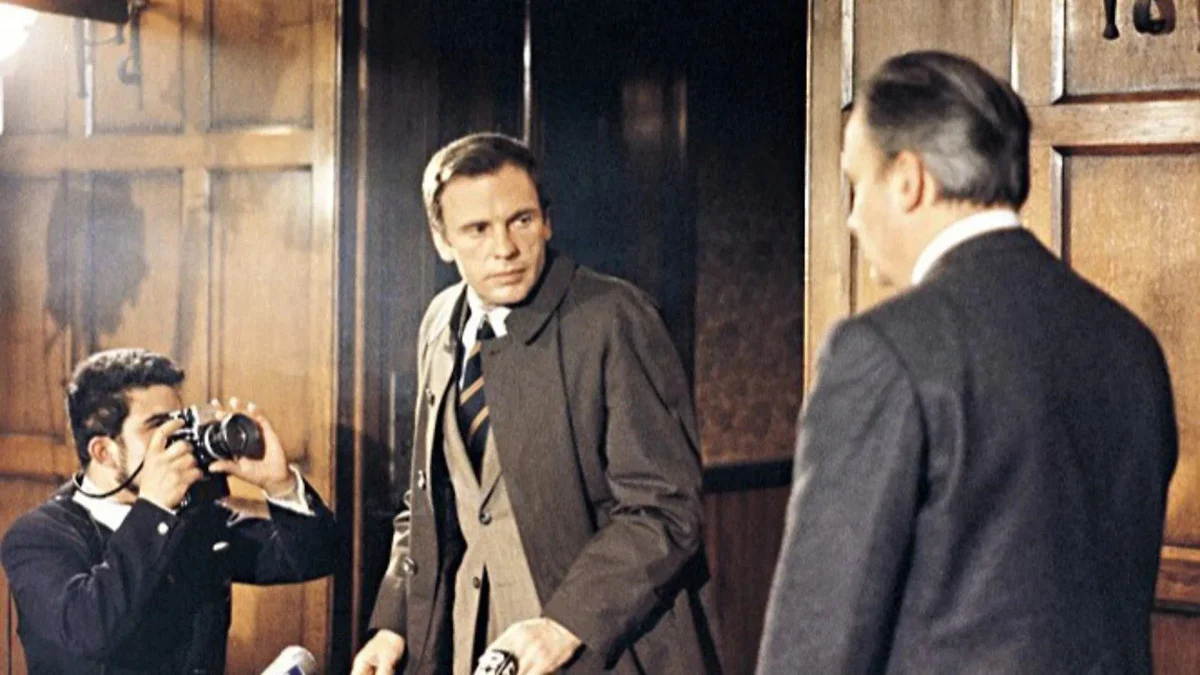
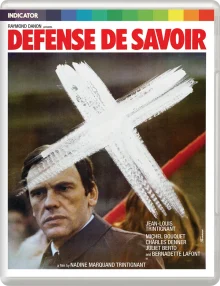
Indicator’s exploration of post-New Wave cinema in France has reaped great rewards in recent years. Firstly, with their expansive reissue of films by the master of fantastique, Jean Rollin, and now with a selection of films by Bertrand Blier and Nadine Trintingant. We shall get to Blier at another time, but for me the films of Nadine Trintignant are a genuinely new discovery. Defense De Savoir (which translates into English as Forbidden to Know) was her fourth film as director – she was credited as Nadine Marquand Trintignant – and concerns what looks at first to be an open and shut case of premeditated murder.
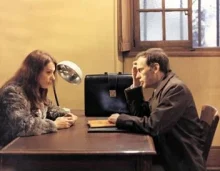
A defence lawyer named Laubre, played by Jean-Louis Trintignant travels to a remote northern town to represent Simone, who is accused of killing her boyfriend Ravier (Charles Desser). Casting against type, Simone is portrayed by Bernadette Lafont, star of Francois Truffaut’s short film Les Mistons which was effectively the first shot fired by the French New Wave. Her anguished portrayal of a women beaten down by the cruelties of life is just one of the many high points of this bleak and unsparing film. Laubre soon establishes that things are not as they seem, and begins to gather evidence that not only leads away from Simone, but leads to very powerful figures in local government, notably the elected official Paul Cristiani. Paul Bouquet’s performance as Cristiani is calmness itself, effortlessly smooth and adept with the media – and utterly ruthless away from their prying cameras.
Under the conservative stewardship of Prime Minister Pierre Messner, France’s post 1968 rot has most definitely set in, and Trintignant captures so much of that malaise onscreen with the help of the esteemed cinematographer William Lubtchansky. The film’s dour characterisation, desolate tone and wintry visuals have a great deal in common with the films of its screenwriter, the great Alain Corneau. Defense De Savoir is a clear precursor to his later adaptation of the Jim Thompson novel A Hell of a Woman as the brilliant Serie Noire. Nadine’s daughter Marie makes an indelible impression here as the girl Ravier takes hostage in one of the tensest sequences in the entire film. Trintignant’s assured direction constructs Defense De Savoir as a series of flashbacks, bringing back to life a character who we first see lying dead at Simone’s feet. Charles Denner’s unnerving performance as the volatile Ravier is another great addition to his illustrious filmography.

As a last-minute piece of casting, you couldn’t do any better than having your husband assume the leading role, especially when that man is Jean-Louis Trintignant. One of the all-time great French actors, Trintignant is exceptional as Laubre, a man of virtue forced to make a living in a corrupt world where ethical compromise and the threat of violence are ever-present. His portrayal of Laubre as fierce and brittle man who will brook no compromise, standing up to injustice whatever the cost is deeply compelling. Laubre’s sneering attempt at a smile is one of the film’s truly horrifying sights. A year away from her signature role in Jacques Rivette’s masterpiece Celine and Julie Go Boating, Juliet Berto is exquisite as Cristiani’s daughter. Infantilised by her domineering father but desperate to escape his control, her confrontations with Laubre lead her on a journey of discovery alongside him. A caustic scene where Berto converses with her father’s associate Jean (Pierre Santini) strongly hints at traumatic past events.
Defense De Savoir is a brutal, unflinching film where corruption is all pervasive, where unrepentant perpetrators run amok and traumatised victims bear the brunt, where the law is absent and good people perish. It is a film far ahead of its time, and is one of Indicator’s most outstanding releases of the year.
INDICATOR LIMITED EDITION BLU-RAY SPECIAL FEATURES
4K restoration from the original negative
Original mono audio
Pour le cinéma set report (1973): extract from the French television programme, featuring interviews with director Nadine Trintignant and actors Jean-Louis Trintignant and Bernadette Lafont
Image gallery: promotional and publicity materials
New and improved English translation subtitles
Limited edition exclusive booklet including a new essay on the film, a look at Nadine Trintignant’s career, an overview of critical responses, and film credits
UK premiere on Blu-ray
Limited edition of 4,000 copies for the UK and US
The special features on the disc are pertinent additions. The on-set report from Pour le cinéma is a great document as Nadine Trintignant is filmed assembling one of the most important scenes from the film itself, as well being highly informative in the interview she gives to camera. The interviews with the actors are again small insights into their contributions to a film which was cruelly unheralded upon its original release.
There is also a short interview with Jean-Louis Trintignant where the interviewer talks more than the actor, but when he does speak, he is effusive about his wife’s authority as a director. In a rare sign of progressive action, he calls for more women directors in the film industry, to the mild consternation of his host.
The booklet contains two essays. The first entitled The World’s A Stage by Adam Scovell is an excellent piece of contextual writing that shines a light on the film’s breaking of formal narrative structures, as well as some architectural aspects of Defense De Savoir, such as the suburban developments glimpsed throughout the film, and how these are also featured in other films of that era. The second essay is entitled A Family Affair, and details the interlocking stories of both her married and professional life. It contains a great deal of both triumph and appalling tragedy, especially with regard to Nadine’s daughters – I will say no more than that. The quotations from various interviews with Nadine and Jean-Louis Trintignant are invaluable additions to the text.
The image galleries contain publicity photos and images from the original shooting script.