


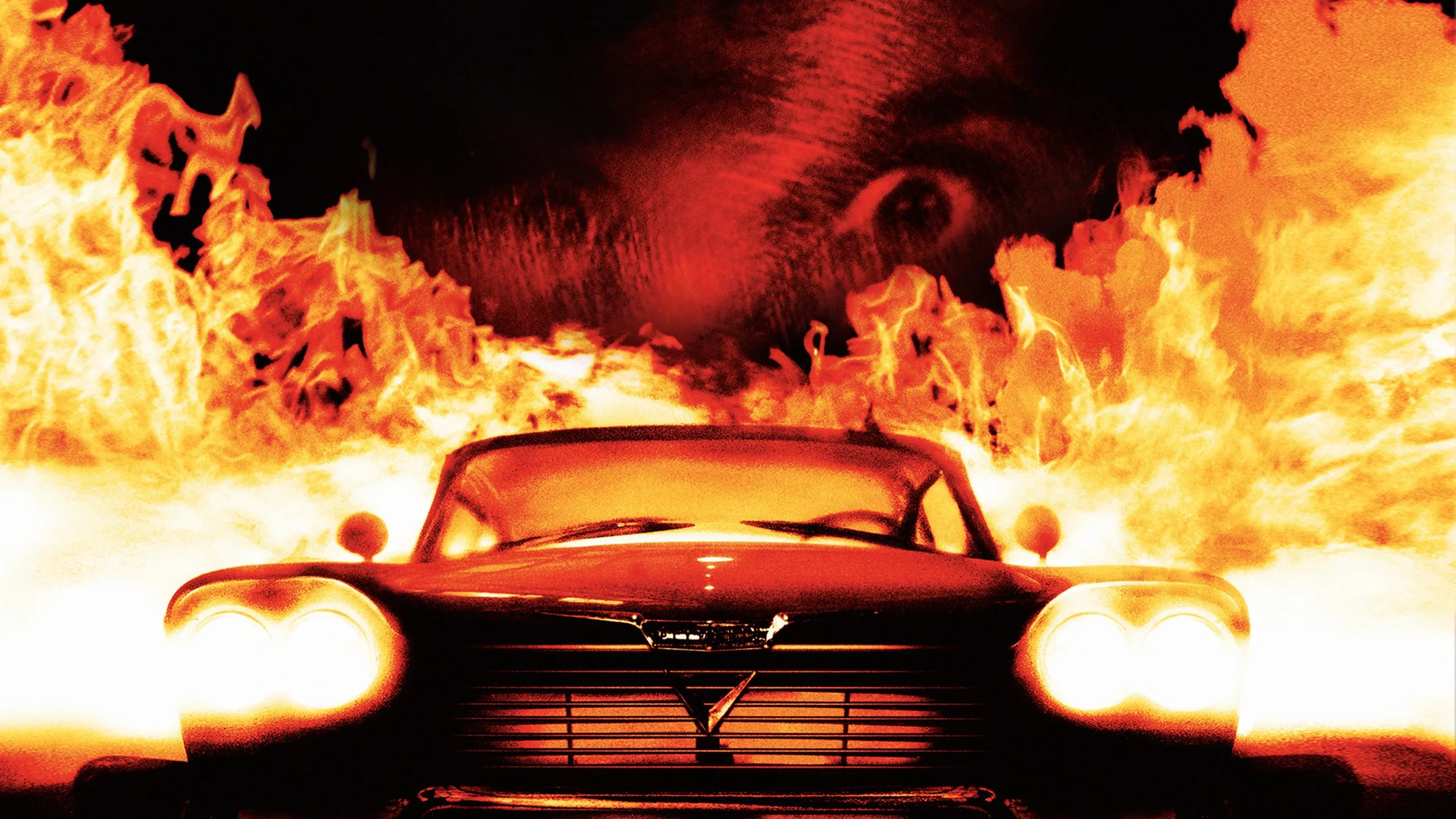
1983’s Christine was a movie that John Carpenter now admits he does not care much for. And that is a shame because, while the film may be questionable as an adaptation of Stephen King’s novel, it does something that is arguably superior.
There is a pattern that runs through a few of Carpenter’s films. And that is that he barely tries to explain the origin of his evil characters. Michael Myers, the creature in The Thing and the car from the movie this editorial is discussing are all examples to varying degrees.
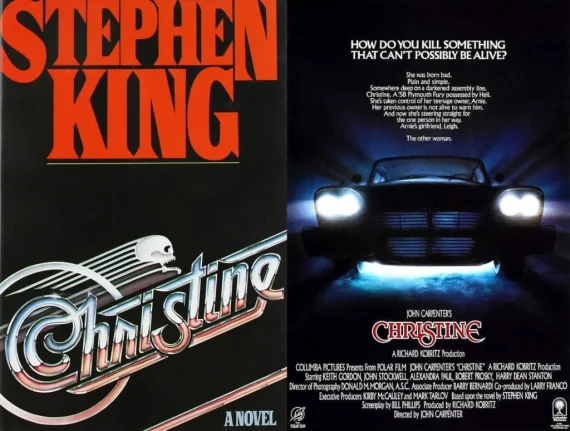
On the other hand, Stephen King spends much more time in the novel of Christine establishing its former owner, Roland LeBay, as a deeply unpleasant man whose malign influence becomes intertwined with the car. After his death, LeBay’s supernatural presence also plays a major role in Arnie’s corruption. Carpenter and screenwriter Bill Phillips deliberately omit that sizeable aspect of King’s story and simplify the film version.
And, for me, that makes Christine in the movie much more terrifying.
The book and movie both retain the corruption of Arnie as Christine’s present owner. But there are many other differences, including the book featuring Roland LeBay still being alive for a portion of the story. In fact, it is Roland himself who sells Christine to Arnie. In the movie, Roland is already dead and his brother George LeBay (Roberts Blossom) sells the sinister vehicle instead.
We are later treated to a scene between Dennis (John Stockwell), Arnie’s longtime friend, and George, which reveals more about Christine’s disturbing history while she belonged to Roland. Feeding us just the right amount of information is enough to make us imagine the worst details about what happened before Christine ended up in Arnie’s (Keith Gordon) hands.
But the ultimate omission by Carpenter is not giving the viewer any information whatsoever about why or how Christine became evil. We first see her coming off an assembly line in Detroit in 1957. She immediately injures a worker as he tries to inspect her. Then another succumbs to an even worse fate when he loses his life while sitting inside her. The scene, which does not appear in King’s novel, immediately establishes that Christine was already dangerous before Roland LeBay ever owned her.
But I want to be careful here. The book does give Christine supernatural abilities of her own. She can move without a conventional driver and regenerate after being damaged. However, Roland LeBay’s supernatural presence is central to the story and to Arnie’s transformation. That leaves more room to question exactly how much agency belongs to Christine herself.
In the film, things are much clearer. Christine feels jealousy and rage and will do almost anything to preserve herself. There is no ghost of Roland LeBay controlling her. She is the monster.
And that leads on to what John Carpenter has said about reading the Christine novel. He recalled thinking, “It just wasn’t very frightening.” He had also just come off The Thing, which had performed poorly at the box office, and has described Christine as something he needed to do for his career rather than a personal project.
In any case, I believe it is fair to suggest that many people find it scarier when the villain in a horror film has no clear motive for doing what they do. And perhaps it is even more terrifying when we do not know why the evil in a movie exists at all. That has worked in other horror films including The Silence of the Lambs, which gives us no explanation for why Hannibal Lecter became a psychopathic cannibal, Black Christmas, where we learn remarkably little about Billy, and The Hitcher, which offers virtually no explanation for John Ryder or his motives.
Deliberately not explaining why Christine is evil is, for me, one of the strongest aspects of the 1983 adaptation. Christine never needed Roland LeBay to become evil. She rolled off the production line that way. And perhaps the most frightening thing Carpenter could have told us about why was nothing at all.