


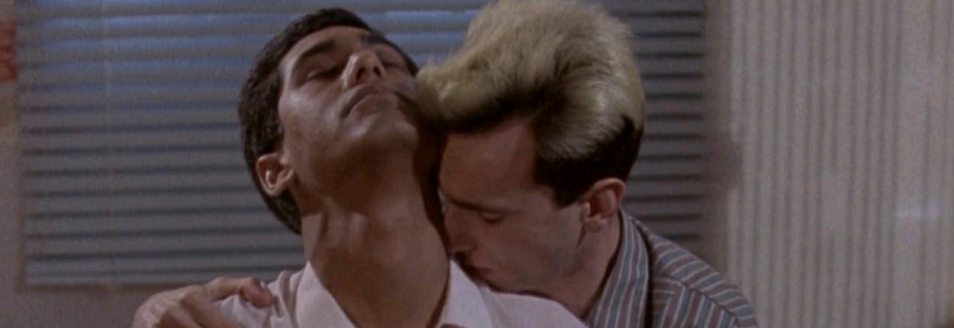
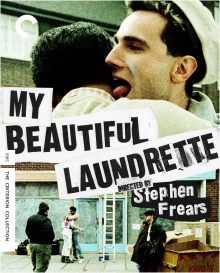
 Director: Stephen Frears
Screenplay: Hanif Kureishi
Starring: Saeed Jaffrey, Roshan Seth, Daniel Day-Lewis, Gordon Warnecke, Shirley Anne Field, Derrick Branche, Rita Wolf, Souad Faress, Richard Graham, Stephen Marcus
Country: UK
Running Time: 97 min
Year: 1985
BBFC Certificate: 15
Channel 4 and its film division, Film Four, have long been a sign of quality, with a particular high point in the 1980s and 1990s. Acclaimed films they produced or co-produced include the likes of Peter Greenaway’s The Draughtsman’s Contract (1982), Alan Clarke’s Rita, Sue and Bob Too (1987), the Merchant Ivory classic Howards End (1992) and Danny Boyle’s Trainspotting (1996). But these titles just scratch the surface, showing the breadth and depth of the quality output, and a small selection of the fabulous British directors they worked with.
Another of the high points for Channel 4 films, which was at the forefront of the British cinema revival in the 1980s, was 1985’s My Beautiful Laundrette, directed by Stephen Frears and originally due to be a drama made for TV, but which garnered such widespread acclaim that it was released in cinemas. The film would also be among the first released by Working Title Films.
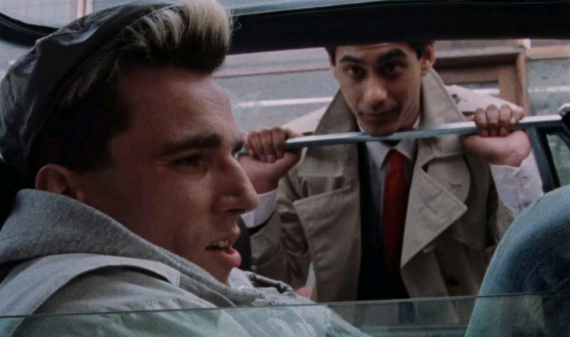
Scripted beautifully by Hanif Kureishi, the film tells a love story between young South London Pakistani man Omar (Gordon Warnecke) who opens an upscale laundromat called Powders to make his family proud, with the help of his childhood friend, skinhead and lover Johnny (Daniel Day-Lewis).
What plays out, as Criterion eruditely describe in their liner notes, is a culture-clash comedy which is also a subversive work of social realism that dares to address racism, homophobia, and sociopolitical marginalisation in Margaret Thatcher’s England.
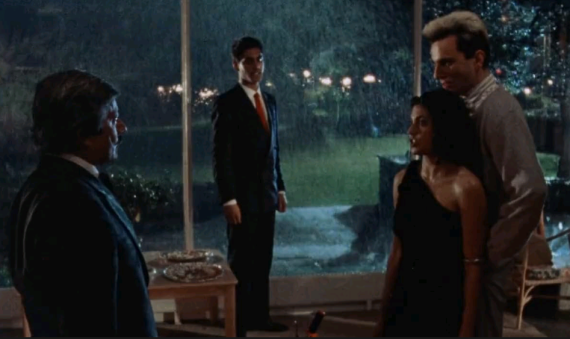
It’s a remarkable script by Kureishi, even more remarkable for the fact it was his first screenplay and would be so well written that it would earn him an Oscar nomination. The script is razor sharp about the Britain of the time, the class and race divide, the impact of Thatcher and her Government, and the challenges of being a young Pakistani-British man at the time.
Whilst the world is not the same place as it was then, some of the themes sadly still prevail, particularly racism and racial and class divide, so in some ways it feels the same. The racism Omar and his community face, and the attempted indoctrination of Johnny by his white peers, are still very real issues at the time of writing. For example, there’s a thread throughout of a fascist white gang targeting the Pakistani community that’s always threatening to boil over, and then eventually does in a tough, visceral finale outside the laundrette.
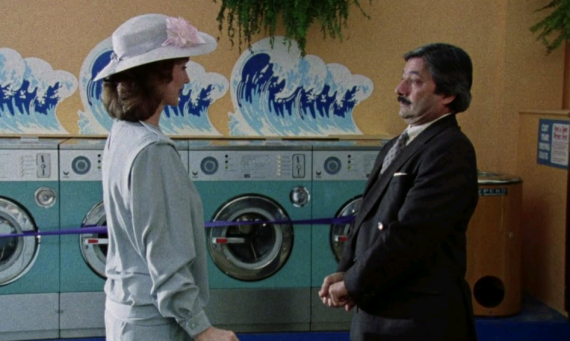
At its heart, as well as probing these very important topics, the film is one of relationships, and these are all vividly portrayed thanks to the perceptive script and the acting. The relationship between Omar and his father, for whom he is a carer for, Omar and his uncle Nasser, and, of course, Omar and Johnny are highlights, though not the only relationships we see in the film.
Some of the themes and situations were also groundbreaking for the time for three reasons: showing the gay relationship between Omar and Johnny, showing cross-cultural relationships like that of the pair but also Nasser and his white mistress Rachel (Shirley Anne Field), and for challenging Thatcher’s Britain.
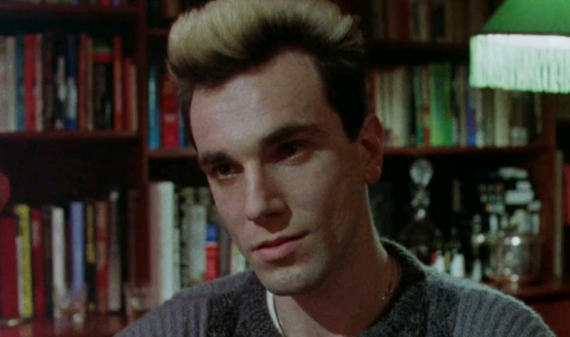
The film was a breakout role for Daniel Day-Lewis, though the part was originally earmarked for Gary Oldman. Day-Lewis is great in the role and commands attention whenever he’s on the screen. It was also Warnecke’s first film and one of only three he’s featured in, though he has acted in some TV shows too. He is also good, playing the lighter and more challenging moments equally well, and has good chemistry with Day-Lewis.
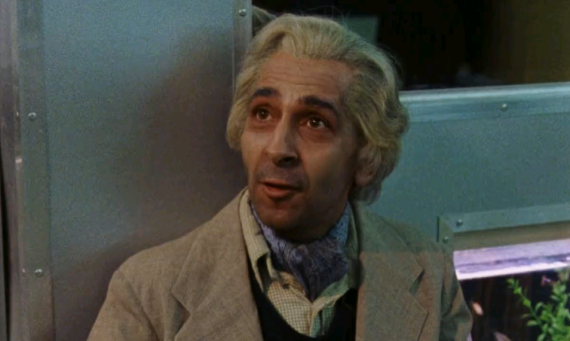
The pair are ably supported by a memorable cast that includes Roshan Seth as Omar’s father ‘Papa’, and the always brilliant Saeed Jeffrey as his uncle Nasser. Jeffrey is very funny throughout, providing plenty of levity and delivering some wonderful lines beautifully, though also not averse to going into some less light territory. He also has a poignant final scene with ‘Papa’ that plays out alongside the aforementioned finale, involving racial tensions bubbling over outside of the laundrette. In a film of great performances., Jeffrey’s character is probably my favourite.
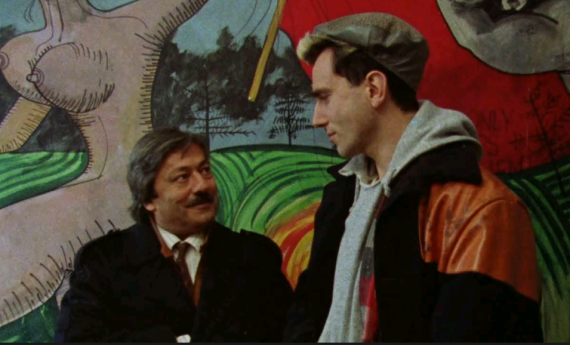
There are also two very strong female performances, including the aforementioned Field as Rachel, who perceptively talks about different classes and ages and the passage of time and whose character’s relationship with Omar is tumultuous and the target for racial prejudice, although this is just hinted at and glimpsed.
The other strong female performance is given by Rita Wolf as Nasser’s daughter Tania, who suspects her father of having an affair and later confronts him and his mistress at the laundrette, in a very good scene.
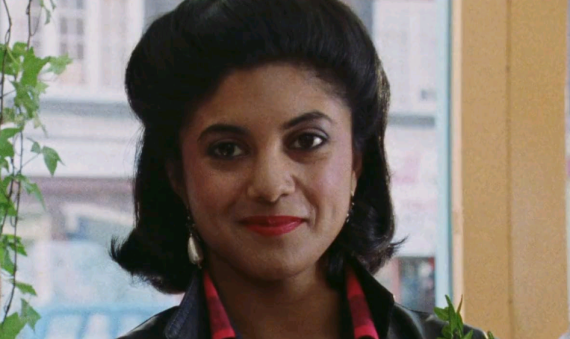
There’s a real sense of place thanks to location filming in the south London districts of Wandsworth, Battersea and Vauxhall, with the train passing the window of the flat where Omar lives with his father, for example. Their flat is also richly evocative and feels very British and very 1980s, which helps with the pervading atmosphere. The production design is beautiful.
Just as beautiful is a perfect, improvised, final shot that, spoiler alert, leaves our characters in a happy place personally, though the politics and prejudices that are the backdrop to their lives are still very much there for them to battle through.
In closing, My Beautiful Laundrette is a perceptive and biting satire of Thatcher’s Britain, highlighting the prejudices and racial tensions of the time through an Oscar-nominated script that in some ways still very much chimes in 2026. Featuring a breakout performance by Daniel Day-Lewis, a wonderful atmosphere, thanks to location filming in south London, and some excellent performances and character moments, it’s a strong early work by director Stephen Frears.
Film: 

My Beautiful Laundrette is released on Blu-ray by the Criterion Collection on 18th May 2026. The 2K digital restoration of the film, which was shot on 16mm, looks stunning, with a very natural feel and look, the right amount of grain, good detail and no blemishes. The film looks as good as I’ve ever seen it, though the occasional outdoor sequence, particularly the opening titles, are a little soft, presumably due to the quality of the source materials.
Director-approved Blu-ray special edition features:
New, restored 2K digital transfer, supervised by director of photography Oliver Stapleton, with uncompressed monaural soundtrack
Conversation between director Stephen Frears and producer Colin MacCabe
Interviews with writer Hanif Kureishi, producers Tim Bevan and Sarah Radclyffe, and Oliver Stapleton
Trailer
English subtitles for the deaf and hard of hearing
An essay by critic Graham Fuller
My Beautiful Laundrette was previously released in the UK on dual-format Blu-ray and DVD by the BFI in 2017. That edition contained a 1986 Q&A from the ICA; a piece with actor Gordon Warnecke; Typically British: A Personal History of British Cinema by Stephen Frears, a brilliant 77-minute documentary from 1994; and two excellent short films, Gurinder Chadha’s I’m British But… (1989) and Prathiba Parma’s Memsahib Rita (1994).
The Criterion Collection edition doesn’t carry over any of those extra features, but does provide around 90 minutes of high-quality interviews.
Firstly, an interview with Stephen Frears is a Criterion Collection one that took place in 2015 and saw him talking to producer Colin MacCabe about the making of the film. Running for 33 minutes it’s a really entertaining piece that starts with Frears being asked to describe who he was as a person in 1984, when the film was made. Frears talks about working at the BBC, the conception of the film and his feelings on the themes and its release. It’s a really good interview.
The interview with writer Hanif Kureishi is also from 2015 and runs for 16 minutes. Kureishi discusses the things that inspired him to write the film, recollections of writing the script and the film’s success. I particularly enjoyed his comments about other films at the time, interactions with Frears and the real-life inspirations for the story. It’s another great interview.
Also from 2015, is a 22-minute interview with Tim Bevan and Sarah Radclyffe, who set up the production company Working Title. The pair are interviewed separately and talk warmly about the film and those involved, the conception of the company and the time in which the film was made. The creation of the company, including music videos that they made before moving into feature films, is a particular highlight of a very good interview. They also share some of the challenges of making the film.
Closing out the interviews from 2015 is one with cinematographer Oliver Stapleton, who discusses his first of eight collaborations with Frears. The 21-minute interview covers his career before the film, his style of shooting, and how the movie was offered to him (Chris Menges was the original choice but he took up a role in Roland Joffé’s The Mission instead). It’s an illuminating interview that gives some insight into cinematography.
Also included is a two-minute US trailer, which features some funny lines and quotes to sell the movie.
I was only provided with a review disc so am unable to comment on the physical leaflet/ booklet containing an essay.
In closing, the Criterion Collection have provided a very welcome new UK edition of Stephen Frears’ classic My Beautiful Laundrette. The picture and sound quality is excellent and the disc contains around 90 minutes of informative and engaging interviews from 2015. The quality of all the interviews is very high, but completists who own the BFI’s previous UK edition will want to keep hold of that one for a completely different selection of extras.
Disc/Package: 