



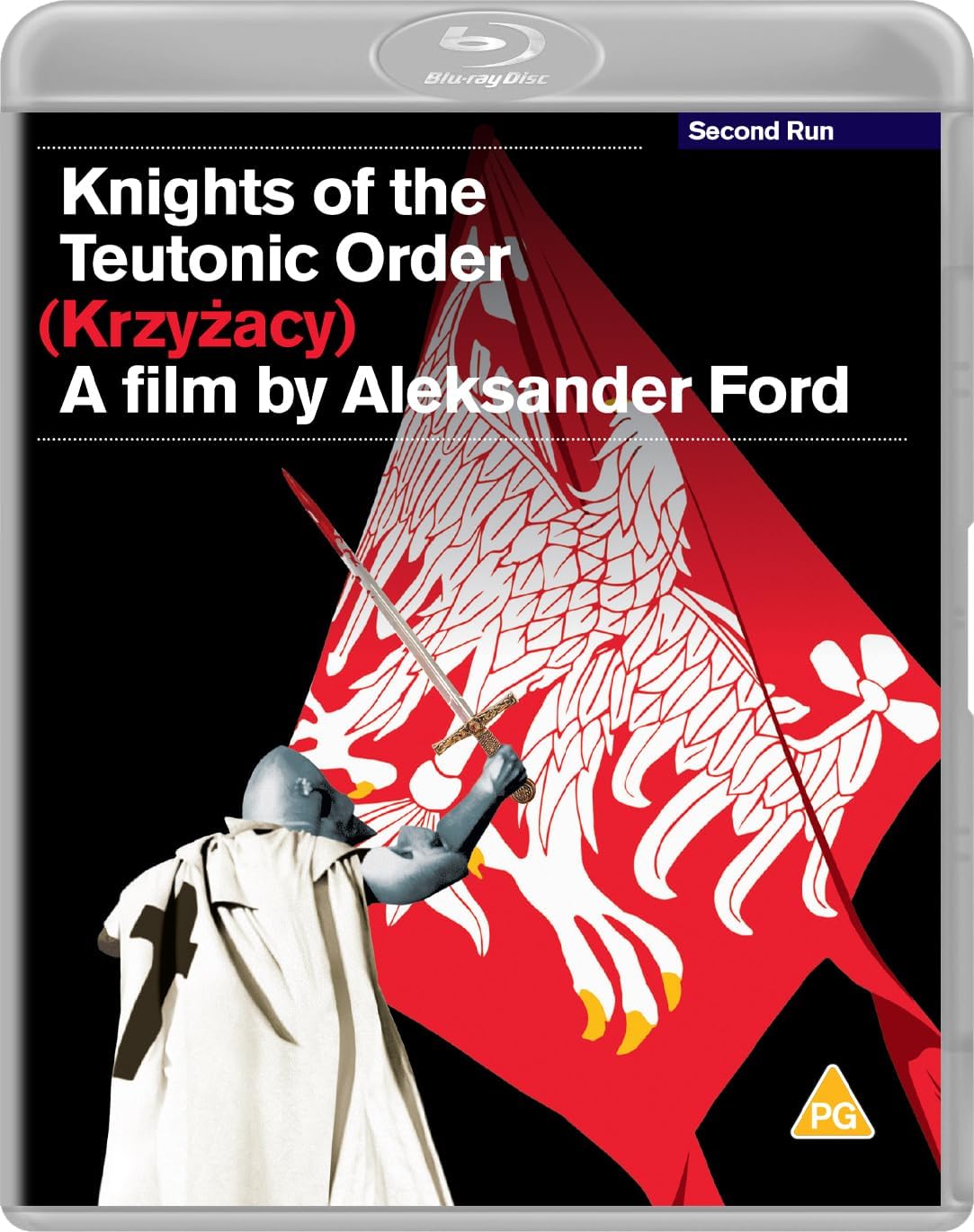
 Director: Aleksander Ford
Screenplay: Aleksander Ford, Jerzy Stefan Stawinski, Leon Kruczkowski
Based on a Novel by: Henryk Sienkiewicz
Starring: Mieczyslaw Kalenik, Urszula Modrzynska, Grazyna Staniszewska, Andrzej Szalawski, Henryk Borowski, Aleksander Fogiel, Emil Karewicz, Lucyna Winnicka
Country: Poland
Running Time: 172 min
Year: 1960
BBFC Certificate: PG
Being the first homegrown, epic-scale mega hit after WWII, Knights of the Teutonic Order (a.k.a. Krzyżacy) was what could be called the first Polish ‘super production’ (or ‘superprodukcja’, as they call it in its native country). These were big, lavishly produced films, akin to Hollywood’s epics of the 50s and 60s, that were usually based on 19th and early 20th-century literature.
Martin Scorsese, a champion of Knights of the Teutonic Order, claims it was “the most viewed Polish movie of all time”. Indeed, by the year 2000, it was reported to have been watched by more than thirty million people.
It’s not, however, a film that is greatly remembered in the UK. It performed relatively well outside of Poland on its original release in 1960, but it hasn’t been as widely available or discussed since.
The UK’s strongest supporter of Eastern European cinema on disc, Second Run, did put it out on DVD 20 years ago. Now, they’re upgrading that release to Blu-ray, from a new restoration. I got hold of a copy, and my thoughts follow.

Knights of the Teutonic Order is based on the 1900 novel ‘Krzyżacy’ by Henryk Sienkiewicz (who also penned ‘Quo Vadis’). It tells the story of the buildup to the monumental Battle of Grunwald, which turned the tides in the Polish–Lithuanian–Teutonic War. It is believed to have been the greatest battle of medieval Europe.
The film frames this with a tale of love, honour and betrayal. Zbyszko of Bogdaniec (Mieczyslaw Kalenik), a young nobleman, comes home from the war and meets the beautiful Danusia (Grazyna Staniszewska), daughter of Jurand of Spychów (Andrzej Szalawski), a noble anti-Teutonic rebel. Upon hearing that the Teutonic Knights killed her mother and burned down her house, Zbyszko promises Danusia that he will claim the life of a knight in her honour.
When Zbyszko attempts to attack Kuno von Liechtenstein (Mieczyslaw Voit), who is dressed as a Teutonic Knight, he discovers that Kuno was riding as an envoy for the Order. Attacking an envoy is a capital offence, and Zbyszko is put on trial and found guilty.
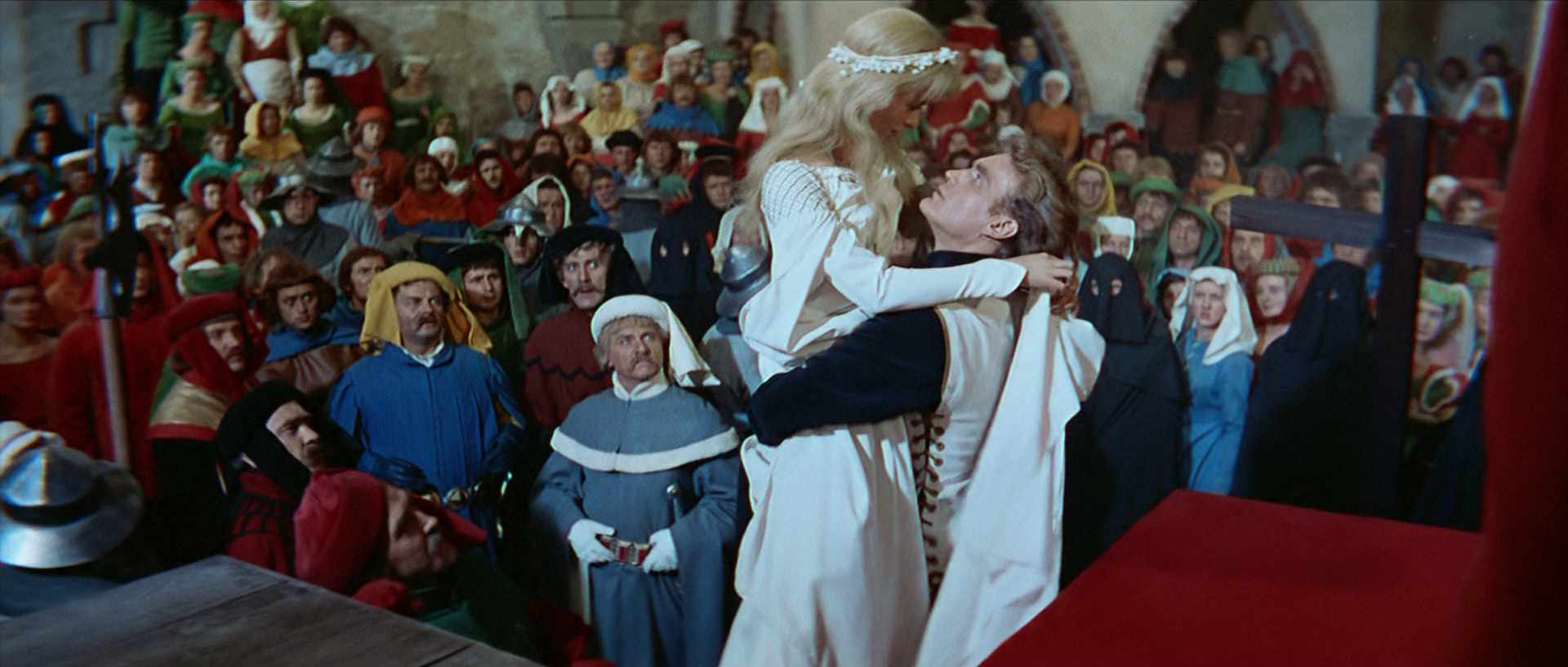
However, Danusia saves his life by covering his head with a handkerchief and promising to marry him (an old Polish tradition that carries a stay of execution). Everything seems perfect until Danusia is kidnapped, and the Order demands Jurand turn himself in to ensure her safe return.
And the story goes on from there, while gradually building tension between the Poles and the Order, ready for the battle.
I enjoyed Knights of the Teutonic Order a great deal. I didn’t use to be into period epics like this but perhaps due to my middle-aged status, I’ve found myself more drawn to them. The great thing about this particular film is that it has a bit of everything – action, drama, political intrigue, romance, music and even a couple of brief splashes of comedy. It’s no stuffy history lesson but a rousing adventure that will keep you hooked throughout its near-three-hour running time.

Like the best Hollywood epics, Knights of the Teutonic Order is also technically very impressive. The cinematography is stunning, with great use made of colour and its wide Dyaliscope frames. There’s plenty of movement, too, with a few epic tracking shots scattered throughout the film.
The use of locations and the production design are impressive, too. The costumes look very clean, compared to modern period interpretations, but they’re colourful and still look relatively authentic.
I was also impressed by the editing. The film is very well paced, and there are some sharply cut sequences. The final battle is particularly well put together, making for a suitably grand climax to the film.

I appreciated the inclusion of a couple of strong female characters, too. Whilst Danusia becomes somewhat of a ‘damsel in distress’, you’ve got Duchess Anna Danuta of Masovia (Lucyna Winnicka), who’s a clever and effective ruler. Then you’ve got Jagienka Zychówna (Urszula Modrzynska), a tough young woman who hunts alongside Zbyszko, creating a bit of a love triangle, as the sparks fly between them.
Overall, then, Knights of the Teutonic Order is a handsomely mounted, stirring epic. It’s a long film, but it’s never tiresome. With drama, heroics and romance in abundance, it’s grand entertainment of the highest order.
Film: 

Knights of the Teutonic Order is out now on region-free Blu-ray, released by Second Run. The transfer is largely very impressive. Colours are rich, and the print is clean. I found it had a slightly artificial look to it in places, though. This might largely be down to the usual issues you get with the colour processes used at the time, but there were a few little patches that looked slightly off to my eyes, and it’s hard to put my finger on why. I’ve used screengrabs throughout this review to give you an idea of how it looks, though it was usually areas of motion that looked slightly peculiar to me. I had no problems with the audio, which comes through nicely.
BLU-RAY SPECIAL FEATURES
• Knights of the Teutonic Order (Krzyżacy) presented from the 2K restoration by WFDiF, Poland in collaboration with Martin Scorsese’s The Film Foundation
• Superprodukcje!: A new and expansive video essay by film historian Michael Brooke on Polish epic films
• Archival 1960s Polish newsreels relating to the film and its legacy
• 24-page booklet with writing by film scholar Professor Anna Misiak
• New English subtitle translation
• Region free Blu-ray (A/B/C)

Other than a couple of brief newsreel pieces that show a snapshot of the making of the film and the effect the release was having on young Polish children afterwards, the only substantial on-disc extra is a piece by Michael Brooke. This is excellent, though. In the essay, Brooke discusses the history of the Polish superproduction (a.k.a. superprodukcje). It’s a fascinating account, and he includes numerous clips of titles within the genre. It gave me a few new films to add to my wishlist. Hopefully, Second Run has some more up their sleeves.
The booklet contains an essay by Anna Misiak. She briefly looks at the history behind the film’s story before discussing the life and career of its maker, Aleksander Ford. His is an eye-opening tale with a tragic end. It makes for good reading.
So, Second Run have put yet another unheralded (in the UK, at least) classic that deserves to be much better known. I had some slight issues with the transfer, but Brooke’s essay and the booklet are excellent, so it’s a strong release of an exceptional film.
Disc/Package: 