


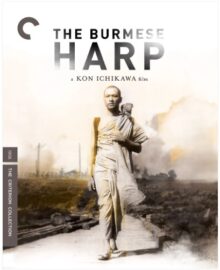
 Director: Kon Ichikawa
Screenplay: Michio Takeyama, Natto Wada
Starring: Rentarō Mikuni, Shôji Yasui, Jun Hamamura
Country: Japan
Running Time: 116m
Year: 1956
An Imperial Japanese Army regiment surrenders to British forces in Burma at the close of World War II and finds harmony through song. A private, thought to be dead, disguises himself as a Buddhist monk and stumbles upon spiritual enlightenment. Magnificently shot in hushed black and white, Kon Ichikawa’s The Burmese Harp is an eloquent meditation on beauty coexisting with death and remains one of Japanese cinema’s most overwhelming antiwar sentiments, both tender and brutal in its grappling with Japan’s wartime legacy.
Made just 10 years after the end of World War II, The Burmese Harp is a fascinating film. Steadfastly sentimental, with its heart on its sleeve, but not in the slightest bit preachy or heavy-handed. It is a beautiful film and of vital importance.
Based on a novel of the same name by Michio Takeyama, it is, unsurprisingly, a children’s story. A fairy story, even, with its indulgences for parable. Director Kon Ichikawa takes that sharp simplicity and layers it with the very real setting of Burma at the end of WWII.
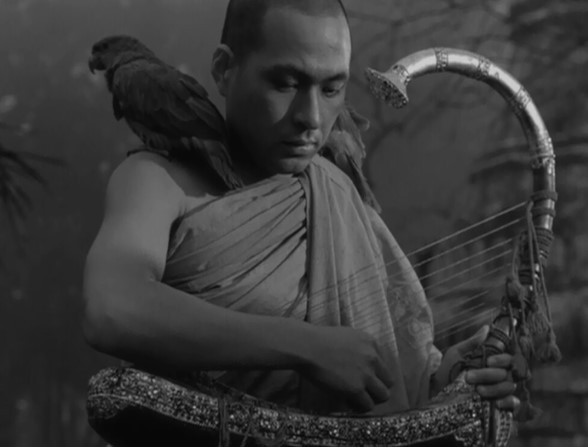
The pace is both indulgent and concise, and the story for the most part is a straightforward tale. Private Mizushima is well suited to Burma and is an accomplished harp player. However, he speaks of returning to his beloved Japan, with the merest hint of regret for his country’s part in the war. This is not a political film though. It’s one of hope, that skewers the nature of war by merely concentrating on the humanity in the story.
So far, it’s an enjoyable film with a touch of humour. And it’s refreshing to see such a story from the Japanese perspective that doesn’t reduce them to caricatures. Still, even when you know the story, the last act sneaks up on you. It is effortlessly profound, as Mizushima, having survived an awful ordeal, embraces a selfless destiny.
It is in its quiet resilience that this unassuming film reveals a sharply observed plea for peace. Where anti-war endeavours often go for extremes, such as humour, satire or nightmarish images, The Burmese Harp is human and pure.
VIDEO
Black and white always responds well to UHD transfers. The painterly The Burmese Harp is no exception. It’s a silky, silvery image, occasionally busy, but for the most part, consistent and balanced. Detail is sharp and bright with a contrast that is sometimes a little soft for 4K. Shadowy moments can be fabulous though.
EXTRA FEATURES
A fine film but the package only includes two archival interviews, so this is a soft release for Criterion. I’d like to have seen more made of this remarkable film’s important legacy.