



 Director: Marcel Carne
Screenplay: Jacques Prevert
Based on a novel by: Pierre Mac Orlan
Starring: Jean Gabin, Michele Morgan, Michel Simon, Pierre Brasseur
Country: France
Running Time: 91 minutes
Year: 1938
BBFC Certificate: PG
The films of Marcel Carne are very dear to my cinephile heart. As a teenager in the early ’90s, I attended a screening of “Les Enfants du Paradis”. The provincial cinema was poorly attended, and the worn-out print broke several times during the screening, but no matter: this magical film was responsible for one of the most formative and indelible experiences of my film-loving life. So it is an honour to return to his work, and this superb reissue on DVD and Blu-ray of what is now regarded as a classic of pre-war French cinema.
Adapted from the novel of the same name by Pierre Mac Orlan, “Port of Shadows” (a.k.a. “Le Quai de Brumes”) is a prime example of what has become known as ‘poetic realism’, although the director himself preferred the term ‘social fantasy’. Jean (Jean Gabin) is a deserter from the French Army, who makes his way to the port of Le Havre as a means of escape. There, in a cabin belonging to a man called Panama, he joins a group of people on the fringes of society, each with their own fugitive pasts and dubious moral scruples. Chief among them is Nelly (Michele Morgan), a young woman hiding from her guardian Zabel (Michel Simon). As this group of misfits argues and pontificate amongst themselves, the attraction between Jean and Nelly blooms, much to the consternation of both Zabel and the venal would-be gangster Lucien (Pierre Brasseur).
Jean Gabin’s performance as the world-weary Jean is a masterclass of bruised humanity, a man so scarred by the violence of war that he flees from it, but who can take care of himself when threatened. Gabin is often compared to James Cagney or Humphrey Bogart, but in my opinion, a comparison to John Wayne may be more apt. His strong physical presence and charisma convey an authority as all-consuming as that of “The Duke” during his Hollywood heyday, although their onscreen capacities are a world away from each other.
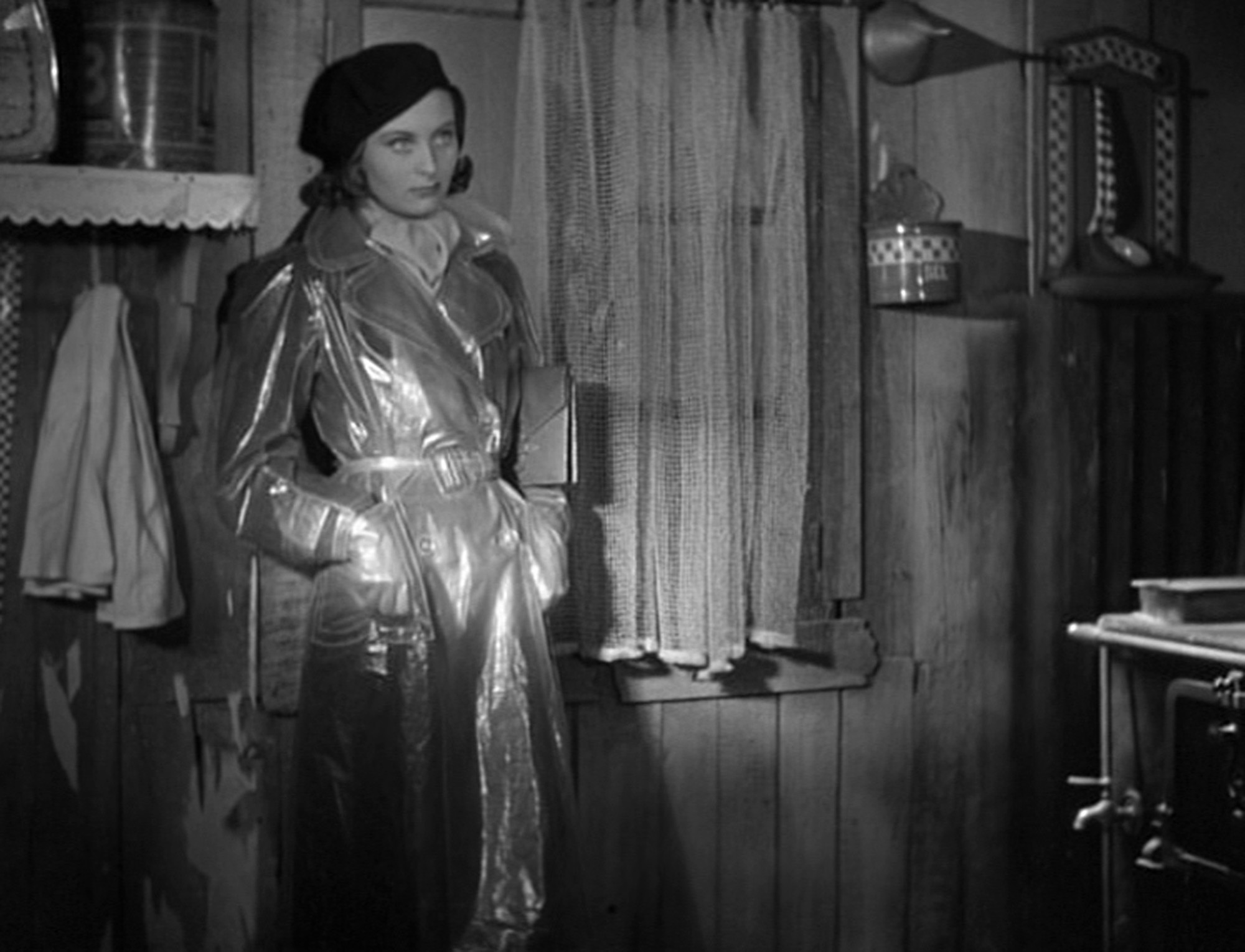
In only her fourth onscreen role, Michele Morgan is dynamic as a young woman daring to live her own life whilst under severe emotional and physical duress. The film alludes to events that could not then be shown onscreen; these allusions darken the film’s narrative considerably. Standing in the literal shadows in an ultra chic beret and transparent Mackintosh coat, her introduction to the audience is as iconic as that of Lauren Bacall in “To Have and Have Not”. The romance between Jean and Nelly is the beating heart of the film, and the onscreen chemistry between Gabin and Morgan crackles with genuine intensity. Morgan more than holds her own with a complex performance that captures her character’s inner turmoil and innate vulnerability.
The film garlands these dissolute characters with a sour sense of dignity due in no small part to the remarkable dialogue authored by the legendary screenwriter Jacques Prevert. Some of it is so flamboyant that it seems to dress the characters in cloaks of ermine, most notably by the suicidal painter Michel Krauss, portrayed by Robert Le Vigan, and the endlessly opaque ramblings by Zabel. Michel Simon excels as the craven, seemingly put-upon shopkeeper who is definitely not who he seems.

Expertly shot in expressionist hues by the great cameraman Eugen Shufftan and featuring some of Alexandre Trauner’s greatest production design work, “Port of Shadows” is one of the all-time great masterpieces of French cinema. It conveys the portentous atmosphere of lost souls adrift and alone, and of a nation bracing for imminent war: casting the rebellious Jean Gabin as a deserter in the lead role was risky, to say the least, and the film was beset with clashes between the producer Gregor Rabinowitch and Carne. Trauner’s fog-laden set design is the perfect backdrop for this heightened tale of doomed romance, and an all-star cast at their very best, harnessed by Carne’s meticulous yet unobtrusive direction.
Le Quai de Brumes is out on Blu-ray and DVD on 13th October, released by StudioCanal.
Special Features:
Introduction by Ginette Vincendeau (8 minutes)
The renowned expert on French cinema provides a short but incisive introduction to the film, explaining its status as a classic and the high-calibre credentials of its cast and crew.
The Poetry of Misfortune (58 minutes) On The Dock (44 minutes)
These two outstanding documentaries about “Port of Shadows” overlap but compliment each other well. In “The Poetry of Misfortune” a group of academics, writers, and former colleagues focus primarily on Jacques Prevert and his legacy as a screenwriter, and provide valuable insight into the creative endeavours from which the finished film emerged. “On The Dock” (credited via the subtitles as “At The Port”) emphasizes Carne’s considerable skills, goes into great detail about Trauner’s production design, and illuminates the divided reception the film initially received upon its release.
Alternate Opening Credits: a credit sequence removed by the French state, who banned the film before restoring it for release in 1941.
“Port of Shadows” is the type of prestige drama that the French New Wave sought to sweep away in the 1950s, and yet to my eyes the film is both a timeless classic of cinematic achievement, and a strikingly modern viewpoint on human beings and their limitless ambiguities. It is a real treat that StudioCanal has reissued this marvellous film, which has so much to give to us in the 21st century