



In 1948, actress Ida Lupino and her then-husband Collier Young formed an independent company called The Filmakers Inc. in order to produce, direct, and write low-budget, issue-oriented films. Lasting until 1955, The Filmakers produced twelve movies, including six directed by Lupino herself, five which she co-wrote and three in which she starred. I have watched, ranked and reviewed these films, except for one, the western Fury in Paradise, which appears to be either lost or very hard to track down. Lupino also later directed the Columbia Pictures film The Trouble with Angels, which I have included here.
12. ON THE LOOSE
The first Filmakers’ movie not to be directed by Ida Lupino, or indeed feature her in the credits in any way, was the strange teenagers-gone-wild forerunner On the Loose. Made several years before the rock ‘n’ roll era changed the notion of what being a teenager meant, On the Loose boasts a poster and a tagline (“School-girl by Day, Thrill-seeker by Night!”) which suggests something very different from the film we actually get. Rather than a rejection of the values of the parents’ generation, On the Loose presents a teenage world in which reacting against those values in any way can lead to outright ostracism by your peers. Protagonist Jill Bradley craves her parents’ approval and companionship, to the point where their neglect and the fallout from her bids for their attention drives her to attempt suicide. This act of self-harm is where On the Loose begins its narrative, flashing back to recount the events leading up to it. Oddly, when we come full circle, that is not the film’s end point. There is instead a whole plot strand involving the rebuilding of the father/daughter relationship and, ultimately, a completely unconvincing happy ending that tosses the mother and friends into that bargain.
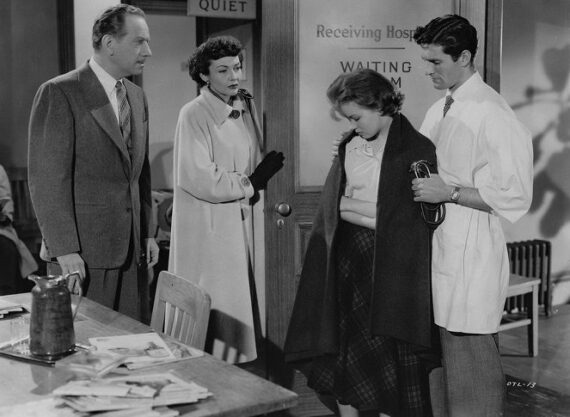
On the Loose may suffer by comparison with the harder-hitting classics of the teen subgenre that followed, with Rebel Without a Cause often being cited as a similar but better extension of this film’s kernel of an idea. As The Filmakers stated intention was to make social issues pictures about marginalised people, exploring the teen perspective was a good instinct. Unfortunately, Dale Eunson and Katherine Albert’s screenplay doesn’t seem quite sure what it wants to say or even how its story should unfold. There’s a disconcerting sense of “I blame the parents” about On the Loose, a reductive attitude exemplified by the utterly caricatured bad mother role that poor old Lynn Bari has to pantomime her way through here. The film also has a veteran star in the shape of Melvyn Douglas as Jill’s father but he doesn’t have much to get his teeth into. On the Loose did have a great screenwriter at its disposal but oddly enough he was in the director’s chair. This is one of only three films directed by Charles Lederer, whose scripts include classics like His Girl Friday, I Was a Male War Bride, Gentleman Prefer Blondes and the underrated Ride the Pink Horse. It’s a shame Lederer never picked up his rewrite pen but then On the Loose requires more than just a tweak to solve its detrimental narrative problems.
11. MAD AT THE WORLD
I should start by admitting that the version of Mad at the World I saw was not in great shape. I could understand the dialogue and see the picture well enough but often this kind of degraded print has an enormous effect on a film’s impact. So perhaps I owe writer/director Harry Essex a rewatch of his treatise on juvenile delinquency, should anyone ever see fit to remaster it. This seems unlikely though, given that the film is perhaps the most obscure The Filmakers Inc. produced, next to Fury in Paradise which I have so far been unable to track down. Although its subject matter of youth gone wild fits with The Filmakers roster of social issues films, it also makes Mad at the World one of many films in a genre that would soon be flooded with entries in the wake of rock ‘n’ roll and the hysteria it inspired. Essex’s film goes considerably darker than most, with its inciting incident being the fracturing of a baby’s skull with a glass bottle, but the subsequent exploration of the father’s vigilante crusade into the teen world fails to engage with the issues in a way that satisfactorily honours its own progressive intentions.
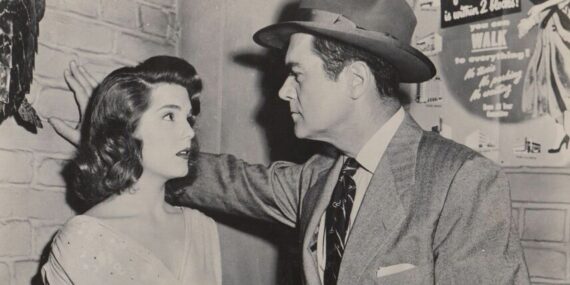
Mad at the World is desperate for us to take it seriously, to the extent where this becomes difficult. The earnest opening address to camera by Senator Estes Kefauver, the over-the-top melodramatic acting of Filmakers regular Keefe Brasselle, the fact that all the teens are played by actors well into their 30s. All of these elements make Mad at the World feel like the hokiest of B-movies, rather than a worthy counterpart to the best work of Filmakers founders Ida Lupino and Collier Young. Only Frank Lovejoy, as the sympathetic police captain, brings an element of class to the proceedings.
Despite its detrimental excesses, Mad at the World isn’t a so-bad-it’s-good film. It isn’t even so bad really, it just sort of…is. It’s frustrating as you can see that there are some interesting themes being circled but Essex’s screenplay just never quite lands on them. It’s intriguing enough that I would revisit it if a better quality copy became available but I fear that in all likelihood Mad at the World will quickly become a film that fades from my memory.
10. NEVER FEAR
The Filmakers’ second release and the first on which Ida Lupino officially took a director’s credit, Never Fear was a very personal film based on Lupino’s own experiences with contracting polio as a teenager. Although her symptoms only persisted for a short time and left only minor damage, Lupino recalled her own loss of hope and fear of permanent paralysis. In a strange twist of fate, an accident on set led Lupino to direct much of Never Fear from the confines of a wheelchair. The film was released in 1949 which turned out to be the year of America’s highest recorded number of polio cases. While this chimed with Lupino’s desire for her films to reflect American lives through socially significant material, it also meant that America was in no mood to go and watch a film about such a prevalent threat to their well-being. Consequently, Never Fear was a flop and, unfortunately, it feels like something of an artistic disappointment too.
For just over ten minutes, Never Fear feels like one of the most joyful films ever made. Focusing on two young lovers and aspiring dancers, this opening section features charming chemistry between Sally Forrest and Keefe Brasselle, last seen together in Lupino’s previous film Not Wanted. Their characters, Carol and Guy, have a sweet and convincing dynamic and Lupino stages a slightly bizarre but beguilingly unique dance routine that incorporates a swordfight. It’s all tremendous fun and I suppose when the polio plot arrived I was just a bit bummed out to not be spending more time in this rom-com-musical which turned out to just be there to make us care enough to feel the weight of tragedy. Having known the premise going in to Never Fear, I knew what the function of all this sweetness and light was but Lupino deploys it so effectively that it got me anyway. Sadly, little else in the remaining hour came anywhere near working as well for me.
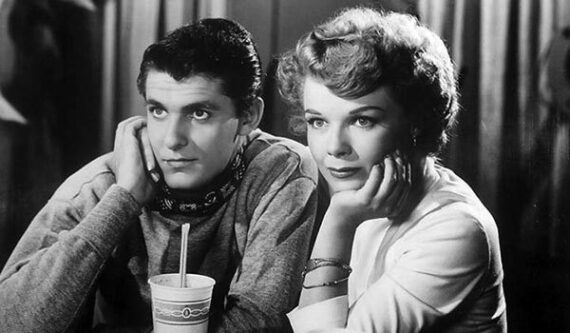
Forrest had been wonderful in Not Wanted but she is considerably less convincing in Never Fear, lumbered with a thinly-written and too rapid descent into hopelessness that sees her becoming a blunt, brooding bore for a long stretch of the runtime. I’m aware that this sounds somewhat insensitive given the circumstances and I’m sure Lupino’s personal experience with these feelings helped her craft a representation of some authenticity, so perhaps my movie-based expectations played a part in my disappointment here. However, the repeated use of voiceover to represent thoughts and Forrest’s plethora of melodramatic breakdowns seemed to contain too little insight into her real mindset. The scene in which she decides to prematurely attempt to walk again is mired in internal monologues to the effect of “I won’t wait. I’ll show them. I’ll walk now” and it all feels terribly spelt out, leading to the inevitable collapse and wail of despair.
Never Fear isn’t just about polio though, it’s about the effect a devastating medical disruption can have on relationships and self image. Brasselle, who I didn’t like so much in Not Wanted, is better in this role as Carol’s initially charming fiancée whose overbearing support eventually becomes controlling, insufferable and, finally, toxic. This is caught up in Carol’s growing coldness towards him but it eventually leads to a scene in which he unleashes his unwanted sexual attentions on her, proclaiming “I don’t care what you want anymore. Carol. Carol! Be a woman for me!” In one respect, this element of the film is the most compelling and astute and, while their eventual reconciliation framed as a happy ending feels somewhat inevitable for the era, there’s every indication that Lupino is showing disapproval towards Carol’s treatment at the hands of a series of men who think that because she is on wheels now they can move her around anywhere they fancy. Several scenes end with her being pushed away against her will. It is this female perspective, either absent from or degraded by so many of Never Fear’s contemporaries, that Lupino brings so brilliantly into her work. Often it is the demands of conventional narratives that seem to be working against this asset and, in the case of Never Fear, the complications of various half-realised love triangles muddy the waters considerably. It feels like the film needs to be pared down to just the treatment of Carol’s polio and the effects on her existing relationship and career. With only about 80 minutes of runtime to play with, the film creaks under the weight of superfluous square-jawed doctors and flirtatious fellow patients.

Never Fear feels like a failure but a nobly ambitious one. The characteristics of Lupino’s best work are here, just obscured behind questionable dramatic choices in the screenplay by Lupino and her producer and then-husband, Collier Young. While the notion of spending eighty minutes watching a woman undergo treatment for polio didn’t exactly pack ‘em in, I ended up wanting to see more of that and fewer relationship diversions. A more nuanced, focused depiction of Carol’s experiences would have gone a long way to making Never Fear better but, at the very least, it manages to show Lupino’s directorial promise still intact beneath the weight of an unwieldy script.
9. HARD, FAST AND BEAUTIFUL
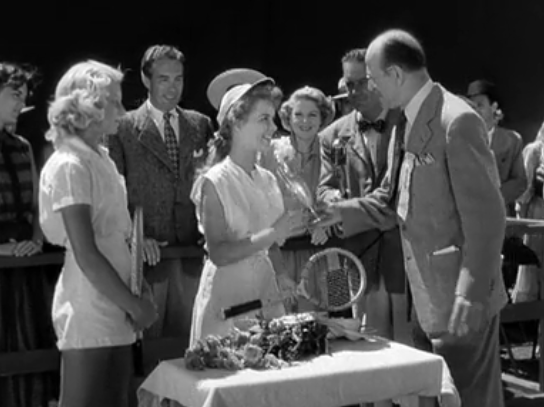
The Filmakers production company kicked off their existence with a trio of social issues films on controversial subjects so this fourth outing, once again directed by Ida Lupino, feels like something of a palate cleanser. Based on the sporting novel American Girl by sports-fiction author and commentator John R. Tunis and written for the screen by Martha Wilkerson, better known as Armed Forces disc jockey GI Jane, Hard, Fast and Beautiful is an entirely hackneyed and predictable affair with a lurid and barely relevant title. It is also, up to a point, quite a fun ride, especially coming off the back of Lupino’s heavy films about rape, polio and unwed motherhood. Tunis’s source novel was apparently a thinly-veiled and unflattering take on the life of tennis star Helen Wills Moody, but that trashily titillating element has largely faded over time and most people who come to this film see it as yet another tale of a manipulative mother and her talented daughter who she pushes too hard for her own selfish ends. It’s a classic tale and its complete familiarity does mean the mind is free to be disengaged to an extent, allowing the film to be appreciated on other fronts.
Fortunately, there are a couple of facets to Hard, Fast and Beautiful that make it more notable than it would otherwise have been. The dual lead roles for the excellent Claire Trevor and The Filmakers’ favourite Sally Forrest ensure that the trite screenplay is injected with some life, even if the male cast largely fail to keep up with these two stars. The chief reason to watch Hard, Fast and Beautiful though is Lupino’s splendid direction. Perhaps realising that the material wasn’t up to snuff this time round, Lupino seems to double down on her directorial invention. The mise en scene is remarkable, running with the theme of tennis and turning various conversational scenes into implied battles by dividing them down the middle with imaginary or stand-in tennis nets. This is most memorably achieved with a pair of single beds used by a married couple. Lupino has them placed headboard to headboard, so that the couple are divided even as they lay talking to one another, symbolising both the distance in the marriage and the back-and-forth match for their daughter’s happiness.
While Hard, Fast and Beautiful isn’t a film I’d recommend rushing to see, it does make for an easy and undemandingly enjoyable evening’s viewing (and, with its 78 minute runtime, a nice early night to follow). Fans of Lupino will not want to miss this demonstration of her talents though, as they are the highlight of the film, from her smartly symbolic setups to the enjoyable tennis footage.
8. OUTRAGE
There’s a scene at the beginning of Outrage that, on paper, could be played as light comedy, or at least it could have in a bygone era. It features the protagonist, Ann Walton, visiting a concession stand and ordering two pieces of chocolate cake to go. “Hey beautiful,” replies the man serving her, “What’s this two-pieces-of-chocolate-cake routine every day? I’ve been here almost a week and every time it’s the same thing. Either you’re nuts about cake or you’ve got a boyfriend. If I was your boyfriend you wouldn’t have to buy me no cake. You better make up your mind. I might be moving on next week.” It’s the sort of dialogue that might’ve been given to Bill Murray or Chevy Chase a couple of decades down the line, ostensibly playful but with an arrogant, sexualised undercurrent that used to pass for charm in 80s and 90s movies written by men. In Outrage, however, it is played in a very different way. Ann’s discomfort with the man’s suggestive comments is clear and only the most deluded of viewers could mistake this behaviour for acceptable. As a man who grew up in the 90s and doubtless committed comparable moments of creepy overstepping without even realising, it’s refreshing and somewhat surprising to see a film from 1950 acknowledging a long trivialised form of transgression as inappropriate.
There are many elements of Outrage that continue to impress with their modern attitude, as well as some that feel distinctly more of their time. As one of the earliest post-Code Hollywood films to address the subject of rape, it carries a heavy historical burden on its shoulders. While it would be naïve to expect a film that, at the time of writing, is three quarters of a century old to fully align with modern sensibilities, it is also perfectly reasonable for a film on such a sensitive issue to be retrospectively rejected as effective any longer. For my own part I’m torn, as in its best moments Outrage feels well ahead of its time in its handling of toxic masculinity and PTSD. Ida Lupino’s writing and direction brings that essential female perspective to the subject matter and Mala Powers, in her first leading role, is devastatingly real which is crucial in preventing the film from drifting into an inappropriately melodramatic key. Although the word “rape” is never used, Lupino’s staging of the lengthy scene in which Ann is stalked and eventually caught by her attacker leaves no doubt as to his intentions or the offscreen atrocities to which he subjects her. The set up leads the viewer to expect a particular kind of film, a crime thriller in which Ann assists the police in their pursuit of her rapist. However, in keeping with The Filmakers Inc.’s interest in exploring socially significant topics, it seems right that such generic entertainments are passed over in favour of exploring the emotional and psychological fallout for the victim.

Lupino’s films thus far had served the female perspective well so it is somewhat surprising that Outrage eventually drops the ball quite badly on this count. The scenes in the immediate aftermath of Ann’s rape are excellent, showing the varying reactions of her loved ones, acquaintances and colleagues and how Ann responds to these changes in her life. Especially strong is the scene in which her seemingly sympathetic boyfriend Jim has an entirely self-centred reaction to her pushing him away that ends in him violently grabbing her and commanding that she “SHUT UP!” The current Wikipedia synopsis of Outrage states “the police and her family, friends, and fiancé, Jim, are supportive” which seems to miss the point of this scene but also demonstrates the different perceptions that even now make this kind of subject matter land differently with different types of viewer. For my money, though it appreciates that Jim is also experiencing trauma because of the situation, the film does not necessarily portray him as sympathetic. That Outrage’s eventual approximation of a happy ending is for Ann to be sent back to reconcile with Jim, a decision that seems all but taken out of her hands, makes me question this however. Outrage was written by three people: Lupino, her then-husband Collier Young and screenwriter Malvin Wald, and while this range of viewpoints may have helped Outrage in some respects, it also appears to have muddied the waters by the time of its jumbled conclusion.
Outrage starts to go off the rails when Ann decides to make a clean break and leaves for Los Angeles without telling anyone. Here she meets the hunky Reverend Bruce Ferguson with whom she forms a close bond. Unfortunately, Ferguson is a verbose bore who quickly assumes the role of moral mouthpiece for both Ann and the film. When a pushy local takes a liking to Ann and decides to move in forcefully for a kiss, she hits him on the head with a wrench and runs. It’s unclear whether Outrage wants us to see this as an overreaction or not. Certainly by today’s standards most would recognise the persistent man’s behaviour as another sexual assault with the clear potential to escalate quickly into rape but when the Reverend hears about it he assures her “I know him, he meant no harm.” After Ann is forced to stand trial, her rape comes to light and her sentence is commuted into a year of psychological treatment, after which the Reverend parcels her up and sends her back to the ex whose reaction to her rape was to physically assault her. By this stage, Outrage can’t really hope to be much more than an interesting glimpse of bygone attitudes with a smattering of promising progressiveness. The astute psychological examinations of its first act are crushed under the weight of a poorly hammered out story that snuffs out the female perspective that had characterised The Filmakers’ output thus far in favour of a convenient, plot-resolving holy man who can solve all the problems with one clunky courtroom speech and who believes that none of his casual acquaintances could ever assault a woman because, well, he knows them. I started out with high hopes for Outrage, but by the end I had no idea at what I was supposed to be aiming that titular emotion.
7. PRIVATE HELL 36
Of all the directors who The Filmakers gave a shot, Don Siegel went on to become the most successful. This early Siegel film, made just a couple of years before his first major classic, Invasion of the Body Snatchers, shows glimmers of his potential but it is essentially just a half-decent potboiler, hampered by a disjointed screenplay and fairly bland playing all round. Written by former husband/wife team Ida Lupino and Collier Young, this straightforward but narratively confused morality tale sees a good cop go bad after his obsession with a nightclub singer drives him to steal $80,000 from the car of a robbery suspect. Steve Cochran and Howard Duff play the cop and his partner, who is reluctantly drawn into the scheme against his will. Despite an interesting flicker of homoeroticism in the dialogue, there isn’t a lot of chemistry between the two men whose relationship should be doing most of the dramatic heavy lifting. Certainly, though her alluring image dominates the film’s poster, Lupino never finds a spark with Cochran, perhaps because in real life she was actually involved with Duff. Despite her proven ability to nail roles like this one, Lupino feels miscast here and I wonder if the film might’ve worked better had she traded parts with Dorothy Malone, who is criminally underused in the role of Duff’s wife.

However you might want to rejig the casting, there are obvious script problems with Private Hell 36 that would prevent it rising above the level of an adequate time-passer. Even at 80 minutes, the material feels stretched and the final reveal, once the effect of its mild gotcha moment fades, makes the whole film feel retrospectively anticlimactic. The best parts of Private Hell 36 come courtesy of Siegel’s direction. The regular spikes of violence are handled with a level of brutality that increases the impact. No punches are pulled, these men hit each other hard! There’s a nice little chase scene and a nasty moment of violence against Lupino’s character which shows that Siegel doesn’t pull his punches either. The noir credentials are there, it’s just unfortunate that the story never quite comes together. Amidst the socially progressive films with which this production company, this unremarkable noir feels a bit lost.
6. NOT WANTED
Ida Lupino’s first job as director was taken up through necessity rather than by design, after the original director of Not Wanted, Elmer Cliffon, suffered a heart attack a few days after shooting began. Regardless of the route she took to get there, Lupino always seemed destined for the director’s chair. After being put on suspension by Warner Bros. for refusing roles in films that didn’t meet her standards, she spent her time studying filming and editing techniques, which she found much more interesting that acting. “It’s so much more fun. Creating it yourself, not just parading in front of a camera,” she observed. Despite her powerful charisma and striking beauty, Lupino was never one for glitz and glamor, and that is reflected in the unconventional and controversial subject matter that characterised the films made by her production company, The Filmakers Inc.. The company’s first film, Not Wanted, is about an unwed teenage mother and her struggles with societal stigmas that conflict with her personal inclinations. Although the opening caption acknowledges that tales of pregnancies outside of wedlock have been told many times before, it refers not only to Hollywood’s output but the personal stories of those who have experienced the weight of public disapproval in real life. By taking this empathetic approach to the material rather than trying to turn it into a romanticised melodrama, Lupino caught the public attention, resulting in an invite from Eleanor Roosevelt to discuss the issue on national radio. Already, then, The Filmakers’ goal of using quickly shot, independent B movies to highlight oft-ignored truths about American lives was coming to fruition.
But how successful is Not Wanted as a viewing experience? After all, The Filmakers intent was to combine social significance with entertainment. It could be said that the film fares a little better on the former count than the latter. With its slice-of-life approach and overbearing air of self-imposed duty which can’t help but tip over into occasionally risible melodrama, Not Wanted is a rather peculiar, if also fascinating, watch. Though she refused to take a director’s credit out of respect for Clifton, Lupino’s name is all over the film as writer, producer and at the very top of the credits in the words “Ida Lupino introduces…” This is Lupino’s picture more than anyone else’s and she makes her mark forcefully with intermittent scenes displaying her flair for visual invention. The intense, hazily hallucinatory birthing scene is especially effective, showing things from the perspective of the protagonist, Sally Kelton. Lupino uses these POV shots a couple of times in the film, but the emphasis on this being Sally’s story above anyone else’s means we largely see things through her eyes even when that’s not represented in the literal sense. As Sally Kelton, Sally Forrest gives an excellent, committed performance. Forrest had previously appeared mostly in uncredited dancing roles so she makes the most of her first big screen lead. By contrast, the male leads are less effective. Leo Penn, as the pianist who impregnates and then abandons Sally, is a little too blatantly villainous, all lascivious sneers and casually flicked cigarettes, while Keefe Brasselle’s gas station owner Drew is the kind of aww-shucks “nice guy” from whom modern audiences would probably advise women to run a mile. Brasselle does well enough but is lumbered with the film’s worst dialogue, all passive-aggressive come-ons and oily approximations of charm.
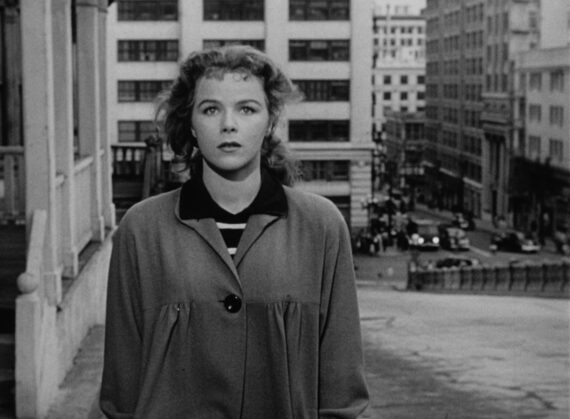
If Forrest must essentially carry this film alone though, that is not necessarily a bad thing. After all, as we’ve established, for Lupino this is her story rather than that of her self-appointed saviours. But there are a handful of these such characters in Not Wanted and the film can only go so far in pushing aside their interferences. Though it questions societies attitudes to unwed mothers, the film can’t quite take an impartial stance on the subject and when Sally regrets giving up her baby, the letter that is read out in an attempt to comfort her seems like a way of acknowledging the supposition that a married couple, preferably Christian, are the only suitable carers for a child. It’s fair to say that a film made in 1949 could only go so far in its criticisms of society’s morals, so Lupino chooses instead to focus on Sally’s continued grief and mental health. Rather than let the news of her baby’s happiness with its new family completely erase the pain as a lesser film surely would have attempted to do, Not Wanted refuses to invalidate Sally’s feelings. It is through this angle that the film questions the pressures of society’s expectations most strongly.
And so we come to the last scene, which could be taken for a straightforward happy ending but which seems to be something a little more complex. The actual happy ending comes a scene earlier, when an act of kindness from a stranger gives us a glimmer of hope in the face of overbearing, mean-spirited moralising. The ending we get though finds Drew arriving to comfort Sally and, instead of running into his arms, she runs from them. She runs a lot. This isn’t a mere impulsive response, the chase goes on for well over a minute, with Sally making it very clear that she doesn’t want Drew’s help when he momentarily catches her. But this is Drew, who earlier used his position as her work superior to coerce her into dating him (jokingly, of course, because that’s just good ol’ Drew!) and so the chase continues. We learned earlier that Drew has a false leg due to a war wound and all that running eventually makes him collapse in pain. It is at this point, seeing his despair and frustration, that Sally returns to him and the film ends on their conspicuously anguished embrace. This isn’t the mere male saviour ending that Hollywood normally likes to feed us. It seems to me that Sally only returns to Drew because he needs her, rather than vice versa. Earlier in the film, Drew attempts to impress Sally by taking her home to show her his large train set. This feels to me like a deliberate infantilisation of the character, which places Sally in the role of carer rather than lover as she cradles him in that final image. There’s no kiss. For those who prefer a more conventional happy ending, you can read this as Sally finding future happiness and an imminent family of her own, but I see it as a confirmation of Sally as a natural and dedicated carer, proof that she could have taken care of that baby herself, baptismal or no.

There’s a lot to discuss in Not Wanted. Even that title has a shifting meaning, sometimes referring to Sally, sometimes her baby, perhaps even sometimes Drew. It’s a sincere title when referring to the pianist’s rejection of Sally and an ironic one when referring to the child whom society demands Sally give away. You can almost picture the big, lurid question mark appearing after the words Not Wanted in an over-eager trailer, although as far as I’m aware that never happened. Instead, the words “UNWED MOTHER” were emblazoned on the film’s poster in lettering bigger than the title itself. You have to get those punters in if you’re going to tap into their capacity for appreciating moral ambiguities, after all. If there’s a sense that Not Wanted’s screenplay hasn’t quite untangled the issues to its own satisfaction, Lupino’s already-impressive direction emphasises the empathy that is key to its impact. A strong start for Lupino and The Filmakers Inc.
5. BEWARE, MY LOVELY
While Ida Lupino’s venture with The Filmakers had thus far allowed her to experiment in the roles of director, writer and producer, for the production team’s sixth film she finally stepped back in front of the camera. Although she had often spoken of how much more attractive she found working behind the camera, her performance in Beware, My Lovely reminds the viewer of why she became a star in the first place. As Helen Gordon, a kindly woman who finds herself held hostage in her own home by the unstable handyman she impulsively hires, Lupino gives a performance of understated warmth and subtlety. By comparison, her co-star Robert Ryan gives a consciously bigger performance as the paranoid, volatile handyman who can’t outrun his own psychosis. Together, the pair blend beautifully to create an utterly gripping, stripped down 77 minute thriller. Beware, My Lovely is based on the play The Man by Mel Dinelli, whose other screenplays include The Spiral Staircase and The Reckless Moment. Dinelli does a fine job of adapting his own work, with a genuinely shocking opening scene setting the mood for the sustained chills to follow.
The Filmakers were known primarily for social issues pictures but occasionally they made films in which entertainment value was prioritised. Beware, My Lovely is arguably that kind of film, although its approach to mental illness does show a slightly more progressive side. Ryan’s Howard Wilton is a man who is only half-aware of what he is doing, finding and fleeing the crimes he has forgotten committing. His utter terror and remorse sets him up as a sympathetic variation on a villain and one of the most interesting things about Beware, My Lovely is how Lupino’s Helen never seems to completely lose sympathy for him, even as she fears for her life time and again. In keeping with The Filmakers tendency to give artists from other areas of the industry a shot at directing (including screenwriters Charles Lederer and Harry Essex, as well as Lupino herself, of course), Beware, My Lovely is directed by Harry Horner, an Oscar winning art director for The Heiress and later The Hustler. Since the majority of the film takes place in one house, Helen’s home and sudden prison, Horner’s technique here leans into that relative simplicity. Dinelli’s screenplay offers several heart-in-the-mouth moments and Horner takes full advantage of all of them.

The best film The Filmakers had released up to this point, Beware, My Lovely showcased their ability to make taut, entertaining B-movies as well as tackling controversial social issues. There’s a sense that they could have had a classic on their hands had the film only combined these two qualities a little more and really got to grips with the reasons behind Howard’s condition and what his ultimate fate might be or even ought to be. The ending, though tense, does leave a bit to be desired after such an intense build up, but it is not so disappointing that it undoes the impact of the preceding 70 odd minutes.
4. THE BOLD AND THE BRAVE
The Filmakers ceased operations in 1955. The following year, their final movie , The Bold and the Brave, was nominated for two Oscars, making it the only Filmakers production to receive that honour. Directed by veteran journeyman Lewis R. Foster and written by future TV screenwriter and producer Robert Lewin, The Bold and the Brave was based on Lewin’s experiences as commander of an anti-tank unit during World War II. For 1956, the film feels fairly old-fashioned in some of its pro-military themes and with its accidentally silly, bombastic theme song. But there are also deeply rooted humanistic themes here that dare to question the black and white morality of religious zealotry and the demonisation and degradation of sex workers. The character of Preacher, played with brooding intensity by Don Taylor, epitomises these themes, with his character’s plot existing at the exact point that they dovetail. Wendell Corey, meanwhile, has the most hackneyed of the storylines, as the soldier whose inability to kill sees him labelled a coward. The inevitability of this redemption arc offers both a comfortingly predictable and entertaining experience and a problematic simplification of sensitivity and valour. Then again, the war was hardly a distant memory in 1956 and, given that the screenwriter had experienced it first hand, there’s a historically interesting viewpoint to be found here, the like of which I myself will thankfully never be able to offer.
The main thing for which The Bold and the Brave is now remembered is the Oscar-nominated performance of Mickey Rooney as the fast-talking, hard-gambling Willie. Previously known mainly for juvenile roles, Rooney is excellent here as the upbeat member of the group. He convinces in both his comedic and dramatic scenes, exorcising images of Andy Hardy with his committed performance. While some find Rooney over the top here, I think he’s often quite impressively naturalistic. The central set-piece of the craps game, for example, contains all kinds of overlapping dialogue and thrown away lines. It’s an ahead-of-its-time technique that is reminiscent of Robert Altman’s MASH, and I’m inclined to believe Rooney’s claim that, as an inveterate gambler himself, he ad-libbed a lot of the dialogue. Certainly it’s a scene that seems very different from the weighty pronouncements of the rest of Lewin’s screenplay, which was also Oscar-nominated, but which some viewers understandably find a trifle too didactic. For me, this is part of the film’s appeal though, with its examination of different attitudes and belief systems leaning into the humanistic tendencies of The Filmakers’ approach.

With its initial mainstream recognition and acclaim, The Bold and the Brave may have temporarily been seen as The Filmakers’ prestige production but in intervening years it has fallen into the same relative obscurity as most of the company’s output. The few who have seen it seem to be lukewarm at best in their assessments, with most dismissing it as a typically shonky B-movie. On that point I am in disagreement, as I think The Bold and the Brave is a rather fine film, combining elements of romance, drama, comedy and action to create an entertaining and thought-provoking experience whose only major flaw is it’s over-ambitiousness. Even this pays off in some respects, with the final battle scenes being effectively realised on a modest budget. The Bold and the Brave combines the comfort of old Hollywood with the thrill of the emergence of independent cinema to wonderful effect.
3. THE TROUBLE WITH ANGELS
When you’re doing a chronological viewing of all of Ida Lupino’s directorial efforts, The Trouble with Angels can seem like a sudden and jarring anomaly. After the serious-minded social issues films of The Filmakers Inc., this lighthearted comedy about a rebellious teenager at a Catholic boarding school initially feels like an indulgent dessert. In fact, there were thirteen years between Lupino’s The Bigamist and The Trouble with Angels and in that interim she had kept her career as both actor and director alive in the world of TV. Amongst her TV projects were Alfred Hitchcock Presents, The Twilight Zone, Have Gun – Will Travel and The Fugitive. She also directed comedies like The Donna Reed Show, Gilligan’s Island and Bewitched, and even starred in her own sitcom, Mr. Adams and Eve, alongside her then-husband Howard Duff. With this career shift in mind, the transition to directing The Trouble with Angels makes a lot more sense, although Lupino acknowledged that the film was a change of pace for her: “the picture will be warm and funny. And it’s such a nice change – no blood spilled at all, darling.” Lupino was right, the film did turn out to be light and funny, but there’s also a terrific depth, pathos and humanism that is surely enhanced by her work as director, with her previous résumé a testament to her knack with those qualities.
Another of Lupino’s celebrated skills as a director is evident here, with an all-female main cast providing a refreshing perspective. Men appear very rarely and are hardly ever discussed, with Blanche Hanalis’s delightful and tender screenplay showing a greater interest in female friendships and the shifting relationship between Hayley Mills’ rebellious schoolgirl and Rosalind Russell’s seemingly stern but quietly kind Reverend Mother. Russell, an old Hollywood pro, is stately and commanding in her role but she is given a run for her money by Mills who, in a bid to escape her wholesome image from numerous juvenile roles for Disney, is absolutely fantastic as the wayward firebrand Mary. June Harding, as Mary’s best friend Rachel, also makes for the perfect foil and it’s a shame her big screen career was so brief. In making this central friendship so utterly believable, Mills and Harding ensure The Trouble with Angels is an appealing bit of representation for young girls who are often shortchanged by an industry more fascinated by male teenage tearaways.

From its animated opening titles to Lionel Lindon’s bright, polished cinematography, The Trouble with Angels is a feelgood picture through and through, but it is smart enough to recognise that truly feelgood films must acknowledge the counterweights of anguish and pathos. There’s an emotional intensity that ramps up in the later scenes of the film, though never to an extent that shatters its delicately forged identity. A sequence in which Reverend Mother, hearing Mary mocking one of the nun’s German accent, confronts her with that nun’s wartime experiences protecting Jewish children is reminiscent of Robin Williams’ sobering speech to Matt Damon in Good Will Hunting decades later. It is a briefer, less showy equivalent but no less impactful for that. The inevitable religious themes that go hand in hand with this setting never feel preachy or exclusionary. The fact that one girl finds her way to religion and the other doesn’t is never held up as a victory or failing on either side. Instead, we are presented with a slice of life with little judgment or sermonising. Consequently, The Trouble with Angels plays well for most audiences and was even popular enough to spawn a sequel, Where Angels Go, Trouble Follows. Lupino was not involved in the follow-up, allowing The Trouble with Angels to be her graceful, unexpected swan song from directing for the big screen. It’s a little treasure of a film.
2. THE HITCH-HIKER
Since the company’s inception in 1949, The Filmakers had released a roster of interesting, laudably progressive, if not always necessarily good films but they didn’t yet have their own classic. This changed in 1953 with the release of The Hitch-Hiker, a taut, brutal and terrifying noir thriller. The Hitch-Hiker received mixed reviews at first and only achieved its cult classic status in retrospect, reaching a wider audience after it fell into the public domain. It holds a unique place in film history as the first noir directed by a woman, the wonderful Ida Lupino. Lupino had been honing her gifts as a producer, writer and director since The Filmakers Inc. was established and, while the films she’d directed up to this point never quite reached greatness, her directorial abilities had notably developed across each project. Though she had not directed a noir before, her suitability for the task was clear in scenes like that of Ann Walton desperately trying to evade her rapist in Outrage. Lupino’s films had often contained eye-catching visual flourishes and tricks but with The Hitch-Hiker she seems keenly aware that the material demands a pared-down approach and that the quality of the final product relies mostly on drawing out strong performances from the three leads and showcasing the fantastic desert backdrops in a manner that accentuates their dry magnificence and dangerous air of isolation.
Although at first The Hitch-Hiker seems less engaged with social issues than it is just a tense thriller, the knowledge that the concept for the film was ripped from the headlines of only a few years earlier brings a different perspective. Based on the crimes of Billy Cook, who murdered six people and terrorised several more in a spree from Missouri to California in 1950/51, Lupino and Collier Young’s screenplay was based around interviews with the real life prospectors who serve as the inspiration for two of The Hitch-Hiker’s main characters. Lupino also managed to obtain a release from Cook before he was put to death, allowing her to incorporate elements of his real life into the screenplay. This results in a film that is a step-up from The Filmakers’ previous, superficially similar hostage drama Beware, My Lovely, in terms of its more realistic and subtle portrayal of its villain’s mental state. In both films there was an attempt made to understand the killer but the sympathy afforded Beware, My Lovely’s unstable protagonist is not mirrored in The Hitch-Hiker. Rather, we get a glimpse of a possible societal cause but also the indication that its significance has been magnified in the killer’s mind. The killer, Emmett Myers, feels society has neglected him so he attempts to take back power in any way possible, including juvenile, sadistic acts of torture. He sees his hostages as a couple of poor schlubs and imagines they long to be like him. In the current political climate this sounds extremely familiar and Lupino’s film offers the hopeful suggestion that only by pulling together can good people overcome such megalomania. It’s a deeply resonant message some 70+ years down the line.

If all you’re looking for is a tough, exciting, fast-paced noir, part of The Hitch-Hiker’s genius is that it absolutely works in that way too. While Lupino’s films were often known for their social relevance, she also grew more adept at layering in this material with a level of unobtrusive subtlety. The Hitch-Hiker moves from one tense set-piece to the next, enhanced by the excellent work of its three leads. Frank Lovejoy and future Oscar-winner Edmond O’Brien are great as the two unfortunate pals who pick up Myers, largely because their laidback chemistry quickly convinces us of a pre-existing longterm friendship. Top honours go to William Talman though, who creates a villain who is indelibly evil but never over-the-top. The screenplay repeatedly creates parallels between Myers and the Devil, and Talman allows the writing to carry those comparisons without feeling the need to back them up with a performance of biblical proportions. Rather, he makes Myers a smirking, vicious but subtly desperate man, whose grasp on the power that is so crucial to his self worth is shown to be tenuous whenever it is tested.
Critics have often expressed surprise at the identity of The Hitch-Hiker’s director, chiefly because its comparatively harsh nature, not to mention its almost entirely male cast, make it seem to the traditionally-minded like the work of a man. But while it is undoubtedly a hard-edged 71 minutes of film, The Hitch-Hiker also betrays a sober omniscient hand on the wheel that is able to offer both a uniquely removed perspective and a refreshing undercurrent of tenderness, the like of which is rarely deployed in noir and certainly not with this level of delicate success. Ida Lupino was not only the first woman to direct a noir, she directed one that can stand up to the very best the genre has to offer.
1. THE BIGAMIST
It’s a real shame that The Filmakers Inc. folded before Ida Lupino had chance to direct another film for them because by 1953, the year of both The Hitch-Hiker and The Bigamist, she had really hit her stride as a director. These two films constitute Lupino’s best-known directorial works and for good reason. Both are excellent but, while the tough, grim noir of The Hitch-Hiker is often cited as the better film, I think it is the tender, layered drama of The Bigamist that emerges as the masterpiece. Despite its lurid, attention-grabbing title, The Bigamist is a nuanced film of compelling moral ambiguity. This characteristic often sees it labelled as a noir itself, although I think it has too strong an air of humanism and hope to really fit that description. Rather, it is a drama with a tainted sense of romance and a forgiving but realistic heart. The story is, indeed, that of a bigamist, Harry Graham, which he narrates to an adoption agent who has stumbled upon his secret. The agent is played by Edmund Gwenn, an actor chosen for his innate lovability and perceived moral purity. This point is made clear by several in-jokes that allude to his famous Oscar-winning role as Santa Claus in Miracle on 34th Street. When Gwenn delivers his final assessment of Harry, a mixture of disgust tempered by reluctant sympathy, it is in validation of the same mixed feelings the film obviously hopes to have inspired in the viewer. Are Harry’s actions forgivable? That is only for the women he wronged to decide. Are they understandable? The film does its darnedest to convince us that they are.
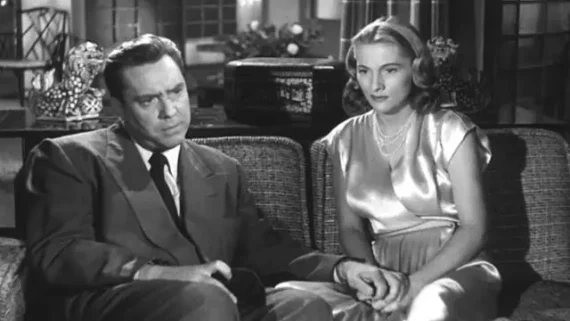
Gwenn’s role as Santa isn’t the only real life event to which The Bigamist winkingly alludes. By the time the film was made, former husband/wife team and Filmakers founders Lupino and Collier Young were divorced and Young, who wrote the screenplay, was married to Joan Fontaine, who stars opposite Lupino as the first of Harry’s wives. Lupino’s affair with actor Howard Duff had resulted in an extra-marital pregnancy, which is a plot point also included for Lupino’s character in The Bigamist. Whether there was any bad blood between these creative collaborators is unclear but Young’s forgiving screenplay, which ends with Lupino and Fontaine exchanging understanding glances across a courtroom, seems to suggest a sophisticated lack of blame. This is the tone of The Bigamist, which resolutely refuses to tip over into melodrama and, as such, feels wholly and invigorating unique for a film of its kind.
As well as Young’s strong screenplay and Lupino’s fantastic direction (a match made in heaven, even if their respective creatives weren’t), The Bigamist benefits greatly from considered casting. While the mean-spirited may scoff at the idea that Edmond O’Brien could enchant either Joan Fontaine or Ida Lupino, let alone both, the film recognises that attraction goes beyond the superficial. O’Brien’s likability is crucial to the film’s success and he does a great job of portraying two different types of chemistry with his leading ladies. Fontaine’s business-minded Eve offers the comfort of long-term love but stifled by the demands of everyday life, while Lupino’s Phyllis offers the excitement of new love and the ego-boost of undivided attention. Numerous factors lead to Harry’s uncharacteristic infidelity, including Eve’s infertility and the loneliness of being on the road all the time, but ultimately it is Harry’s emotional needs that push him to seek more love than he can ultimately handle. At the time of writing, male loneliness is frequently being used by toxic individuals in order to blame their isolation on women, rather than acknowledge they own unpleasantness as the major cause of that isolation. The Bigamist doesn’t go down either of those paths. The women are rightly portrayed as innocents in Harry’s deception, while Harry has every intention of doing the right thing but is frequently prevented from following through by unfortunate circumstances and his own inability to accept control of the situation. Fontaine plays her role perfectly, refusing to portray Eve as cold or clinical and displaying a convincing and deep affection for her husband. Lupino, meanwhile, is absolutely superb as the witty, vulnerable Phyllis. This was the only time Lupino directed herself and she brings the character to life to the extent that her sheer magnetism almost becomes a factor in the audience’s forgiveness of Harry. The early scenes of their friendship blossoming into a romance are so delightful that I ended up longing for them to be part of a romantic comedy in which I could uncomplicatedly root for them to get together.

It would’ve been so easy to make The Bigamist into an unremarkable melodrama filled with shrieked insults and slapped faces but the film instead largely avoids confrontation. It is interested in the mechanics of infidelity and how deception can become a self-defeating web spun from the tiniest of initiating events. The final courtroom scene is the one moment when The Bigamist becomes a self-consciously philosophical tract but as a conclusion to such a thoughtful film it works very well, giving the audience food for moral nourishment rather than attempting to end with an incongruous bang. This unassuming mood is part of the reason why so many viewers are underwhelmed by The Bigamist and why a small handful are utterly beguiled by it. I am amongst those resting upon the latter palm! Though not as instantly and obviously gripping as The Hitch-Hiker, I think The Bigamist satisfies to a greater and more lasting extent. It remains a cult film that ought to be reassessed as a classic.