



 Director: Claude Faraldo
Screenplay: Claude Faraldo
Starring: Michel Piccoli, Beatrice Romand, Francesca R. Coluzzi, Marilu Tolo, Jeanne Herviale, Patrick Dewaere, Coluche, Miou-Miou
Year: 1973
Country: France
BBFC Certificate: 15
Running Time: 109 min
For a brief period in the mid-to-late 1980s, the embryonic British TV station Channel 4 showed daring foreign-language, censor-baiting, arthouse films late at night, with a red triangle and the words “special discretion required” preceding the broadcast as a warning about the content.
The series, which only ran from 1986-87, featured showings of two films by Japanese director Shuji Terayama (1974’s Pastoral Hide and Seek and 1971’s Throw Away Your Books, Rally in the Streets), as well as 1982’s Identification of a Woman by Italian director Michelangelo Antonioni, and 1980’s Out of the Blue, directed by Dennis Hopper.
The use of the red triangle, which also appeared in the top left corner of the screen during the broadcasts and the films that were shown, sparked controversy, with some newspapers branding the movies to be shown as “video nasties”. Mary Whitehouse’s National Viewers’ and Listeners’ Association also campaigned against the broadcasts, lobbying parliament for them to be stopped.
Viewing figures fell as viewers realised they were arthouse films and not as salacious as they expected – there were certainly no video nasties here – but the broadcasts continued to be controversial, leading to Channel 4 to stop using the red triangle warning after only 10 films were shown.
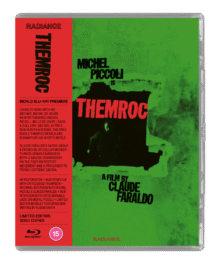
Yet these films were important, including the one that started it all; the first to be broadcast with the red triangle warning in September 1986 – Claude Faraldo’s Themroc, which is getting an excellent new Blu-Ray release from Radiance Films.
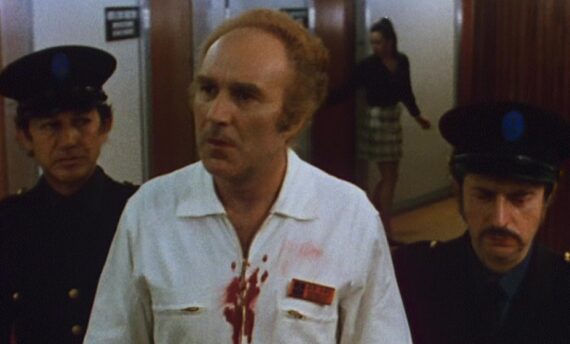
The low budget French satire follows the titular character, portrayed by Michel Piccoli, who is a bachelor house painter, a blue collar worker who lives at home with his mother and sister and leads a dull life. One day after a clash with his boss, the usually docile Themroc snaps and lashes out at modern society, essentially acting like a modern-day caveman, a neanderthal who rejects modern life and trashes his home.
The first thing to be said about Themroc is how it fit perfectly with Channel 4’s red triangle broadcasts, and was a great one to start with: it features the salacious content the red triangle inferred, in this case incest and nudity, and is most definitely an arthouse film.
It features no intelligible dialogue and is shot and edited in an avant-garde style. The film explodes onto the screen with angry growls, howls and grunts and other loud noises as the colourful opening credits play, before we follow Themroc’s life. He makes breakfast, washes up, and then eats, staring into the distance and exchanging glares with his mother before leering over and smelling his naked sister whilst she sleeps and his mother coughs away in another room. The film has only just begun and we’ve had an assault of sounds and a lead character who is already acting like a neanderthal.
We then see Themroc’s commute to work, (a wonderful sequence shot on the subway and streets of Paris), him getting changed with his colleagues, and painting a house, before that aforementioned brush with his boss which then leads to him travelling home, destroying his apartment and throwing out his belongings. He grows increasingly caveman-like in his demeanour and actions as the film progresses. We also see flashbacks, which seem to be telling us what Themroc is thinking.
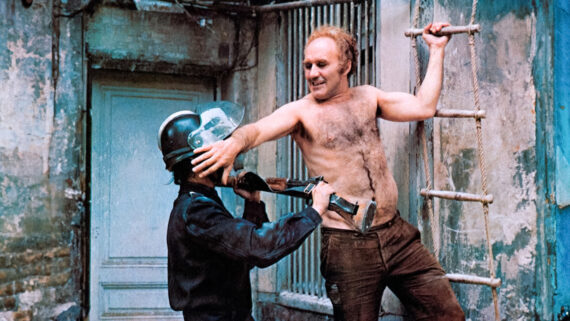
His destruction of his apartment is a sight to see; we watch as neighbours look on, presumably not really knowing how to react on one hand, and looking on in awe on the other. Themroc really goes for it, smashing everything, throwing things way and turning his home inside out. A film crew, police and the military later turn up but the destruction continues, with neighbours following Themroc’s lead as the film unfolds, and we are effectively watching the breakdown of modern society.
The film is shot in a very observational, almost documentary, style, throughout and well edited; there is an astonishing montage and the use of flashbacks are fantastic. We observe Themroc and his family, as well as other characters who live around him, his neighbours and the residents of the city where he lives and works, which visual clues tell us is Paris. We also hear them talking to each other, but we can only glean what they’re saying by the way they’re delivering their lines; angrily, for example; as the dialogue makes no sense. There’s also no music, just the unintelligible dialogue, grunts, and noises of the city.
It’s an astonishing way to film a movie and it works; whilst we may not always know exactly what’s going on, we’re never lost and we can see the motivations of characters and understand the main thrust of the story. It’s a challenging work for sure but one that’s not too difficult to watch.
Piccoli is outstanding in this wordless (well, aside from the unintelligible language and grunts) performance, which showcases his skills as a very physical actor. We’re with him for the whole film, aside from the occasional shot and brief scenes and he’s frequently moving and destroying. It’s a very different role to other characters he would portray in films like Luis Bunuel’s Belle de Jour, Alfred Hitchcock’s Topaz, and Jean-Luc Godard’s Contempt.
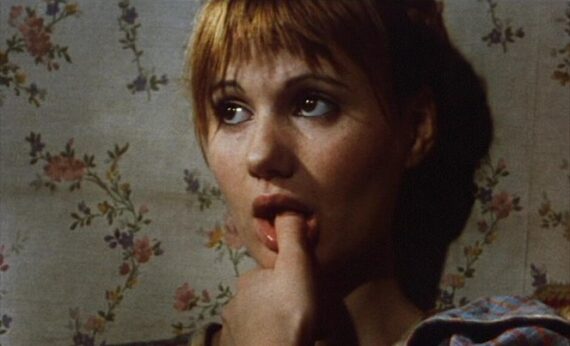
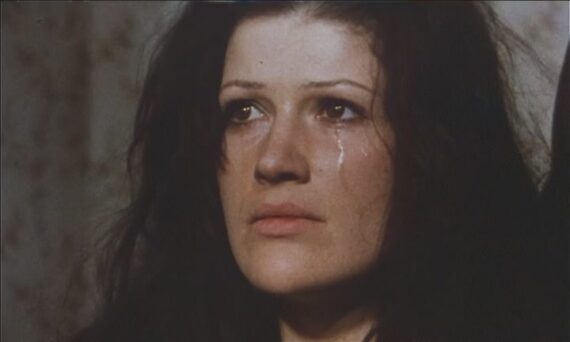
Beatrice Romand is also brilliant as Themroc’s sister; it’s a daring and very challenging role for her to play. Much of the rest of the cast came from a theatre company and all play their parts well. One thing of note about those who appear in the film is that in many of the general city scenes, people go about their day, presumably wondering what’s going on and why there’s a camera on them. Little did they know they’d be appearing in such a controversial film.
It’s hard to imagine what viewers tuning in late at night to watch Themroc on Channel 4 in the 1980s would have made of it all. Watching it now in 2025, it’s a very odd and strange watch, but incredibly compelling; a provocative piece of cinema, a satire that you can’t look away from, and which I found to be very captivating.
Film: 

Themroc is released on limited edition Blu-Ray by Radiance Films on 19th May 2025. The films is presented with a 4K restoration carried out by StudioCanal from the original negative and it’s a revelation. The film may have been shot on a low budget but it looks absolutely phenomenal; crystal clear, fine detail, natural colour schemes and tones. The audio is also great. The visuals and the audio are both such important features for a film that is such a visceral experience and barrage of sound at times, so it’s great to see it presented so well.
Limited edition Blu-Ray features:
4K restoration from the original negative by StudioCanal
Original uncompressed PCM mono audio
Interview with critic David Thompson (2025)
Interview with actor Michel Piccoli and director Claude Faraldo (1973)
Interview with Manuela Lazic on Michel Piccoli (2025)
Gallery
Trailer
Optional English subtitles for the deaf and hard of hearing
Reversible sleeve featuring original and newly commissioned artwork by Sam Smith
Limited edition booklet featuring new writing by Alison Smith, author of French Cinema in the 1970s: The Echoes of May
Limited edition of 3000 copies, presented in full-height Scanavo packaging with removable OBI strip leaving packaging free of certificates and markings
The new interview with critic David Thompson runs for 23 minutes and provides a fascinating, detailed look at the film, its release, the controversies surrounding it and what makes it such a special movie. Thompson also looks at the career of Faraldo, and provides some insights into some of the actors in the film, and the controversy around one of its posters, which is all really interesting. An excellent piece.
The interview with actor Michel Piccoli and director Claude Faraldo from the time of the film’s release in 1973 starts with the often quite wonderful reactions of audience members following a screening of the movie. The interview with Piccoli and Faraldo follows, with the pair surrounded by an audience, and sees them on fine form talking about some of the scenes, the choice to use unintelligible dialogue and much more.
Manuela Lazic provides a great and new 23 minute look at actor Michel Piccoli, running through his family background, what led him into his career as an actor, his training, his looks, voice and gravitas, and some of his key roles. There are some brilliant insights in this piece and I gleaned plenty from it. It’s another strong extra.
The gallery contains seven posters, including the controversial one mentioned in Thompson’s piece on the disc; all of which are striking and visually arresting.
The trailer that is listed on the Radiance website was nowhere to be found on the advance copy disc provided to me for this review and I wasn’t provided with the booklet, unfortunately.
Radiance Films have compiled a small but perfectly formed selection of extras, totalling just over an hour, for an astonishing, avant-garde piece of provocative cinema. The 4K restoration is fabulous and fans of the film, or more challenging cinema, should be very pleased with this edition of an incredibly memorable 1970s French satire.
Disc/Package: