


 Director: King Hu
Screenplay: King Hu
Starring: Hsu Feng, Pai Ying, Roy Chiao, Sammo Hung, Yuen Biao, Han Ying-Chieh, Lee Man-Tai, Hao Li-Jen, Yuen Siu-Tien
Country: Taiwan, Hong Kong
Running Time: 106 min
Year: 1975
BBFC Certificate: 12
King Hu’s 1975 film, The Valiant Ones, was made after the commercial failure of A Touch of Zen but before that film found a new lease of life when it won the technical prize at Cannes in 1975. As such, he was searching for somewhat of a safer bet and The Valiant Ones was made as part of a deal with Golden Harvest, alongside The Fate of Lee Khan. The films would be made back-to-back in partnership with the company, sharing cast and crew members, but with Lee Khan produced under the banner of Golden Harvest and The Valiant Ones under Hu’s own, independent production company. Financial problems meant that the latter film wouldn’t get finished and released until two years after its predecessor though.
Following this, and due to changing tastes in the industry, Hu moved away from making wuxia films. His next two projects had swordplay elements but were much less action-orientated and he ended up abandoning the later The Swordsman part-way through production. As such, many consider The Valiant Ones the director’s last true wuxia film.
I’m a lover of the genre and the work of King Hu, so I was thrilled to hear Eureka would be releasing The Valiant Ones on Blu-ray as part of their Masters of Cinema series. I got hold of a copy and my thoughts follow.

The film tells the story of a conflict between Ming Dynasty warriors and pirates, who have been plundering China. The Jiajing Emperor puts his loyal official Zhu Wan (Tu Kuang-chi) in charge of dealing with the problem and he dispatches a skilled strategist named Yu Dayou (Roy Chiao), along with a small band of elite soldiers, to confront the growing pirate threat. These pirates, of mixed Chinese and Japanese descent, are disrupting trade and causing havoc in the region.
Yu, known for his cunning and tactical prowess, must devise a plan to defeat the pirates and bring an end to their reign of terror. He’s aided by a married couple of highly skilled swordfighters, Wu Ji-yuan (Pai Ying) and Wu Ro-shi (Hsu Feng).
I’d seen all the King Hu films that have been readily available in the UK and loved each and every one of them, but I hadn’t seen The Valiant Ones, so my expectations were high. Thankfully, I was not disappointed and it may, in fact, be my favourite so far.
In my eyes, The Valiant Ones perfectly balances the taut thrills of his early wuxia with the artistic beauty of his later films. There’s plenty of action throughout but this is all shot with a cinematic flourish lacking from a lot of martial arts and wuxia films from the era.
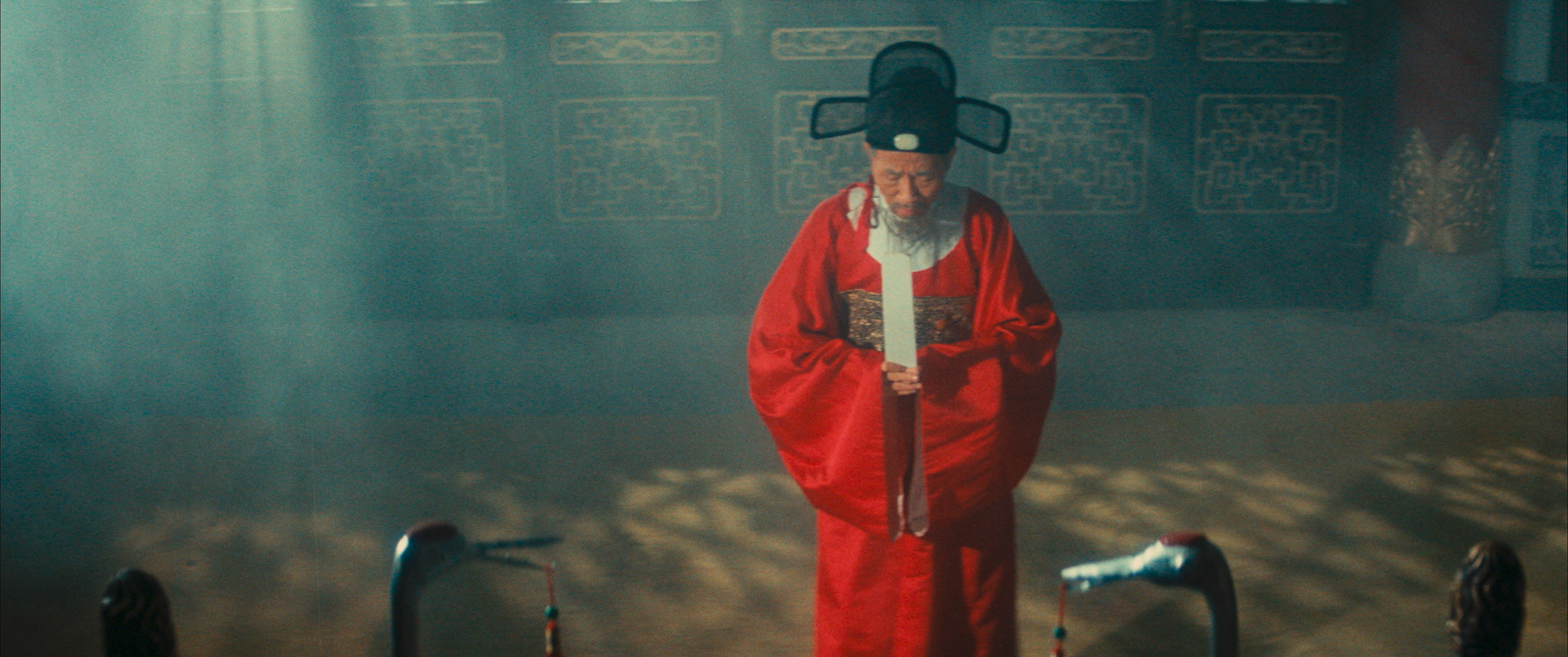
Not only do we get Hu’s typical use of gracefully moving cameras tracking characters’ movements and striking use of colour, light and smoke, we also get some wonderful directorial flourishes that set the scene and tell the story visually and sometimes poetically. My favourite example of this comes in a scene where a large group of pirates ascends on our band of expectant heroes. As the enemy closes in from all directions, Yu plots the battlefield out on his Weiqi board (often mistaken for a Go board). This fun device gives us a sense of the scale of the threat and silently shows how our heroes are plotting to get out of it.
It’s not all about the visuals though. Sound and music are beautifully used too. Most notably, the Zhou Fa (Ng Ming-choi) character plays the flute to transmit signals between members of the team (including in the aforementioned Weiqi board battle scene). This is a wonderful touch and the music played on the flute often effortlessly blends into the non-diegetic soundtrack.
As with the rest of Hu’s wuxia films, editing is also masterfully used, and he edited The Valiant Ones himself. Whereas most Hong Kong contemporaries would use long takes for their action sequences, Hu used sharp cuts to give a great sense of speed and skill. There are a few clever match cuts between scenes too.

The general pacing is also strong, with little time wasted in the first half of the film, having the audience thrown straight into the authorities’ battle against the pirates. Characters are efficiently developed through their actions rather than any dialogue and the story moves along nicely. The only time the film slows down a little is actually in the final act, when the action completely takes over. Whilst being fight-heavy like this might not sound slow, I found a couple of the clashes went on longer than necessary, particularly when the Wus are asked to demonstrate their skills to a lengthy queue of pirates. The clashes are excellent but there are one or two too many, in my humble opinion. Plus some of the fights following this included odd repetition of moves and shots that didn’t work for me.
Moving away from the visual style and action, I enjoyed the clever tricks and tactics employed by our band of heroes to catch the pirates. It’s a lot of fun seeing them work together in such a way, rather than just beating the crap out of one another.
Hu was very interested in Chinese history and went out of his way to ensure accuracy in the costumes and settings of his period films. Many of the characters here were based on real figures in history, in fact, made clear by intercutting the characters’ entrances with period drawings of the actual people being represented (though the identity of those in some of the drawings has been disputed by print expert Ellis Tinios).
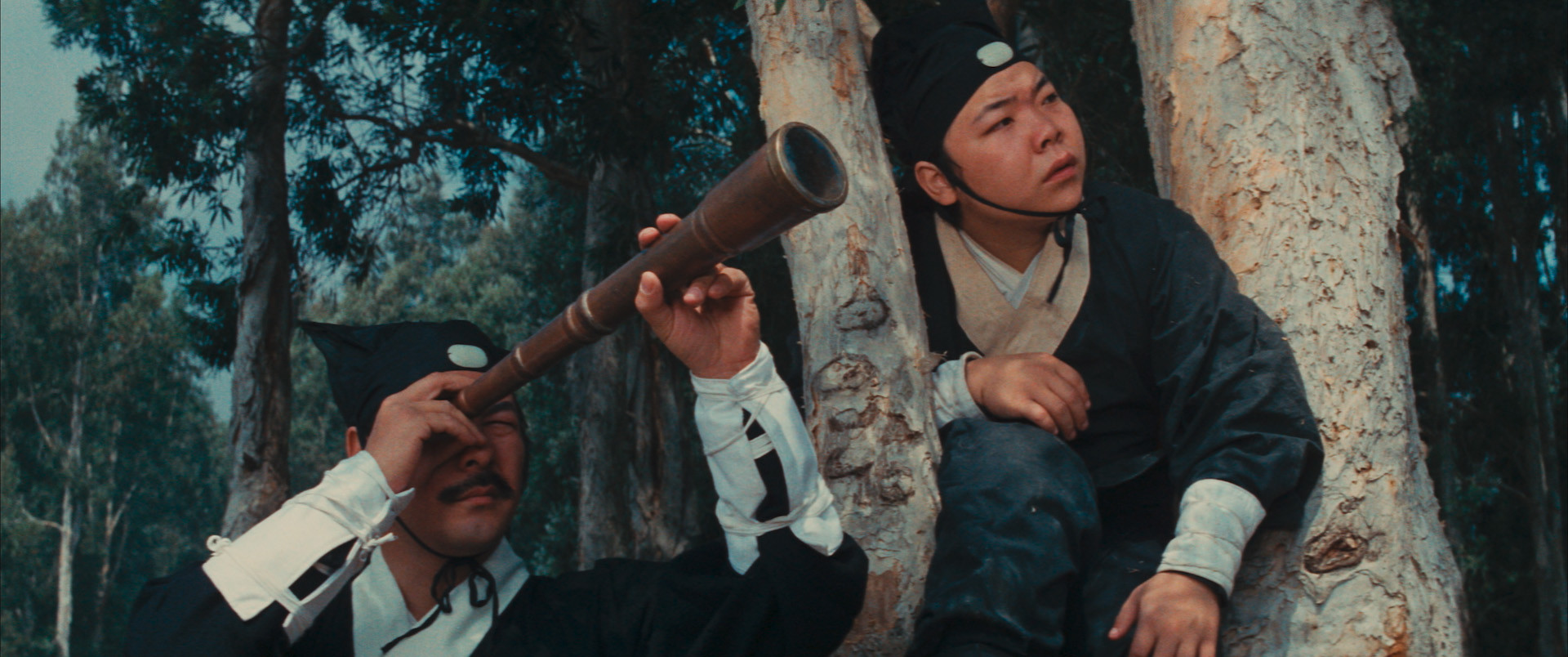
There’s some political commentary too, looking at different issues faced in the chain of command. The Emperor, for instance, is lazy and disinterested in dealing with the pirate problem himself. Some aspects, particularly the end, also make a thinly veiled metaphor for then-contemporary political issues in China.
All-in-all then, it’s another masterpiece from King Hu. His skills behind the camera have never been bettered and this is possibly his most enjoyable film.
Film: 

The Valiant Ones is out on 27th May on Blu-Ray and 4K UHD in the UK, released by Eureka as part of their Masters of Cinema series. It looks stunning, with rich colours, clear details and little to no damage. It sounds great for a film of its age too.
SPECIAL FEATURES
– Limited edition O-Card slipcase featuring new artwork by Grégory Sacré (Gokaiju) [2000 copies]
– 1080p HD presentation on Blu-ray or 4K (2160p) UHD Blu-ray presentation, presented in Dolby Vision HDR from a 4K digital restoration of the original negatives gifted by director King Hu to the Hong Kong Film Archive
– Uncompressed original Mandarin mono restored from the original soundtrack negative
– Optional English subtitles newly translated for this release
– Brand new audio commentary by Asian film expert Frank Djeng (NY Asian Film Festival)
– Tony Rayns on The Valiant Ones – Brand new interview with critic and Asian film expert Tony Rayns
– Tsar of all the Wuxia – a new video essay by David Cairns
– The Life of a Lucky Stuntman – Brand new interview with stuntman Billy Chan
– My Father and I – Brand new interview with actor Ng Ming-choi
– Archival 2003 interview with actress Hsu Feng by Frédéric Ambroisine
– Memories of Hu – Archival 2003 interview with Roger Garcia (Hong Kong International Film Festival Society) by Frédéric Ambroisine
– Archival 2016 interview with actor Ng Ming-choi by Frédéric Ambroisine
– A collector’s booklet featuring new writing on the film by Jonathan Clements
Frank Djeng provides a commentary on the disc. He’s certainly done his homework, as not only does he provide his usual whirlwind tour of the careers of the cast and crew, but he also delves into the history of the period being depicted. It’s a wonderful track, even by Djeng’s high standards.
Roger Garcia talks about Hu’s life and career in his archival interview. He knew the filmmaker best in his later years so largely discusses projects Hu had planned but never completed. As such, it’s an interesting piece that offers a tantalising look at what could have been.
David Cairns’ piece, ‘Tsar of all the Wuxia’, looks at Hu’s place as the master of the wuxia genre. As is the norm for Cairns, it’s thoughtfully written, offering a mixture of background information and analysis.

Long-time Hu champion Tony Rayns also provides a 24-minute interview about the film. He details its inception, background and qualities. There’s some similar ground covered here that’s covered elsewhere but Rayns has a knack for putting things clearly and adding particularly interesting details.
‘The Life of a Lucky Stuntman’ sees Billy Chan talk about his training at the Peking Opera School and how his career as a stuntman progressed from there. He worked with Sammo Hung for a long time and talks about working with him in his stunt team, as well as discussing what he learnt from Hu. He has some fun stories to tell.
There’s also an archival interview with longtime Hu collaborator Hsu Feng. She talks about her career, how she applied for a job in an electrical appliance factory at the same time as applying for a role in her first film, for Hu. She talks about working for the director as well as working in Taiwan, in comparison to Hong Kong. She goes on to talk about her move from acting to producing, a role in which she found great success.
Finally, we get two interviews with Ng Ming-Choi. One is archival, short and rough around the edges, shot whilst he was out eating his dinner. The second, more recent interview, is much longer (25 minutes) and sees the actor and stuntman talk about Hu, who he refers to as his dad. He has some interesting stories to tell, including financial difficulties faced during the production of The Valiant Ones. He also talks about how meticulous Hu was as a director and how much thought he put into the action scenes, whereas many other filmmakers would leave the choreographers to it. He talks about working with Sammo Hung too.
The essay in the booklet, by Jonathan Clements, really digs into the history represented on screen and the contemporary politics that influenced Hu’s take on the story. It’s a fascinating piece.
Overall then, it’s a fabulous package for a film I adored. As such, it gets an easy recommendation from me.
Disc/Package: