



Director: Yukisada Isao
Screenplay: Kudō Kankurō
Based On A Novel By: Kaneshiro Kazuki
Starring: Kubozuka Yōsuke, Shibasaki Ko, Otake Shinobu, Yamazaki Tsutomu
Year: 2001 Duration: 122 min Country: Japan BBFC Certification: 15
Sugihara, a Japanese-born Korean student struggles to find his identity – and love – in a Japan that sees him as an untrustworthy, second-class citizen.
The 2001 movie, adapted from an award-winning novel was the first co-production between Japan and South Korea and was Japan’s official submission for the 2002 Oscars. Clearly, its subject matter is important – and, for many Western audiences, I suspect, something of a revelation. Japanese-born Koreans – referred to as Zainichi, a term that implies that they are simply visitors, temporary residents – represent the second largest ethnic minority in the country. The racist attitudes they face and the practical problems of attaining passports is a rich and important theme that should yield as powerful and important a film as it did a novel. And yet…

Kubozuka Yōsuke as Sugihara, swaggers and poses through a life of rebellion and aggression. From the – very much of its time – kinetic, freeze-frame, fast-edit opening where he tries to outrun a subway train to several fist fights with his ex-boxer father (fights he never comes close to winning); from falling in love with a girl whose family’s view of Koreans will soon come to complicate matters to attacking his fellow players during a game of basketball, Sugihara is at great pains to look cool. His hair is a thing of wonder, deserving a share of the awards the film received on release in Japan. The problem, however, is that while we may understand why this young man fizzes and pops with violence, anger and posturing – indeed, few of his age don’t – it makes him extremely hard to sympathise with.
Wait, don’t worry, I’m not one of those terrible people who demands ‘likeable’ characters, talk of that sort of reductive storytelling is worse than chewing on tinfoil to anyone who earns a crust being creative. Our lead character can be as complicated as you like. He can certainly be – as here – a bully whose view of women should be the red flag that gives Sakurai pause for thought, rather than his heritage (he’s at pains to describe her as exciting to his friend because she wears skirts so short ‘you can see her panties’).

If, however, the film, the authorial voice if you will, seems to want the audience to celebrate those qualities, to find them as “cool” as Sugihara does – or as cool as Sakurai finds them, especially when watching him attack his teammates, a moment that gives her excited shivers, she tells us – then we stray into a more complicated area. The film may have a lot to say about racism but it has broader points about bigotry and misogyny to make too, and the filmmakers don’t come out of the argument so cleanly.
When Sugihara’s father beats him to a pulp for the final time, the thrilled onscreen audience, a taxi driver, will eventually locate the son’s popped-free, bloody tooth in the dirt. The audience at home seems told to celebrate too, and we’re left, a couple of scenes later, to believe that this father is a good sort really, determined to give his son freedom to be whoever he wants. As much as I’m growing to dislike Sugihara, I’m not sure I can entirely agree.
Film 

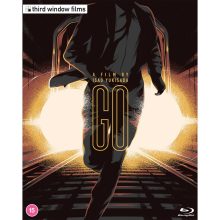
GO is out now from Third Window Films. For those who enjoy the film more than I, this blu-ray presentation certainly offers both a clean and rich presentation of the film with plenty of supplementary features, a making-of as well as footage of the premiere and press launch.
• Making Of GO (40 mins)
• Portrait of GO (16 mins)
• Premiere Stage Greetings (17 mins)
• Yosuke Kubozuka and Isao Yukisada press launch (11 mins)
• Original Trailers
• Slipcase with artwork from Thomas Walker
• Reversible Sleeve featuring original Japanese artwork
• Slipcase edition limited to 1000 copies
Disc/Presentation