



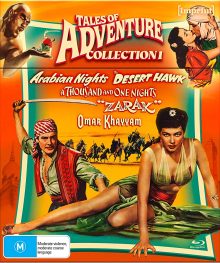
 I’ve always been a keen fan of Adventure films, with my preference being for Swashbucklers, but I’ve generally been more likely to seek out swordplay in Sherwood Forest, a medieval castle or a seafaring poop deck than amongst the Exotica of Hollywood’s Middle Eastern obsession of the 40s and 50s. Perhaps I was driven away by the discomfort of the unfortunately plentiful brownface or the parched desert settings, but a handful of classics aside (The Thief of Bagdad, the Harryhausen Sinbads), I tended to overlook this particular strand of the subgenre I loved so much. The release of Imprint’s excellent new boxset, Tales of Adventure: Collection 1, has set me straight on this point though. While a cursory glance at online reviews of the films included herein will reveal less than stellar reputations, those seeking a certain type of escapism will doubtless find this Technicolor trove to be a veritable Aladdin’s Cave.
ARABIAN NIGHTS
Director: John Rawlins
Screenplay: Michael Hogan, True Boardman
Producers: Walter Wanger
Starring: Maria Montez, Jon Hall, Sabu
Year: 1942
Country: USA
BBFC Certification: PG
Duration: 87 mins
By far the most famous film in this set, Arabian Nights was a massively popular upon its release in 1942, even receiving several Oscar nominations. Universal’s first film in three-strip Technicolor, it was producer Walter Wanger’s attempt to capitalise on the then-recent popularity of The Thief of Bagdad, from which it took one of its leads, Sabu. The other two leads, Maria Montez and Jon Hall, would go on to make many more films of this ilk together, sometimes as a trio with Sabu, and while they have largely fallen out of fashion, the Adventure-film-lover in me has always been interested in checking them out. Arabian Nights was a great place to start. A colourful, lavish production, it prominently eschews the supernatural elements of other films like its model, The Thief of Bagdad. The characters of both Aladdin and Sinbad appear in supporting roles, but they have apparently fallen on hard times. Aladdin is searching for his lost lamp (one of the film’s best, most visually inventive gags has him mistake a shadow for the genie), while Sinbad is eager to tell the tales of his fantastical adventures but keeps getting cut off in the attempt. By this film’s reckoning, they could easily just be a pair of attention-seeking cranks.
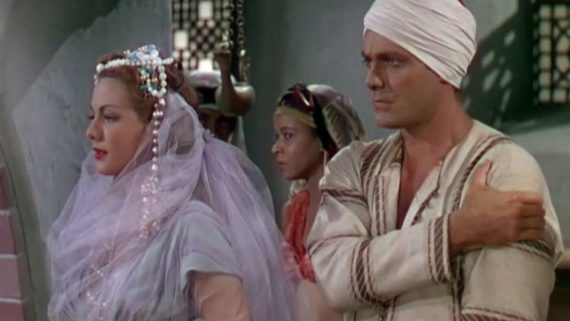
With tales of magic held in check and no carpets looking at all likely to take off, Arabian Nights opts instead for a full-blooded desert adventure, filled with romance, action and extremely goofy humour. The main comic relief comes from Billy Gilbert, a rotund comedian who uses his belly in battle, each time omitting a ludicrous, reverberating sound effect. Gilbert, though not well-remembered these days, was known for his over-the-top sneezing routines (he voiced Sneezy in Disney’s Snow White and the Seven Dwarfs) and one such gag is incorporated into Arabian Nights. It’s a moment that may seem ludicrous to modern audiences but, with the proper context, it shows a refreshing willingness to break the fourth wall in a genre that could sometimes lose its sense of humour amongst its stuffy opulence. Arabian Nights manages to keep its tone light but its stakes high, ensuring that the action and comedy work as well as each other. A somewhat unnecessary framing device in a Persian harem seeks to reinforce the link to the film’s literary source, although it is actually only loosely based on the concept and these scenes mean the film fizzles out in its closing bookend, rather than ending on the sort of triumphant flourish that would’ve better suited it. But it’s not enough to kill the general mood of good-natured bombast that prevails throughout.


THE DESERT HAWK
Director: Frederick De Cordova
Screenplay: Gerald Drayson Adams
Producers: Leonard Goldstein
Starring: Yvonne DeCarlo, Richard Greene, George Macready, Jackie Gleason, Rock Hudson
Year: 1950
Country: USA
BBFC Certification: U
Duration: 77 mins
Before he became famous to most audiences as Robin Hood, Richard Greene played a similar figure in The Desert Hawk, a lively little B-picture from Universal. There’s an immediate tension in The Desert Hawk between the sumptuous Technicolor in which it is presented and the low budget artificiality of its sets, which have a tendency to suck the atmosphere out of the outdoor scenes especially. You’d think a film that relies to some degree on the vast mystique of the Arabian desert would be dealt a death blow by being shot in a glorified sandpit and I admit I braced myself for the worst immediately. But to my surprise and delight, The Desert Hawk managed to overcome its obvious financial limitations and emerged as an extremely effective little Swashbuckler. The fanciful story has a fairy tale flavour which is not to its detriment, with the swapping of clothes to disguise identities being a pivotal and agreeably whimsical theme, while the sword fights are brisk and chaotic but also plentiful, culminating in a suitably lively finale.
Modern viewers not put off by the artifice of The Desert Hawk may find themselves struggling a little with its gender politics. At first glance, the tale of a thief, the nominal hero, who lies about his identity in order to marry a princess might seem irredeemable. But there are political motivations to his actions, and even if the character betrays an era-accurate attitude to women in a later scene, he is deliberately matched with Yvonne De Carlo’s feisty princess who gives as good as she gets at every turn. Without this balanced power dynamic, scenes such as the Desert Hawk’s humiliation of the Princess at a slave auction could’ve come across as mean-spirited misogyny. But the fact that she regularly outwits him, and even has her romantic finale by way of a cruel deception, almost gives The Desert Hawk a primitive Screwball edge. When the hero can only take the heroine in his arms once she unlocks them from chains, it’s clear with whom the film has chosen to place the power.
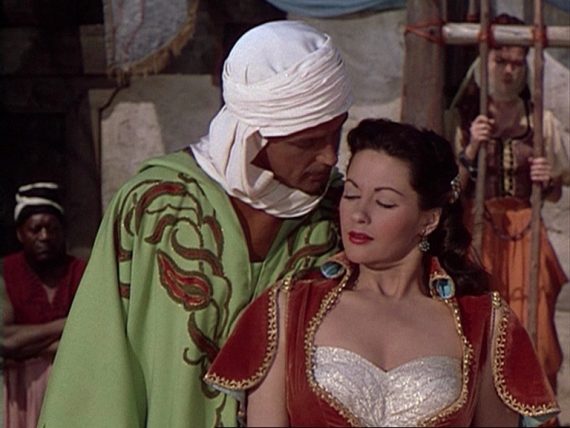
Though some of the acting is a tad stiff, it doesn’t take long to get into The Desert Hawk’s rhythms, and De Carlo especially stands out as an able performer. Jackie Gleason and Joe Besser provide some effective comedic support as two characters once again called Aladdin and Sinbad (though apparently no relation to their more famous namesakes). Gerald Drayson Adams’ screenplay is a fun trifle with a few delectable cherries to be found amongst the whipped cream, and director Frederick De Cordova provides a couple of nice flourishes, notably a great scene in which, as a character prepares to relate some details of which the audience is already aware, the camera follows a passing harem girl who provides an interval of erotic dance for the camera while the characters in the background silently work through their exposition.
The Desert Hawk may not be the sort of film you’d recommend to most people but those with a thirst for these old Adventure films will probably be pleasantly surprised, as I was. With plenty of swashbuckling action, a good story and an appropriately slender runtime, it’s a small gem to which I’ll gladly return again in future.

ZARAK
Director: Terence Young
Screenplay: Richard Maibaum
Based on the novel by: A.J. Bevan
Producers: Irving Allen, Albert R. Broccoli
Starring: Victor Mature, Michael Wilding, Anita Ekberg, Bonar Colleano, Finlay Currie, Patrick McGoohan
Year: 1956
Country: UK/USA
BBFC Certification: 12
Duration: 96 mins
I tend to like a splash of humour to my Adventure films so when I signed up to review this boxset I had slight concerns that it might be filled with the more po-faced brand of Exotica that tends to leave me more bored than thrilled. While I was delighted to find that this was not the case in most cases, even the one example of the more serious-minded Adventure film here is a rather good one. Zarak, the story of a banished chief’s son who becomes an infamous bandit, is the work of the main creative team behind the early Bond films: director Terence Young, screenwriter Richard Maibaum and producer Albert “Cubby” Broccoli. As I’ve never been a Bond fan, this was initially another cause for concern but Zarak turned out to be a gripping, impressively mounted Action Adventure, filled with well-staged battles, fights, chases and song and dance numbers. What it lacks in the lighthearted charm of Arabian Nights, it makes up for with a consistent tone and forward drive, punctuated by set pieces that always manage to arrive every time the film threatens to hit a lull.
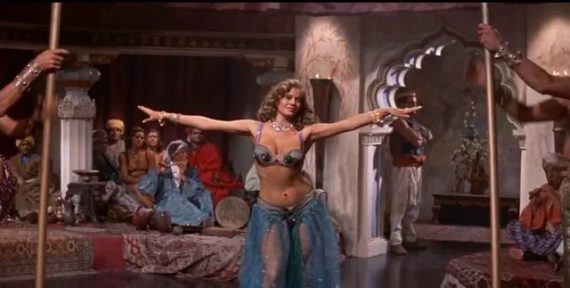
Zarak was a British/American production and the difference in tone from the purely Hollywood productions surrounding it here is instantly noticeable. But Zarak hits its targets more often than not, managing to transcend a certain stiffness in the acting stakes by virtue of good pacing, beautiful locations and striking colour cinematography from John Wilcox and Ted Moore, the latter another key Bond collaborator. If the ongoing central battle between Zarak Khan and the British Major tasked with taking him down can get a little repetitive across an overlong 100 minutes, the film emerges as the sort of reliable afternoon entertainment you’d watch with your Dad on a bank holiday. It brings a pleasing sense of variety to this boxset.
A THOUSAND AND ONE NIGHTS
Director: Alfred E. Green
Screenplay: Wilfrid H. Pettitt, Richard English, Jack Henley
Producers: Samuel Bischoff
Starring: Cornel Wilde, Evelyn Keyes, Phil Silvers.
Year: 1945
Country: USA
BBFC Certification: U
Duration: 94 mins
Loosely based on the One Thousand and One Nights tales of Middle Eastern folklore, this tongue-in-cheek Comedy Adventure has quite a poor critical reputation but is actually a lot of fun and the sort of film that would be destined for cult status if only enough people saw it. A light-hearted reimagining of the Aladdin story (yep, he’s here again!), A Thousand and One Nights wonders how things would’ve played out had the genie of the lamp been a woman who took a fancy to Aladdin herself. Faced with the extra hurdle of a wish-granting would-be saboteur, not to mention an avaricious thief for a best friend, Aladdin must struggle to achieve his dream of marrying the princess.
There are issues with A Thousand and One Nights. It hasn’t quite worked out its tone, which is caught somewhere between a children’s film and a bawdy caper, with one character given the ability to talk in contemporary 40s slang and fourth wall breaking references. This grab bag of stylistic choices ends up being part of the its audaciously preposterous charm but the film’s major flaw is the casting of Phil Silvers as the wisecracking pickpocket Abdullah. In certain scenes, such as one where he attempts to help a guard win a card game from within the confines of his prison cell, you can see how well this casting might’ve worked, but Silvers just doesn’t seem invested in the material and his half-hearted line deliveries undermine the potential charm. Fortunately, we have the scene-stealing Evelyn Keyes as the sassy lovesick genie Babs. As soon as she turns up, the film steps up a gear, with her comic prowess instantly eclipsing Silvers’ meek support. The only problem with her presence, and maybe this is just my thing for funny women, but I feel like there can’t be a man in her audience who wouldn’t say to hell with with princess in the face of her romantic attentions!
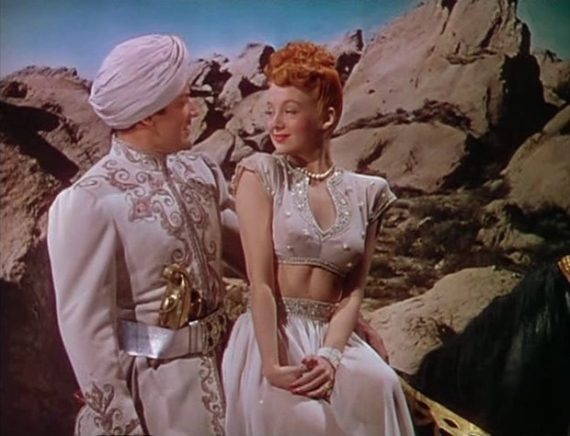
Aside from its engagingly all-over-the-place tone (the final beat, another anachronistic reference, is particularly bizarre), A Thousand and One Nights has other things to recommend it. Apart from a couple of flimsy courtyard scenes, the production values are actually very good, with the film bagging Oscar nominations for Art Direction and Special Effects. There’s a nice scene with a giant in which the dated visuals are part of the fun, a third act swordfight is delightfully scrappy and fast paced, and the comedy picks up pace in a later plot about retrieving the lost lamp from a succession of fleeting owners. There’s also unfortunately one of the worst musical numbers I’ve ever come across, although the eleventh hour edition of an out of the blue melodic interlude does help pad out A Thousand and One Nights’ immense cult potential.
I enjoyed the hell out of A Thousand and One Nights and even toyed with the idea of giving it a four star rating. Ultimately, after itemising its disparate ingredients, I’ve decided 3.5 might be more appropriate but fans of the Adventure genre like me will likely find a great evening’s entertainment here, especially if they have a sense of humour.
OMAR KHAYYAM
Director: William Dieterle
Screenplay: Barré Lyndon
Producers: Frank Freeman Jr.
Starring: Raymond Massey, Anthony Caruso, Cornel Wilde, Michael Rennie, Debra Paget
Year: 1957
Country: USA
BBFC Certification: U
Duration: 101 mins
After four hugely enjoyable films, it’s a shame that Tales of Adventure: Collection 1 comes a cropper with its fifth selection. Based very loosely on a real life Persian polymath, Omar Khayyam is an often beautiful but dramatically inert picture that only really justifies the Adventure label in its closing ten minutes or so. The rest of the story spends a long time aiming to depict its lead character’s moral excellence and affable intelligence, with Cornel Wilde proving to be a barely adequate leading man for such a supposedly charismatic figure. Co-star Michael Rennie, handsome and dignified as Omar’s best friend Hasani Sabah, has no trouble at all walking away with the film tucked under his arm.
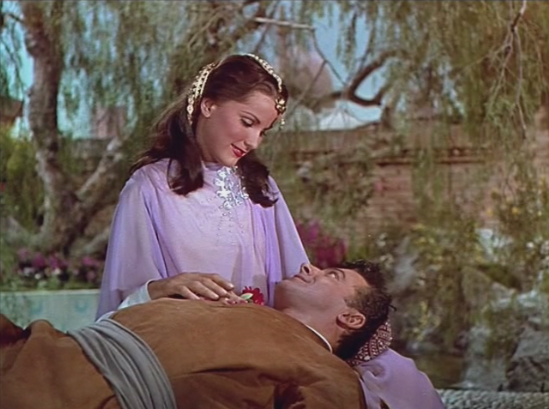
There’s a reasonably pleasing hanging out vibe to Omar Khayyam which is at first refreshing. Though a plot about assassins is gradually seeded in, the real pleasures of these early stages are in drinking in the colourful artifice of this version of Persia and listening to the poetic dialogue. But when the film tries to step up a gear it falters, seemingly unable to shift out of neutral and kangarooing towards an ill-fitting rush of a finale. Though there is little written about this film, I did find one quote from critic Dennis Schwartz which read “What I liked about it, is that it stunk but its smell wasn’t that bad.” This is an accurate assessment of how I felt about Omar Khayyam. It wasn’t a chore to be in its company but I was rarely close to being entertained, a far cry from how the other films in this boxset made me feel.
Tales of Adventure: Collection 1 is a wonderful boxset for those who have a yen for these kind of frothy thrills. While we’re not dealing with masterpieces here, it’s refreshing to have a collection of such undemanding, purely enjoyable films all in one place. I can’t wait for Collection 2!
Tales of Adventure: Collection 1 was released by Imprint Films on 10 May 2023. Four of the five films here are making their Blu-ray debuts and there are several commentaries and featurettes to supplement them. My favourite extra though is a 25 minute discussion of the Arabian Nights phenomenon with Kim Newman, always a welcome presence and one of my dream dinner party guests. Special features in full are as follows:
ARABIAN NIGHTS
* 1080p High-definition presentation on Blu-ray from a 2K scan from the original negative
* NEW Audio commentary by film historians Michael Schlesinger and C. Courtney Joyner
* NEW Video essay on “Maria Montez” by film historian Phillipa Berry
* NEW Video featurette on composer Frank Skinner with film music historian Preston Jones
* NEW Interview with author & film historian Kim Newman on Maria Montez, Jon Hall and Sabu adventure films.
* Introduction by Turner Classic Movies Host Robert Osborne
* Trailer
* Original Aspect Ratio 1.33:1
* Audio English LPCM 2.0 Mono
* Optional English HOH subtitles
THE DESERT HAWK
* 1080p High-definition presentation on Blu-ray from a 2023 2K scan from the original negative
* NEW Audio commentary by film historians Phoeff Sutton and Mark Jordon Legan
* NEW Audio commentary by film historians Jonathan Rigby & Kevin Lyons
* NEW Video featurette “Jeff Chandler at Universal” with film historian/author C. Courtney Joyner, film historian Michael Schlesinger, and more
* Original Aspect Ratio 1.33:1
* English LPCM 2.0 Mono
* Optional English subtitles
ZARAK
* 1080p High-definition presentation on Blu-ray from a 2K scan from the original negative
* Original Aspect Ratio 2.35:1
* Audio English LPCM 2.0 Mono
* Optional English HOH subtitles
A THOUSAND AND ONE NIGHTS
* 1080p High-definition presentation on Blu-ray from a 2K scan from the original negative
* Original Aspect Ratio 1.37:1
* Audio English LPCM 2.0 Mono
* Optional English HOH subtitles
OMAR KHAYYAM
* 1080p High-definition presentation on Blu-ray from a new 2022 6K scan from the original negative
* NEW Audio commentary by film historian Phillipa Berry
* NEW Interview with film historian Sheldon Hall
* Original Aspect Ratio 1.85:1
* Audio English LPCM 2.0 Mono
* Optional English HOH subtitles