


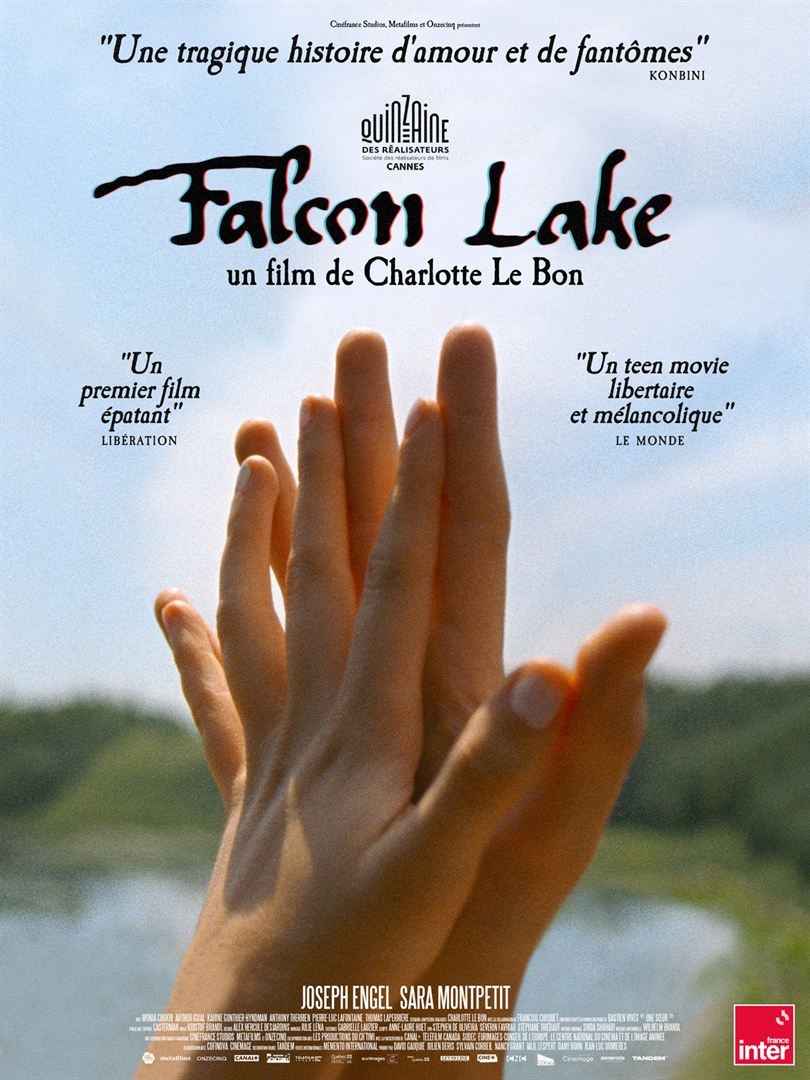
 Director: Charlotte Le Bon
Screenplay: Charlotte Le Bon
Starring: Joseph Engel and Sara Montpetit
Country: Canada / France
Running Time: 100 min
Year: 2022
BBFC Certification: N/A
Charlotte Le Bon’s directorial debut, Falcon Lake (2022), resembles quirky coming-of-age films such as Peter Weir’s Dead Poet’s Society or Richard Ayoade’s Submarine while adding hints of the best genre narratives conveying mystery, and suspense. From its finely delineated establishing shot of a body floating face down in the lake, there exists an ever-present sense of foreboding. This menace does not payoff in exactly the way one might suppose.
Fourteen-year-old Bastien (Joseph Engel) arrives at Falcon Lake in a remote area of Quebec late one summer evening. His parents have accepted the invitation of friends to stay at the cabin. Noting a lack of power when they first arrive, Bastien and his younger brother Titi are given a flashlight to find their way to their room through the dark and confining space. Here we find the perfect setup for a jump-scare; the unknown thing lurking close enough to reach out and grab them. Bastien and Titi take the lack of illumination in stride, but Bastien does see an odd shape that might be human or spectral near him in the benighted room, but it just as quickly disappears.
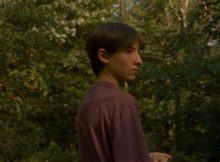
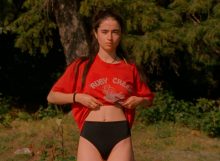
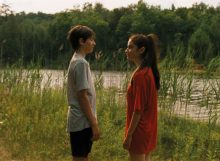
The next day they are introduced to Chloé (Sara Montpetit), the room’s occupant. This dark-haired girl of 16 with whom they will share the space, is initially uninterested in socializing until forced to do so. Although she sports posters of Psycho and the original Nosferatu on her wall and is a self-professed lover of “weird” things, she’s not the stereotypically angst-ridden teen. Like most young people, her biggest fear is that she will never fit in.
We see mom and dad interacting with their friends, yet these incidents occur in the background while the children are largely left to their own devices. Chloé’s mother foists the two boys on her, but she and Bastien begin spending more and more time together as Titi watches anime or, one presumes, stays in with his folks.
Cinematographically, Falcon Lake utilizes subtle framing, slow pans, and an aspect ratio akin to fullscreen due to being shot in 16mm, thus allowing viewers to feel as if we’re transported into a magnificently done home movie. About a third of the story takes place during late evenings with particularly stunning night scenes. The eerie quality set by such camerawork elicits the sort of tone one experiences in any number of movies where a family or group of young people decide to vacation near a wooded lake where they are soon to be hacked into mincemeat by an axe or chainsaw wielding maniac. Le Bon’s intentions lead her production in another direction, but the inclusion of such elements proves a smart choice because, even with its rather sleepy pace, the audience cannot help feeling compelled to follow along with the drama.
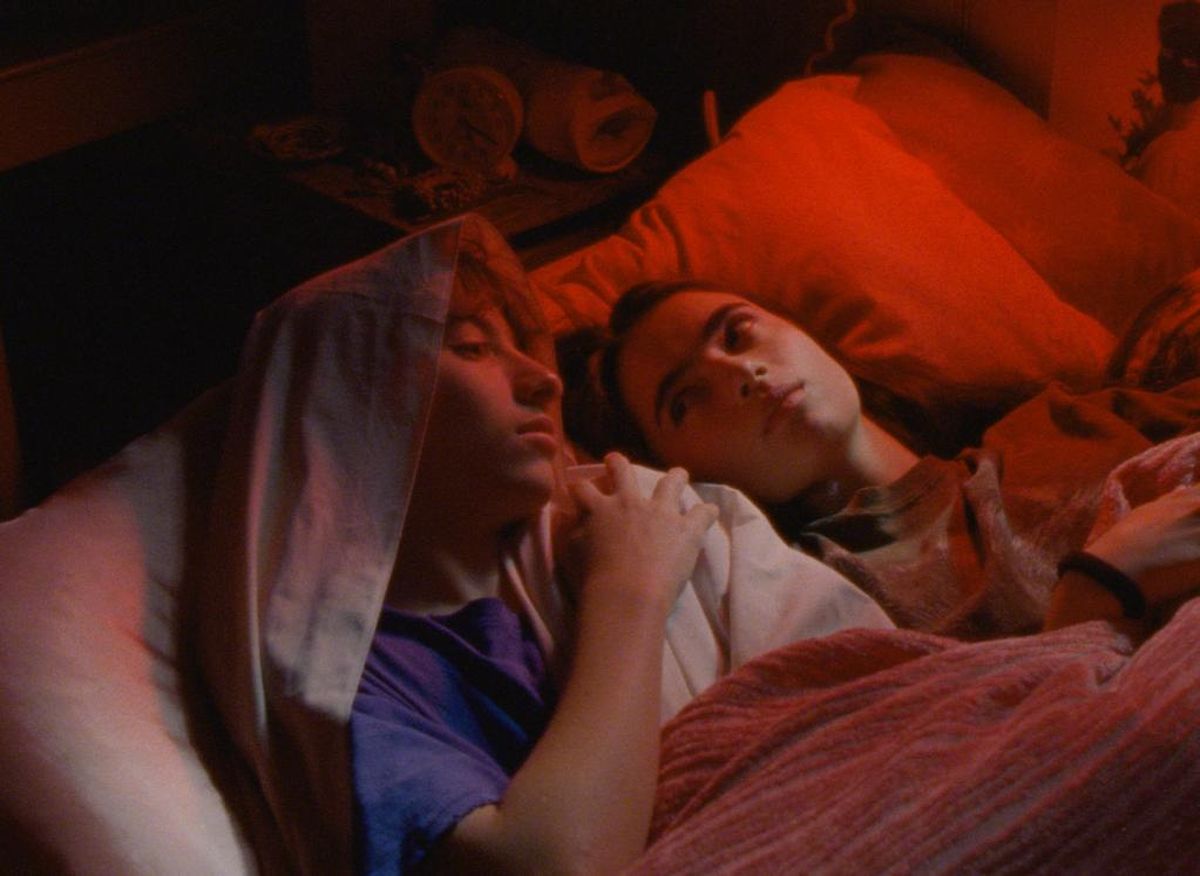
The budding sexual tension between our protagonists burns as slowly as the rest of the picture with Chloé’s flirtations with older boys leaving Bastien feeling in the way and neglected. His desire for Chloe appears obvious in his quick, yet smoldering glances. For her own part, Chloé begins to feel something for Bastien who, unlike the slightly older guys with their overt sexual advances, seems reserved and sweet in his attentions and sincerity.
Chloé’s fascination with an urban legend concerning a young person who drowned in the lake and whose ghost haunts it leads her to take a series of photos with a sheeted Bastien in the role of “ghost.” Their discussions concerning this phantasm, and others, concludes with Chloé’s belief that we can return after death if we choose to do so, where Bastien acknowledges how it might not be a decision we are allowed to make.
Falcon Lake takes film goers in several directions, providing us with a bevy of red herrings—the sort of paranoiac plot devices associated with the worst horror movies: bigger kids ganging up on their weaker counterparts, sexual harassment (and worse), and the “I dare you” aspects that tend to congeal the brains of those watching into eyerolling disgust—none of which occur as we fear they might. Instead, we find pleasure in the director’s command of foreshadowing, allowing elements to play out in a manner that appears more natural rather than relying on worn out tropes.

Without spoiling the conclusion, audiences will note the influence of David Lowery’s 2017 masterpiece A Ghost Story. Charlotte Le Bon’s Falcon Lake borrows nothing from the former, however there remains a sensibility about both films that viewers cannot help but appreciate—Le Bon’s ability to provide us with a new perspective that is simultaneously fresh and contemporary, while touching upon older motifs without the burden of nostalgia.
Do note that Falcon Lake’s slow pace is not for everyone. Despite fine performances by Engel and Montpetit, the dialogue is rather trim in relation to its 100 minute run time. The poignancy of what the characters experience becomes muted by the director’s requirement to immerse ourselves in the movie’s atmosphere.
But for those who appreciate such a style, Falcon Lake will not disappoint. And whether one considers it a drama with the oblique possibility of the supernatural, or a ghost story focused more on the banality of day-to-day existence doesn’t seem to be the point. Charlotte Le Bon gives us the freedom to make up our own minds, to take away from her debut the kind of experience we want it to be. Like it, or don’t, such motion pictures are rare, and their creators should be lauded for allowing their audiences such autonomy.
Falcon Lake is being released on digital platforms by Signature Entertainment.