


 Director: William Wyler
Screenplay by: Ruth Goetz, Augustus Goetz
Based on a Novel by: Theodore Dreiser
Starring: Laurence Olivier, Jennifer Jones, Miriam Hopkins, Eddie Albert, Basil Ruysdael, Ray Teal
Country: USA
Running Time: 121 min
Year: 1952
BBFC Certificate: PG
Theodore Dreiser is considered an influential figure in American literature, particularly within the naturalist school. However, his career as an author got off to quite an inauspicious start. After beginning as a newspaper reporter and drama critic, he was encouraged to write his first novel, ‘Sister Carrie’, at the end of the 19th century and into the 20th. After struggling to find a publisher, it was eventually picked up by Doubleday & McClure Company, but they had a change of heart after the wife of one of the publishers told her husband she thought it was too sordid. With a contract already signed, however, the book was released but only in 1000 copies and with little to no marketing to back it up.
‘Sister Carrie’ then, made little impact on its initial release. However, over time, whilst Dreiser began to gain a better reputation following the release of his later work, most notably his first financial success, ‘An American Tragedy’ (1925), ‘Sister Carrie’ was rediscovered. It grew to be somewhat of a classic, though the manuscript was edited by others heavily over the years after its first draft and was further cut when it was published in different territories, partly for length and prose quality but also for censorship reasons.

Once the novel gained popularity, it didn’t take long for Hollywood to become interested. However, the film adaptation, which would eventually be retitled Carrie, was also beset by problems, before, during and after production. The property was bounced around different studios to begin with, whilst they struggled to get their treatments past the Hays code. It took three decades to make it to the screen in fact, from the time producers were interested in the novel.
William Wyler directed the film and it was eventually released in 1952, after having languished on the shelf for a year because executives weren’t sure how to successfully market it. The many changes made to the source material (largely due to the code) led to most critics looking down on the adaptation and it didn’t perform well at the box office either. Wyler himself has professed his disappointment in the film.
Obviously believing Carrie deserves a second look though, Imprint are releasing the film with a handful of extras to put it in context and help better appreciate it. Intrigued, I got hold of a copy and my thoughts follow.

Carrie stars Jennifer Jones as the titular character, a country girl who moves to Chicago in search of a better life. She soon, however, falls afoul of the amorous advances of a smooth-talking salesman, Charles Drouet (Eddie Albert). He helps her out in hard times and uses this as leverage to make her his ‘kept woman’.
Carrie eventually realises Drouet has no wish to marry her, despite her wishes, and, in the meantime, falls for one of Drouet’s acquaintances, George Hurstwood (Laurence Olivier).
George seems to be a more gallant gentleman and is head over heels for Carrie, so the pair begin their own romance. However, when Carrie learns George is married and George’s wife Julie (Miriam Hopkins) also discovers the truth, the pair’s worlds come crashing down. Julie has the power to cut off her husband and does so. Though Carrie and George try to fight on, believing love will prevail, things only get worse.
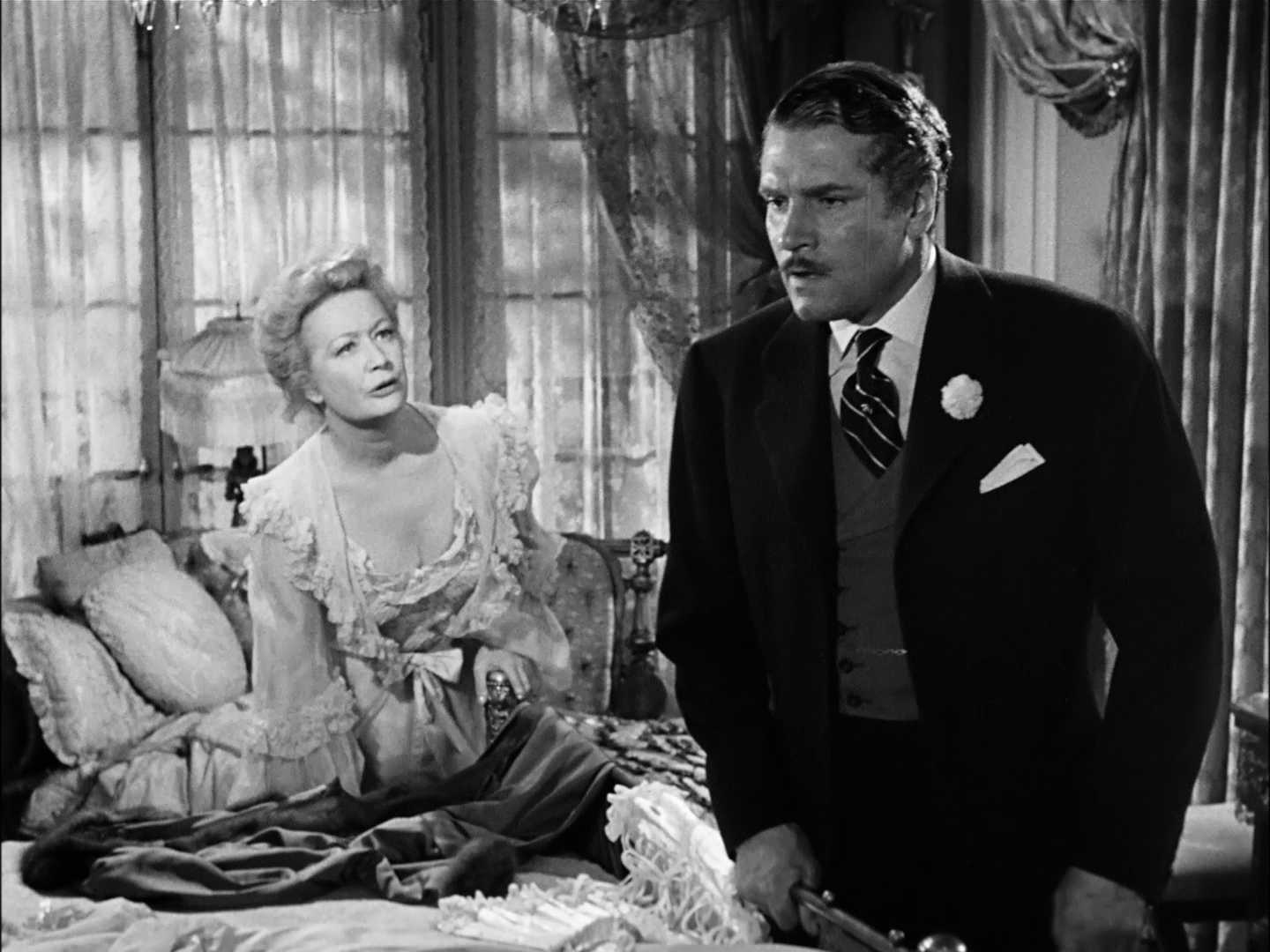
As mentioned, one of the chief complaints about the film on its release was how much had been changed from the novel. I haven’t read it I’m afraid, but from what I can gather from the extras on this disc, the biggest difference is the fact that Carrie is a much more virtuous character on screen. The production code likely had a lot to do with this. It makes the character easier to warm to though, which could be seen as an improvement, depending on your taste and point of view. I was certainly caught up in the story and found the way Carrie was manipulated and strung along by her suitors to be a powerful aspect that says a lot about the problems women faced back then (and can often still face now). The George character remains flawed too, which makes for compelling viewing.
Wyler also gets to show why he’s considered such a master craftsman. Great use is made of depth, space and movement to tell the story in a cinematic fashion rather than relying on a series of close-ups as would be the norm for such a character-based melodrama.
The performances are very strong too. Movie mogul David O. Selznick was married to Jones at the time and got her ‘loaned’ to Paramount for the film (gaining him a special ‘by arrangement’ credit in the opening titles). He was a controlling man and kept a close eye on his wife and the film though, causing much frustration to Wyler and Olivier (who didn’t like Selznick, after the way his then-wife Vivien Leigh had been treated by him previously).

In his commentary on the film, Jason A. Ney calls Jones’ performance “middling” and he offers some similarly lukewarm or unkind quotes from contemporary reviews and those involved in the film but, personally, I didn’t think she did such a bad job. Her delivery has an ‘of its time’ quality but I think she does well with conveying her character’s feelings through her face and body language.
Olivier is unquestionably brilliant though. Keeping things relatively low-key, he does a great deal through expression and physicality. He’s often thought of as one of the greatest actors of his generation and, in this performance, it’s easy to see why. He and Jones have chemistry on-screen too, which is quite a feat given that Olivier reportedly hated his female co-star (most likely due to her connection with Selznick, as much as anything else).
Olivier and Jones are also backed up by some memorable supporting players, such as Hopkins, Albert and Ray Teal, the latter of whom has a scene-stealing turn as a slimy bond company officer sent to get stolen money from George.
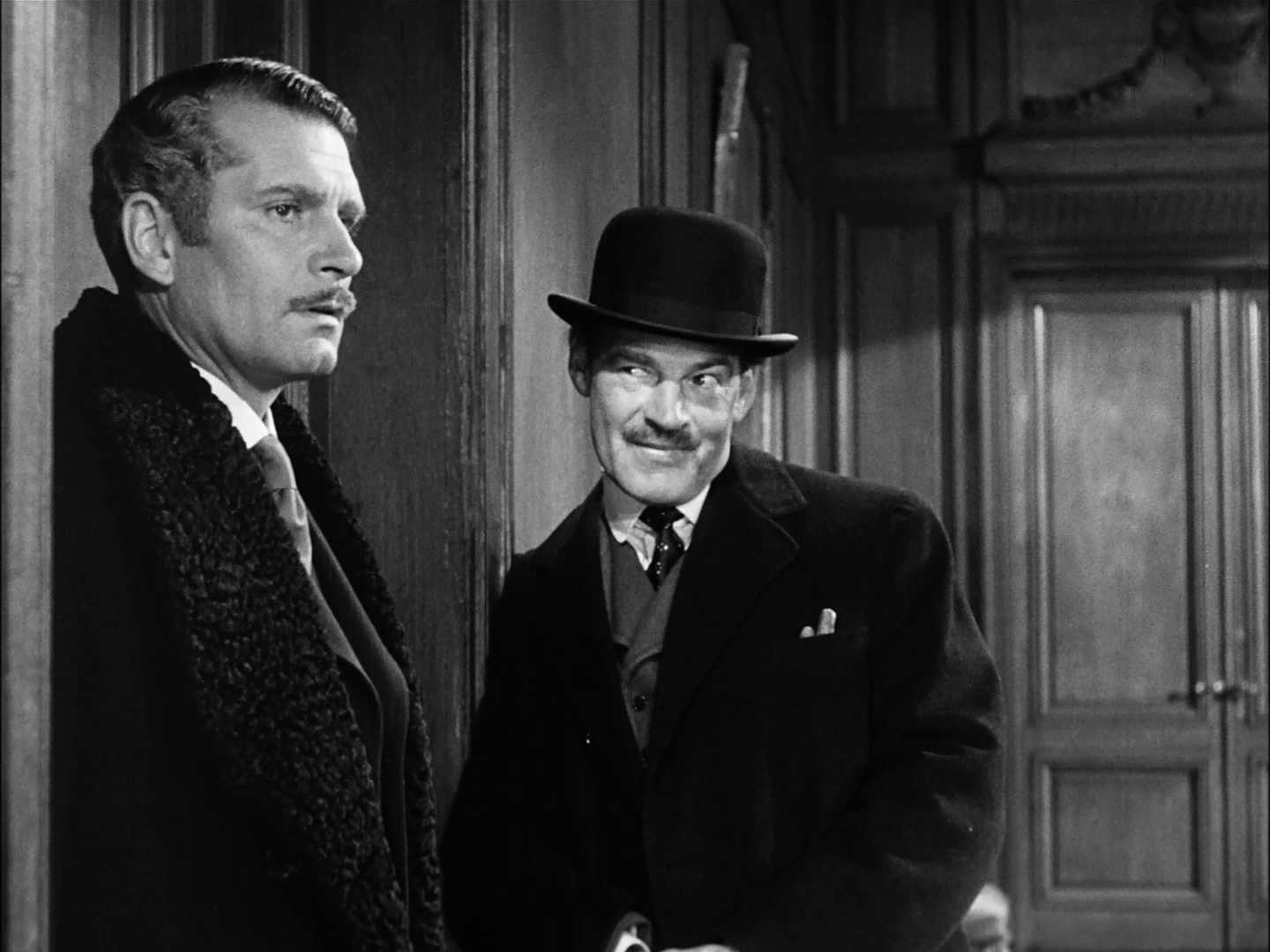
I preferred the first half of the film to the second, as it favours subtlety and commentary on the treatment of women over any contrived melodrama. However, the later, ‘bigger’ moments still prove to be quite effective and it all ends on a beautiful final shot that doesn’t over-bake the potential drama of the situation. The original novel had a much bleaker conclusion but Wyler’s take has a deep poignancy whilst offering a slightly more ambiguous final note.
Overall then, Carrie is a beautifully handled melodrama, even if it may have been compromised in comparison to its source material. It begins stronger than it ends perhaps but remains a fine picture. Directed and performed with great class, it’s well worthy of rediscovery.
Film: 

Carrie is out now on Blu-Ray in Australia, released by Via Vision as part of their Imprint Collection. The picture quality is reasonable but not exceptional. There’s some light damage throughout and details aren’t as rich as on some other restorations I’ve seen of films of the era, with the blacks a touch crushed and the image slightly soft. I’ve used screen grabs throughout this review to give you an idea of how it looks.

Special Features and Technical Specs:
– 1080p High-definition presentation on Blu-ray
– NEW Audio commentary by professor/film scholar Jason A. Ney
– NEW Neil Sinyard on Carrie – interview with the author of A Wonderful Heart: The Films of William Wyler
– Theatrical Trailer
– Aspect Ratio 1.33:1
– Audio English LPCM 2.0 Mono
– Optional English subtitles
– Limited Edition slipcase on the first 1500 copies with unique artwork
Jason A. Ney’s commentary is fantastic, one of the best I’ve heard in a while. Over the course of the runtime, he describes the film’s tumultuous history, as well as looks at the differences between the film and the novel it was based on. He offers a little analysis here and there too. It makes for an engrossing listen.
Neil Sinyard opens his interview by saying he thinks Carrie is one of the finest films of Wyler’s career, despite the director having thought it was somewhat of a failure. Sinyard’s half-hour piece provides a condensed version of the story Ney tells in his commentary. It’s not a total retread though. Sinyard has some different information to impart and has his own opinions on the film. He has some more complimentary notes on Jones, for instance.
So, whilst you only get a pair of extras to sit alongside the film, they’re both excellent, providing a fascinating and dramatic tale in themselves. With the film, in my opinion, being an underrated gem, this is an easy recommendation.
Disc/Package: