


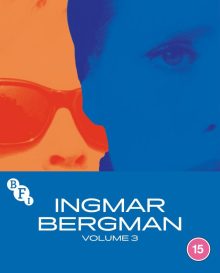
 In my previous review of the BFI’s second volume of Bergman films, I began by pooh-poohing the widely held notion of Bergman as a humourless misberalist, going on to illustrate that point by highlighting the humour in The Seventh Seal, the warmth in Wild Strawberries, the hope in Summer Interlude. But this third volume, focusing on Bergman’s 60s work, is less easy to defend against such accusations. Although there are two comedies present amongst the contents of this new volume, they punctuate a particularly bleak set of films which take a greater engagement for those hoping to unearth the glimmers of positivity within. I’m not about to throw my weight behind the notion of Bergman as a one-note depressive but the existentialist crises, the explorations of mental illness, the tales of physical, emotional and sexual violence, that can be found here are likely to scare away many hopeful newcomers. I’d strongly advise using Volume 2 as a gateway to Bergman, but having explored those more readily palatable works I’d definitely strongly suggest returning to Volume 3 afterwards. There is much to recommend here, including two definitive masterpieces, and the properly prepared viewer will likely have their thirst for further Bergman sufficiently piqued.
THE VIRGIN SPRING
Director: Ingmar Bergman
Screenplay: Ulla Isaksson
Producers: Allan Ekelund
Starring: Max von Sydow, Birgitta Valberg, Gunnel Lindblom, Bitgitta Pettersson
Year: 1960
Country: Sweden
BBFC Certification: 15
Duration: 89 mins
Bergman’s first film of the 60s is immediately indicative of a shift into the darker territory that would characterise most of his work during this decade. There is none of the humour that leavened The Seventh Seal or Wild Strawberries in The Virgin Spring, neither is there room for any. As a longtime Bergman fan, I’m not averse to his grimmer leanings but, having seen The Virgin Spring before, I did feel the need to fiddle with my viewing schedule in preparation. Bergman shot a comedy, The Devil’s Eye, immediately before making The Virgin Spring but it was actually released after it. While this boxset cannily preserves the order of production by placing The Devil’s Eye first in the running order, I decided to watch in order of release instead. This was entirely due to the fact that, knowing the themes of rape and murder that awaited me in The Virgin Spring, I thought it would be a necessary relief to follow it up with a comedy before plunging headlong into the subsequent Silence of God trilogy.

The Virgin Spring is based on the medieval ballad Töres döttrar i Wänge, with a screenplay by Ulla Isaksson who had previously collaborated with Bergman on Brink of Life. In keeping with the hallmarks of a traditional ballad, Isaksson’s script tells the story in bold strokes, depicting the rape of a wealthy Christian family’s only daughter and the revenge wrought upon the assailants by the girl’s father when they happen to seek lodging with him in the aftermath of their crime. Bubbling beneath these plot points are examinations of themes relating to guilt and religion, a driving force behind what could otherwise have been a pointlessly brutal and nihilistic affair (many felt this way about Wes Craven’s subsequent 70s Horror The Last House on the Left, which was inspired by Bergman’s film but dwelt more heavily on the violent ordeal of the girl). However, for me The Virgin Spring represents a rare occasion on which Bergman’s grappling with his themes seems uncertain rather than deliberately open-ended. Isaksson was reportedly most interested in her screenplay’s focus on the conflict between Christianity and Paganism, while Bergman was fixated on the effects of guilt. Perhaps this clash of intentions is what makes The Virgin Spring feel less thematically satisfying than other Bergman films. It works well as a straightforward interpretation of a folk tale, but who wants to watch scenes of rape and murder without a clear point behind the viewing experience? There are many interesting themes to be unpicked here but it feels as if Bergman still has them all tangled round his fingers. The director himself would ultimately call The Virgin Spring “a wretched imitation of Kurosawa”, although it lacks the humanism that characterises the best work of Kurosawa, and of Bergman himself.
Despite its comparative failure as a philosophical piece, The Virgin Spring remains a powerful and sometimes even beautiful film. The latter point is aided enormously by the crisp cinematography of Sven Nykvist, who replaced Bergman’s regular cinematographer Gunnar Fischer after their relationship broke down on The Devil’s Eye. Nykvist ultimately became a repeat Bergman collaborator and his work here shows why. He captures the natural beauty of the forests, valleys and streams against which the central atrocity is committed. This clash between the glory of nature and the ugliness of humanity is epitomised in a striking scene in which Max Von Sydow’s anguished Töre literally fights a tree. Bergman and Nykvist make this battle as compelling as if it were between two animate figures. The tree appears to fight back, with an almost tangible sadness and sense of defeat as it ultimately surrenders its branches. Contrast this with the rape scene itself, in which Birgitta Pettersson’s Karin lies helpless and motionless as her attackers violate her. Pettersson’s performance prior to these scenes is somewhat distracting, as she appears to have been directed to maximise her character’s precocity to an irritating level. But her depiction of Karin’s assault and subsequent reaction is ferociously realistic and upsetting. For a film released in 1960, this is explicit stuff, although it never feels exploitative. Only the subsequent failure to successfully explore the implications of the aftermath make it feel retrospectively questionable.
The Virgin Spring is a good Bergman film but not a great one. Its unflinching approach, which removes a schlocky twist in the original ballad on which it was based but replaces it with a more troubling strand involving a young boy, is to be commended but Isaksson’s screenplay feels like it needs a little more focus, or else Bergman feels like he needs to be a little more in tune with his material. Either way, this is an atmospheric and hard-hitting, if ultimately slightly unsatisfying work.


THE DEVIL’S EYE
Director: Ingmar Bergman
Screenplay: Ingmar Bergman
Producers: Allan Ekelund
Starring: Jarl Kulle, Bibi Andersson, Stig Järrel, Gunnar Björnstrand
Year: 1960
Country: Sweden
BBFC Certification: PG
Duration: 87 mins
When Bergman floated his controversial and uncommercial idea for The Virgin Spring, SF Studios agreed he could make it on condition he made a comedy first. The result of this pact was The Devil’s Eye, one of the lesser-discussed Bergman films but an entertaining little anomaly nonetheless. Bergman had always said that comedy didn’t come naturally to him, yet he had made at least one masterpiece in the genre with Smiles of a Summer Night. The Devil’s Eye, despite its outlandish plot about the Devil sending Don Juan up from Hell in order to corrupt a chaste vicar’s daughter, is not quite so merrily lighthearted as that film. Though its narrator (a droll Gunnar Björnstrand) states openly that this is a comedy, it’s an odd sort of hybrid affair, with demons in cupboards and brief bursts of farce mingling with long, anxiety-ridden dialogues about love, loyalty and emotional repression. The way The Devil’s Eye bats its screenplay backwards and forwards between absurdity and angst is both to its credit and its detriment. Like The Virgin Spring, there’s a slight sense that Bergman hasn’t quite worked out what his point is here (as was also the case in his earlier but better comedy A Lesson in Love). However, at the very least in The Devil’s Eye he seems to be having some fun trying to work it out.
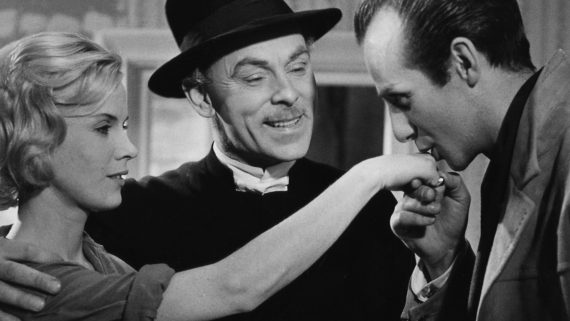
If The Devil’s Eye is rightly seen as minor Bergman, it is also confirmation that even the lesser Bergman’s tend to be interesting at the very least. The Devil’s Eye is both interesting and fun, though also weightier than one may expect from its goofy premise. If there’s a sense that Bergman at this stage is more out of his depth discussing love than he is focusing on grimmer emotions, he also does himself credit by not bending to expectations of a neat, upbeat conclusion. His Hell is not one from which release or reprieve seems remotely possible. As a result, the ending of The Devil’s Eye feels more satisfying than that of The Virgin Spring, despite as many themes being left only half reckoned-with.
THROUGH A GLASS DARKLY
Director: Ingmar Bergman
Screenplay: Ingmar Bergman
Producers: Allan Ekelund
Starring: Harriet Andersson, Gunnar Björnstrand, Max von Sydow, Lars Passgård
Year: 1961
Country: Sweden
BBFC Certification: 15
Duration: 91 mins
One of Bergman’s most notable achievements of the 60s was his loose trilogy about religion, referred to variously as The Silence of God Trilogy, The God Trilogy and The Faith Trilogy. Bergman himself pointed out the links that connect the three films, although later in life he denied that the films were meant as a trilogy. Still, it is instructive to view them as such and as a thematically interconnected suite of films they undoubtedly enhance each other, especially when viewed in quick succession. Perceived flaws in one film, such as the simplicity of Through a Glass Darkly’s “God is love” coda, are sometimes expanded upon or contradicted in the other films, in a way which provides an appropriately multi-faceted view of the complex topic of faith. That Bergman was wrestling with his own religious upbringing and budding agnosticism during the making of these films informs their refreshingly ambiguous but intellectually engaged nature.
Through a Glass Darkly is a Strindberg-influenced chamber piece about four family members taking a brief holiday on a remote island. Though their initial interactions seem warm, there is an artificiality that all too soon begins to show. Middle-aged writer David is struggling with a lack of inspiration and his emotionally distant relationship with his children, Karin and Minus. Minus is struggling with his own emerging sexuality, while Karin has recently been released from an institution where she was treated for schizophrenia. Karin’s husband Martin feels pushed away by his wife who is no longer interested in him sexually, though his love for her remains strong. But events that take place across the first 24 hours on the island exacerbate Karin’s condition and everyone has to deal with the effects of watching her slip away and their differing reactions.
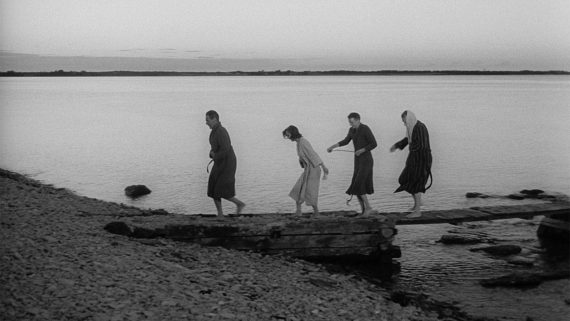
It’s clear from the synopsis that Through a Glass Darkly is a weighty, disturbing and upsetting film but it is also a fascinating one and easier to engage with than one might expect. When there is such an abundance of gloomy subject matter (and we haven’t even mentioned the allusions to suicide and incest), a film is in danger of becoming ridiculous if that subject matter is not handled with sufficient insight and sensitivity. Fortunately, we’re in good hands here and while I felt The Virgin Spring failed to properly explore its themes, Through a Glass Darkly strikes just the right note somewhere between deliberate ambiguity and full narrative closure. The limited number of characters allows Bergman’s screenplay to engage more intimately with them, with Gunnar Björnstrand’s David and Harriet Andersson’s Karin emerging as particularly well-rounded creations.
Andersson in particular is superb in Through a Glass Darkly. The film received two Oscar nominations, for Foreign Language Film (which it won) and Original Screenplay. I can only attribute Andersson’s lack of an Leading Actress nomination to the Academy’s tentative attitude to nominating international films outside of the International category. Her portrayal of a woman split between worlds, reaching the end of her sanity as encroaching voices control her, is perfectly pitched between realism and horror, the latter witnessed powerfully in her famous speech about having met a sexually aggressive, spider version of God. Björnstrand, meanwhile, is understated but with a couple of deeply moving outbursts of emotion that offset his carefully composed exterior. Max von Sydow as the husband is brooding but with a hint of the happier person he used to be still evident, while Lars Passgård uses his unenviable position as an acting novice among experts to bring out the confusion and naïvety of the little brother. It’s a tight little ensemble that elevates Bergman’s dialogue-rich script.
Through a Glass Darkly has much else to recommend it, including the stunning location of the island of Fårö, which Bergman would utilise again in several later films. The Bergman/Sven Nykvist collaboration continues here too, with Nykvist developing the cinematographic style that would characterise his fruitful work with the director. It’s easy to appreciate why many consider Through a Glass Darkly to be one of Bergman’s finest works, although I do occasionally find it more emotionally elusive than his very best efforts. That is not to say that it isn’t a great film, just that there is not quite the same personal connection for me here that I found in the likes of Wild Strawberries or the subsequent Winter Light. Through a Glass Darkly was a deeply personal work for Bergman and perhaps for those with a greater experience of its subject matter it will be too. For me, it remains a fascinating and intelligent meditation that I watch appreciatively from one remove.
WINTER LIGHT
Director: Ingmar Bergman
Screenplay: Ingmar Bergman
Producers: Allan Ekelund
Starring: Gunnar Björnstrand, Ingrid Thulin, Max von Sydow
Year: 1963
Country: Sweden
BBFC Certification: PG
Duration: 81 mins
If you look up the word “parochial”, you’ll find two definitions: “relating to a Church parish” and “having a limited or narrow outlook or scope”. This interesting duality of meaning is reflected in Winter Light, the second film in the Silence of God trilogy. It is the story of Tomas, the pastor of a small church who’s dwindling flock seems to reflect his diminishing faith. Having lost his beloved wife, Tomas feels his own life has ended and subsequently feels useless in his attempts to offer support and guidance to a suicidally depressed parishioner. The only freedom for Tomas seems to lie in the denunciation of God but this has consequences for other people in his life. Winter Light runs for just 80 minutes but Bergman’s phenomenal screenplay packs in so many fascinating questions that a superficially small-scale film becomes philosophically gigantic.
As a man of no religious belief myself, Winter Light is a fascinating insight into the middle ground between faith and scepticism, the spot where a questioning attitude can so easily lead those who seek understanding of God without the obligation to defend his infallibility. Tomas mentions the dangers of this tendency when he talks of the horrors he saw during the Spanish Civil War and how his inability to reconcile them with his loving image of God necessitated that he simply ignore them. But Winter Light isn’t a full-frontal attack on religion. I spent very little time transitioning from a primary school education that treated God as fact into more questioning teenage years that saw me reject that attempted indoctrination seemingly with little trouble. But the upshot was that I developed a long-term prejudice against religion based on naïve anger and wilful oversimplification. Winter Light does not go down this road, although the making of the film was apparently accompanied by Bergman’s own rejection of the religious belief that had been forced upon him growing up, the residual effects of which he felt ruined his previous film Through a Glass Darkly by leading him to tack on a hopeful but insincere “God is love” epilogue. Winter Light explicitly challenges this image of God, even referencing Through a Glass Darkly’s hideous spider-God. It is not a film interested in finding a redemptive final note and the ending it does settle on is ambiguous enough that some have taken it to be a reaffirmation of faith while others see it as a depiction of a pretence of faith continued only out of habit. I tend very much towards the latter, with Winter Light’s great tragedy being that Tomas, a man who ought to feel saved by his faith, is ultimately trapped by it.
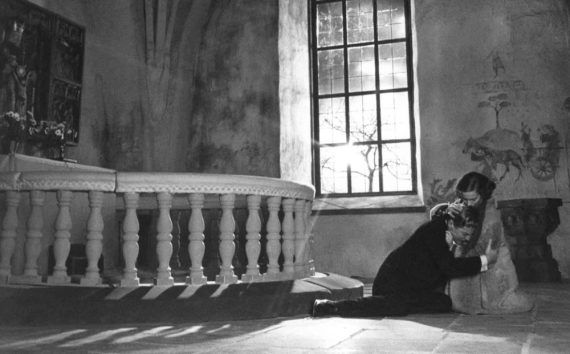
From the moment I first saw Winter Light I considered it a perfect film. At that time I would’ve been mired in my prejudices, whereas subsequent watches have perhaps seen me come at the film from a more clear-eyed personal agnosticism. The film highlights the idea of religion as a personal experience that differs from person to person, and accordingly it plays well with audiences of various belief systems who bring different experiences and interpretations to it themselves. Bergman leaves room for these varied readings but it never feels like he is hedging his bets with what he is trying to say. He also refuses to fall back on cliches. Loss of faith is almost invariably seen as a tragedy in films, with unambiguously redemptive finales seeing belief restored equated with happiness. Winter Light shows how the removal of faith can destroy some, while the insistence upon it can imprison others.
Winter Light opens with one of Bergman’s most stunning set pieces, a 15 minute church service in which Tomas and his tiny congregation go through the motions in an utterly joyless fashion. The circular structure of the film deposits us back at this point at the climax, only with the congregation gone and Tomas speaking well-rehearsed words into a void. Defiant persistence driven by faith or redundant repetition driven by desperation? In either case, we do not leave Tomas as a happy man and, depending on your personal view, the potential for future happiness is debatable.
As well as Bergman’s intricate screenplay, the effectiveness of these devastating ambiguities can be attributed to Gunnar Björnstrand’s intense performance. Björnstrand was a Bergman regular by this point but he often played quirkier or more comedic roles and reportedly doubted his ability to convincingly portray Tomas. But, off the back of one of his weightier performances in Through a Glass Darkly, Björnstrand once again impresses, making Tomas’s existential struggle sympathetic without necessarily making the man himself quite so easy to warm to. This is mainly due to his cold treatment of Märta, the schoolteacher who loves him, played with exceptional realism by a deprettified Ingrid Thulin. Thulin makes Märta utterly convincing in her shyness, her hurt and her conviction that she could serve as Tomas’s alternate redemption. Though this is kept wide open as a legitimate possibility, it is not one that Tomas is at all interested in and Bergman is careful to make Märta, who’s philosophies often stand opposed to a religious alternative, as potentially naïve as those of any other character. She is not a simplified saviour and Bergman thankfully avoids a secular rewrite of his previous God is love ending, instead examining that theme from a different point of view. God may not be love but what use is the love of someone you don’t love back? In tales of how an extreme skin disease Märta developed exacerbated Tomas’s repulsion towards her, she is aligned with the God whom Tomas also finds increasingly repulsive.
A third appearance by a Bergman regular completes the film’s triptych of exemplary performances. Max von Sydow provides evidence for Stanislavski’s old line “There are no small roles, only small actors” with a brief but extraordinary turn as a suicidal man driven to despair by fears of nuclear war, a possibility that to him makes his faith seem untenable. von Sydow provides a studied, entirely unmelodramatic representation of depression that has made even straightforward communication seem intimidating. He has very little dialogue but the performance is all in his immaculate body language which reveals so much about the character before we’ve even heard about his problems.
When Bergman’s wife first saw Winter Light, she reportedly said “It’s a masterpiece, but it’s a dreary masterpiece.” This drear factor could be off-putting for some but while I’ve never disputed the film’s sometimes overwhelmingly downbeat nature, Winter Light is also a film I find strangely comforting. Perhaps it is because it’s a film I feel I can point to as an example of why I completely rejected Christianity and why that is the right choice for me. But it’s also a film that I can imagine a Christian using to show why their religion is the right choice for them. Films that pull off such deliberate ambiguity without sacrificing a personal directorial viewpoint are incredibly rare. Winter Light is the work of a man transitioning from faith to agnosticism, and as such it doesn’t seem to glorify or condemn either so much as question and evaluate both, and encourage others to do the same. I see something new in it with every viewing and think long on its impact as it’s final image abruptly cuts to creditless nothingness. A treasure masterpiece and my favourite Bergman film.
THE SILENCE
Director: Ingmar Bergman
Screenplay: Ingmar Bergman
Producers: Allan Ekelund
Starring: Ingrid Thulin, Gunnel Lindblom, Birger Malmsten
Year: 1963
Country: Sweden
BBFC Certification: 15
Duration: 96 mins
In my early days as a budding cinephile, I knew I would eventually have to get round to Ingmar Bergman. The thought hung heavy in my mind, for from everything I had heard I was in for a dose of Swedish miserablism which, while probably brilliant in numerous technical capacities, was also likely to be virtually impenetrable. Fortunately, my fears were assuaged when a season of Bergman films on TV began with the likes of Smiles of a Summer Night, Wild Strawberries and The Seventh Seal, allowing me to ease in with films that contained a good deal more humour and warmth than I had been expecting. By the time the grimmer 60s films came round, I was in the rhythm and ready to appreciate them in a way which might have been tougher had I started out with them. But The Silence was one film I found difficult to fathom. I originally watched it late at night, forcing myself to stay awake to log another Bergman, and my hazy memory of it was that of a chilly, forbiddingly symbolic work. Although it made a little more sense to me this time round, I don’t think l was too far off in my original assessment.
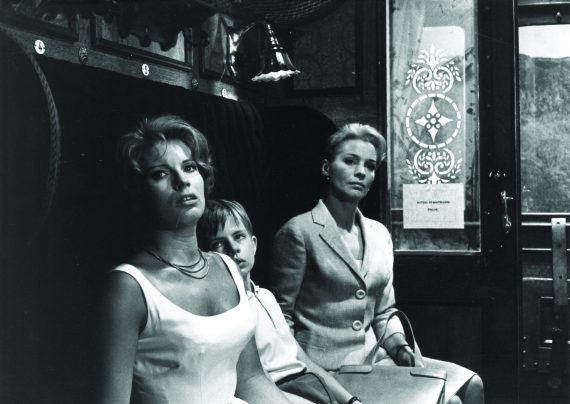
The Silence plays like a realisation of every fear I had about first approaching Bergman. It is cold, impressionistic and slow. Unlike the first two parts of the Silence of God trilogy, which are heavily character and dialogue based, The Silence lives up to its name, relying primarily on images to tell its esoteric tale of two sisters and a young boy holed up in a Central European hotel where they do not speak the language. Though this exacerbates communication problems, it is clear that the relationship between the sisters is already fractured, leading to confrontational behaviour between them. The Silence is at its best when it is focusing on the young boy and his exploration of the large, mostly empty hotel. There is an alluring surreality to these sequences and they are shot beautifully, with a real sense of childhood wonder laced with a sinister edge, captured by Bergman’s delicate direction and Sven Nykvist’s cinematography. But the central story of the sisters failed to capture my interest in the same way. Sensuality and aversion to the same are a major theme and Bergman ups the sexual content considerably here, which is necessary for the exploration of his themes but sometimes teeters on the edge of ridiculous (although it did contribute to making the film a surprise box office hit). I also felt that there was a melodramatic edge to The Silence that rarely infiltrates Bergman’s films. The lack of dialogue means that the performances become more demonstrative and less believable. Perhaps that is in keeping with the heightened world Bergman is creating here but it never quite works for me.
The Silence still has things to recommend it and is a film which may reward frequent rewatches, although I don’t particularly feel inclined to return to it anytime soon. I’ve given it a middling 3 stars for now but that could go up or down on subsequent viewings. This can often be the sign of a slow burning masterpiece. It can also be a sign of an ambitious failure. Having now seen it twice, I’m damned if I know which one The Silence is.
ALL THESE WOMEN
Director: Ingmar Bergman
Screenplay: Ingmar Bergman, Erland Josephson
Producers: Allan Ekelund
Starring: Bibi Andersson, Harriet Andersson, Eva Dahlbeck
Year: 1964
Country: Sweden
BBFC Certification: PG
Duration: 80 mins
Looking to work on something a little lighter after the Silence of God trilogy, Bergman ended up creating the biggest anomaly in his whole catalogue. It’s a shock to run across the broad comedy All These Women if you’re not prepared for it and those who buy this boxset may well suspect an incorrect disc has been slipped into its packaging. Though many are critical about Bergman’s comedies, in general I’ve always enjoyed them, from the good The Devil’s Eye to the great A Lesson in Love and the masterpiece that is Smiles of a Summer Night. But All These Women is a complete misfire which attempts to parody 1920s sensibilities and the tropes of slapstick farce by amping up the ludicrous elements and executing the gags with a self-aware artificiality which fails to make them any funnier. Based around the thin story of oily music critic Cornelius who, tasked with writing the biography of a famous cellist, visits his summer estate and encounters his wide-ranging group of doting mistresses, All These Women is an opportunity for Bergman to bring together some of his greatest female collaborators, including Bibi and Harriet Andersson, Eva Dahlbeck, Gertrud Fridh and Mona Malm, but the roles they are given provide little opportunity for showcasing their talents, and their actions, which often involve seducing the odious critic, are frequently inexplicable.
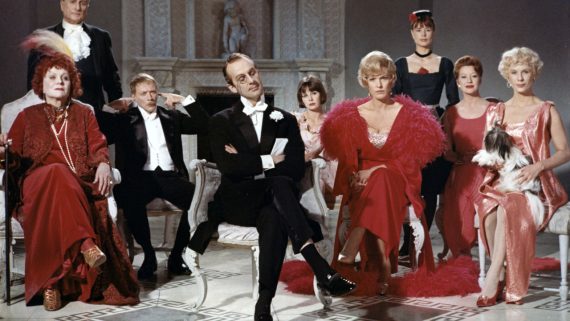
There are promising elements to All These Women. This is Bergman’s first film in colour and Sven Nykvist’s colour cinematography is sumptuous, pitched at the exact right midpoint between gaudy and washed out. The mise en scene sometimes has a proto-Wes Anderson feel, particularly the opening scene of a funeral, with sets thoughtfully arranged and the characters beautifully framed. I quite like some of the excessively arch fourth wall breaking, the droll intertitles and the exaggerated props, especially Cornelius’s huge quill pen which he produces as if from nowhere whenever he spies something of note. All these things could have worked were they allied to a better screenplay but All These Women just meanders, its novelties not even sufficient to carry it through an 80 minute runtime. Any hopes that this would be an underrated, misunderstood classic were dashed early on when an excruciatingly protracted slapstick routine involving a large, heavy bust of the maestro was accompanied by an overly insistent piano rendition of Yes, We Have No Bananas. Jarl Kulle, so effective as Don Juan in The Devil’s Eye, is asked to overplay wildly as Cornelius and his blundering with the bust is pathetic. It is so clearly as light as polystyrene that the joke is immediately dead in the water. There seems to be a sense of self-awareness even to the poor execution, like a Stewart Lee routine that deliberately drains the comedy from the routine through over extension, but even if we make this allowance it still doesn’t work.
All These Women is one of the boldest experiments in the Bergman filmography but it fails spectacularly. Bergman himself saw it as an angry film, remembering that he was tired and irritable during its production. This comes through on screen, as none of the actors appear to be particularly enjoying themselves despite the pantomime excess of their performances. After watching The Silence the previous evening, I was looking forward to a comedy to provide some relief, but All These Women may be a more depressing experience than any other film in this set. After it was over, I thought Thank God it’s Persona next!
PERSONA
Director: Ingmar Bergman
Screenplay: Ingmar Bergman
Producers: Ingmar Bergman
Starring: Bibi Andersson, Liv Ullmann
Year: 1966
Country: Sweden
BBFC Certification: 15
Duration: 84 mins
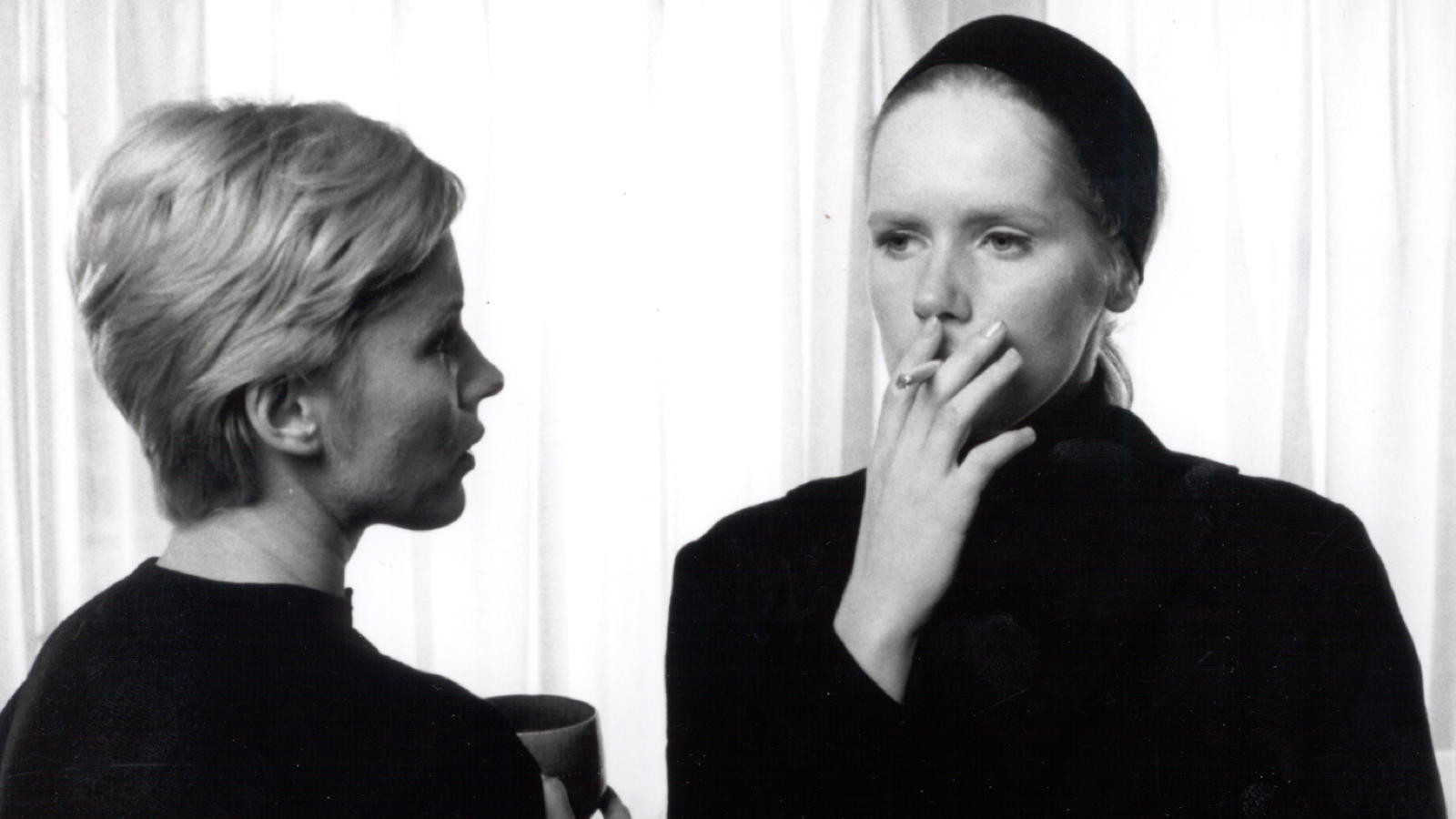
After the strange, failed and now virtually forgotten experiment that was All These Women, Bergman made what would become perhaps his most acclaimed film, Persona. Pushing further into the surreal and expressionistic style of The Silence, Persona emerged as an even more complex but much more satisfying film. Though it used an unconventional approaches to narrative, The Silence was still essentially a linear story, whereas Persona is much more fluid, opening with a six minute prologue of intercut, tangentially related and often troubling images. For a while, the film settles into a more straightforward story of a young nurse tasked with caring for a stage actress who has suddenly stopped speaking. Although it is easier to follow, this section of the film never loses the overall atmosphere of looming dread that hangs over Persona. There’s a disturbing sterility to the hospital scenes which is initially alleviated when the two women are moved to a seaside cottage in order to aid the healing process. But this isolation ultimately opens up even darker implications as the barriers between the nurse and her patient begin to crumble and their personalities start to bleed into each other.
One oft-discussed theory about The Silence is that its two female protagonists represent two sides of one woman. In Persona, these themes are explored more definitively as the characters’ methods of communication begin to seem more like the expression of one person’s inner thoughts. The women are mistaken for each other by people from their past, or manifestations of them, and their initial simpatico experience becomes a psychologically distressing loss of individuality. Bergman expresses these developments through various filmic techniques, such as fake film breakdowns, repeated dialogue, split screen facial meshes and fourth wall breaks. The casting of the two leads is key here. Bibi Andersson and Liv Ullmann don’t look alike but somehow, through both direction and performance, they start to. It helps that Ullmann’s strikingly unusual face resembles a haunted mask in Sven Nykvist’s perfect black and white cinematography, giving the impression she could tear it away to reveal another face at any moment. This was Ullmann’s first Bergman film and it’s unsurprising that she became a regular collaborator. She has a certain indefinable quality that makes her exquisitely unsettling, perfect for Bergman’s oeuvre. She puts across so much with very little dialogue here. By contrast, established Bergman collaborator Andersson is given a very dialogue-heavy role as the nurse, which includes a lengthy and very sexually explicit monologue. The two women are both wonderful and their different acting styles melt together as hypnotically as their characters’ identities.

Persona is undoubtedly a challenging film but for those who enjoy such a thing it is endlessly rewatchable. Unlike Winter Light or Through a Glass Darkly, which promote discussion of their themes by presenting them in a clear but open-ended manner, Persona is an elusive puzzle box of a film, presenting dozens of possible interpretations but refusing to confirm the correct one. Bergman claimed he had a definitive reading of the film in mind but felt it was better to allow viewers to draw their own conclusions. In doing so, he created one of cinema’s most fascinating and most analysed films. To offer anything as crass as a solution would be to rob Persona of its complexity and its allure, yet knowing that there is an underlying intention makes it more satisfying. For some, Persona will be an easier film to admire than to enjoy and to begin with I felt the same way. But now I have seen it several times, Persona just gets better and better with each watch. Once you know what’s coming on a basic story level, it allows closer engagement with what lies beneath that initially forbidding surface.
THE RITE
Director: Ingmar Bergman
Screenplay: Ingmar Bergman
Producers: Lars-Owe Carlberg
Starring: Gunnar Björnstrand, Ingrid Thulin, Anders Ek, Erik Hell
Year: 1969
Country: Sweden
BBFC Certification: 15
Duration: 72 mins
It may seem odd at first that this boxset, which features most of Bergman’s 60s work in chronological order, suddenly jumps over two acclaimed films towards the end of the decade in order to include The Rite, a television film made after Hour of the Wolf and Shame. I’m sure there are issues involving film rights or other such technicalities I don’t understand, but if it was purely an aesthetic choice to include The Rite then it was a good one. In his subsequent career, Bergman would utilise the medium of television for some of his most acclaimed works, so it makes sense to end this particular chapter with an early entry into the world of TV as a sort of teaser for what I hope will be more boxsets to come.
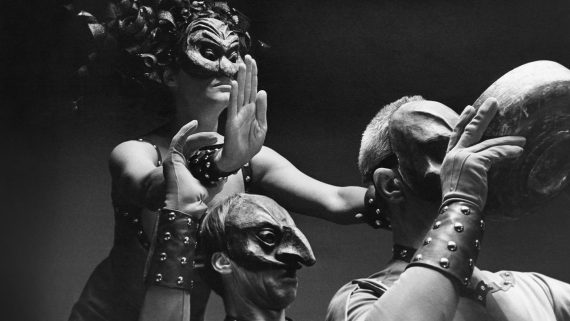
Having said that, I can’t say I was particularly enamoured with The Rite. An angry, oddly clumsy satire on censorship, it was made in the aftermath of Bergman’s tenure as managing director of the Royal Dramatic Theatre. Bergman had met with constant frustration due to censorship and the differing tastes of those to whom he had to answer, and in The Rite he (barely) symbolically puts those people on trial. There’s nothing wrong with this approach, of course. Bitterness and anger can drive some of the greatest satire but unfortunately that’s not the case here. The Rite feels hurriedly concocted and bluntly executed. In the aftermath of Persona, a film that can be endlessly discussed and re-evaluated, The Rite feels one-note and bland. Shot almost entirely in close-ups and emphasising a less naturalistic performance style, The Rite is technically fine, even vaguely impressive, as far as the limitations of 60s TV go, but it definitely feels like minor Bergman.
For completists, this new Bergman set is a must. While I definitely found it more hit and miss than the previous Volume 2, which is an absolutely essential collection, the fact that lesser-known films like All These Women and The Rite are being made more widely available is laudable. In terms of the films themselves, the 60s was an exciting but odd time for Bergman. His films were becoming more intense and explicit, sometimes to extraordinary effect and sometimes to less satisfying ends. But no Bergman library is complete without the masterpieces Winter Light and Persona, while the likes of Through a Glass Darkly, The Virgin Spring and The Devil’s Eye also have much to offer. While I still think my heart belongs chiefly to 1950s Bergman, continuing in that same vein would’ve been to dilute the effect. Where Bergman went in the 60s was a necessary development and the results at their best are astounding.
Ingmar Bergman Volume 3 is released on Blu-ray by BFI on 26 September 2022. Special features are as follows:
-Newly commissioned audio commentary on The Virgin Spring by Alexandra Heller-Nicholas and Josh Nelson
-The Men and Bergman (2007, 52 mins): Eva Beling’s documentary featuring Erland Josephson, Thommy Berggren, Börje Ahlstedt and Thorsten Flinck
-Ingmar Bergman Introductions (2003, 10 mins): Ingmar Bergman, in conversation with Marie Nyreröd, provides introductions to Through a Glass Darkly, Winter Light and The Silence
-BFI Screen Ephiphanies: Richard Ayoade Introduces Persona (2011, 11 mins): the award-winning actor, director and novelist discusses Bergman’s masterpiece in this introduction recorded at the BFI Southbank
-Persona trailer
-100-page perfect bound book featuring new essays by Catherine Wheatley, Claire Marie Healy, Jannike Åhlund, Philip Kemp, Ellen Cheshire, Geoff Andrew, Andrew Graves and Kat Ellinger
-Newly commissioned artwork by Andrew Bannister
-Limited edition of 5,000