


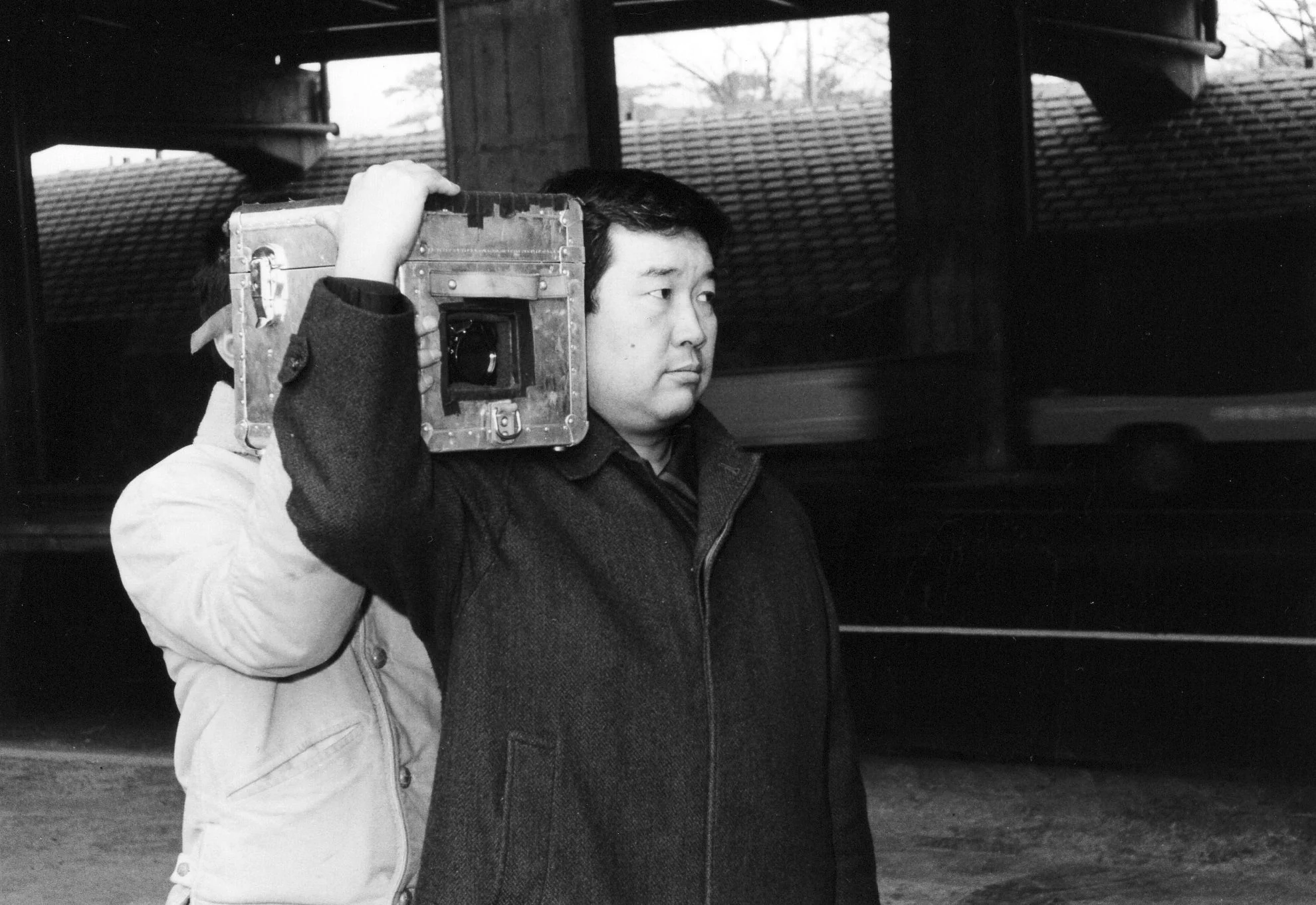

Director: Shohei Imamura
Screenplay: Toshiro Suzuki, Kon Tōkō (Stolen Desire), Shohei Imamura (Nishi Ginza Station, Endless Desire, The Insect Woman, Intentions of Murder), Hisashi Yamanouchi (Endless Desire, Pigs and Battleships), Keiji Hasebe (The Insect Woman, Intentions of Murder)
Starring: Hiroyuki Nagato, Osamu Takizawa, Shinichi Yanagisawa, Kō Nishimura, Frank Nagai, Masahiko Shimazu, Hisano Yamaoka, Sanae Nakahara, Taiji Tonoyama, Jitsuko Yoshimura, Yōko Minamida, Sachiko Hidari, Masumi Harukawa, Shigeru Tsuyuguchi, Yuko Kusunoki
Country: Japan
Running Time: 92 mins/52 mins/101 mins/108 mins/123 mins/150 mins
Year: 1958/1961/1963/1964
BBFC Certificate: 18
A year on from their Nagisa Oshima box set, the debut release of their Radical Japan series, Radiance have assembled a sequel: Radical Japan: Survival and Desire – Six Films by Shohei Imamura. These six films represent the early works of a director who would come to be known as ‘the ethnographer of Japan’ for his exhilarating and fierce filmography. Having studied as an assistant to the great master director Yasujirō Ozu at Shochiku studios, Imamura then moved to rival studio Nikkatsu to begin his own directorial career.

Stolen Desire (1958)
Imamura’s acerbic and confrontational qualities were present right from the start. Stolen Desire was his debut feature, concerning the stresses and strains of an itinerant theatre troupe eking out a living in the shadow of Tsūtenkaku (the ‘Tower Reaching Heaven’) in Osaka. An opening narration of pure sarcasm lauds the people of Osaka as ‘stout hearted’, but times are hard. The troupe’s performances of Kabuki plays are leavened by scantily clad dancing girls, and frustrations at their constant poverty see the various members at each other’s throats. At the centre of all this is Kunida (Hiroyuki Nagato, a regular of early Imamura films), an idealistic young director trying to find his way in the world, at the mercy of the troupe’s ageing patriarch and his wilfully contrary group of unco-operative performers. His uncertainty about his place in the world both personally and professionally lead to all sorts of comedic adventures when the group set up for a short spell in a rural village. Imamura’s flair for matching the vulgarity of everyday life with more philosophical concerns begin their deep roots here; the clash of art versus commerce are the very heart of the film. The film is replete with voyeurism, love affairs, pull apart mass brawls and even a kidnapping attempt. Kunida mentions being part of the ‘Sengeki’ (the New Drama ‘movement), a detail that illuminates the tensions at the heart of the narrative. It is a raw, bawdy but also warm-hearted debut feature.
Nishi Ginza Station (1958)
Ostensibly a star vehicle for the singer Frank Nagai, Nishi Ginza Station is a strange little confection. This tale of a hen-pecked husband attempting to have an affair whilst his wife and children are away for the weekend just about hangs together in its early stages, where the focus is on the relationship between Oyama (Shin’ichi Yanagisawa) and his lascivious friend Asada (played with verve by the redoubtable Ko Nishimura). The husband’s dreams of a tropical island paradise are very problematic and the latter half of the film strains credulity beyond its breaking point. You can tell that Imamura’s heart wasn’t really in this studio-ordered assignment. However, there are several aspects that keep your interest, namely the wry interventions of the fourth wall-breaking Nagai with his hit song ‘Nishi Ginza Station’ and a streak of screwball comedy that Imamura would put to greater use later on in his career.

Endless Desire (1958)
The potential abundantly evident in his first two films was made manifest in Endless Desire, Imamura’s third feature in just one calendar year. Adapted from the novel by Shinji Fujiwara, Endless Desire is a black-hearted crime drama concerning a group of ex-soldiers who attempt to unearth a hidden cache of morphine buried beneath a shanty town in Hiroshima, ten years after the end of the war. Their mutual distrust is only heightened by the arrival of Shima (Misako Watanabe), who claims to be their former officer’s younger sister. In a race against time, the group plots to excavate the treasure, unleashing forces that ultimately spill out of their control. The romantic leads of Hiroyuki Nagato and Sanae Nakahara receive top billing, but it is the tumultuous criminal quintet that Imamura keeps our attention on, as they bicker and batter each other in their haste to uncover their hidden fortune. Takeshi Katō is superb as the violent bully Yamamoto, but the real star of the film is Misako Watanabe. Her performance as the endlessly duplicitous Shima is a case study in amoral ruthlessness. The final 40 minutes of Endless Desire are a descent into the darkest of film noir territory, where recriminations built up over a decade finally erupt into betrayal and bloodshed. Imamura’s flair for the grotesque is honed to perfection here, to say the least. Not only is Endless Desire Imamura’s first masterpiece, it is one of the great film noirs of 1950s Japanese cinema.
Pigs and Battleships (1961)
The set then skips past Imamura’s next directorial outing The Second Brother from 1959 (omitted for unknown reasons), instead alighting upon one of the director’s most well-known and infamous films; Pigs and Battleships. The crime story dominated the narrative in Endless Desire, but here the love story between Kinta, a lowly member of a Yakuza gang (a scarcely recognizable Hiroyuki Nagato) and his spirited girlfriend Haruko (Jitsuko Yoshimura) is centre stage amidst this sprawling tale of black-market activity on the streets of Yokosuka. The naval base in the city’s port is named United States Fleet Activity Yokosuka, and exists there to this day as home to US Seventh Fleet. Pigs and Battleships depicts an inverse relationship where elements of the native population engage in illegal acts of crime with members of the occupying US Navy, where both sides benefit from the wholesale corruption. Nagato portrays Kinta as an overgrown teenager, immature and volatile, pulled in all directions by competing forces. Haruko is also assailed by her struggles and desires for a different future, and their strife as a young couple trying to make their way forwards is the film’s narrative anchor. Bosses vie for power in business meetings, but the grim results of their decisions play out as poverty and violence. Nagato is naturally superb as the man-baby Kinta, but Jitsuko Yoshimura is simply extraordinary as Haruko. Her inner drive and self-assurance, despite the very dark journey that she undergoes through the film is a wonder to behold. The final sequence of the film is justly celebrated for its grandeur and excess, and might seem over the top to some. But for me this was a perfect way to expel the heightened tension that lies beneath everything that Imamura shows us onscreen. Pigs and Battleships is another masterpiece by Imamura.

The Insect Woman (1963)
Imamura would pay a very high price for the budget overruns on Pigs and Battleships, as Nikkatsu banned him from directing for two years. Whilst in exile, Imamura penned several scripts for other directors and worked on scripts for what would become his next pair of projects: Intentions of Murder and The Insect Woman. Sachiko Hidari stars as Tome Matsuki, a girl born into a rural peasant family in 1918. Her precarious rise from the daughter of poor peasant (who may or may not be her real father) to a position of respectability through the illicit trade in sex work parallels the rise of Japan as a country through two tumultuous wars and rapid industrialization. Imamura portrays Tome as both victim and bully, enduring harsh treatments throughout her young life, only to become just as vindictive to those around her in later life. Tome is one of Imamura’s greatest anti-heroines, and Sachiko Hidaki delivers an outstanding performance in the lead role, turning vulnerability into success seemingly by sheer force of will. Jitsuko Yoshimura’s performance as her determined daughter Nobuko is equally as impressive. In some ways, The Insect Woman reminds me of a melodrama like Mildred Pierce, but unlike Michael Curtiz with Joan Crawford, Imamura makes no attempt to absolve his lead character of her worst aspects. We see Tome for what she really is, good and bad, from birth to old age. Shinsaku Himeda’s stark cinematography is matched by a modernist approach to editing that ultimately comprise Imamura’s most challenging film to date. It is my favourite film of the entire box set.

Intentions of Murder (1964)
Also known as Unholy Desire, Intentions of Murder is Imamura’s bleakest and most unsparing cinematic achievement, which is saying a lot given the litany of emotional and physical destruction meted out to the protagonists across this entire set. Having made such a great impression as Midori in The Insect Woman, Misumi Harukawa is stunning as Sachiko, a young woman sold into servitude to a cruel middle-class family. She suffers every conceivable indignity, from insults and abuse to a series of sexual assaults; firstly, she is impregnated by her sickly and repulsive ‘husband’ Takahashi (Ko Nishimura), and is then viciously attacked by Hiraoka, a genuinely terrifying character portrayed by Shigeru Tsuyuguchi in a performance that would make his name. Sachiko endures every excruciating humiliation as if her spirit is completely broken, but somehow, she finds a way to survive the worst that the world can throw at her. Intentions of Murder can be an intense and often gruelling watch. This is no attempt to sacralise a woman’s suffering, like Bresson’s Mouchette. Imamura details Sachiko’s suffering because so many poor women in her position suffered – and sadly continue to do so. However, Sachiko does not simply accept her abuse, but finds a way to move forward with her life, enduring despite everything she has been through. Intentions of Murder is one of the darkest and most extreme entries in Imamura’s filmography.
4K UHD & BLU-RAY LIMITED EDITION BOX SET SPECIAL FEATURES
- 4K restorations of Pigs and Battleships, The Insect Woman and Intentions of Murder
- High-Definition digital transfers of Stolen Desire, Nishi Ginza Station and Endless Desire
- 4K UHD and Blu-ray presentation of the features Pigs and Battleships, The Insect Woman and Intentions of Murder
- Blu-ray presentation of all features and extras
- New critical appreciation of Pigs & Battleships by filmmaker and Shohei Imamura’s son Daisuke Tengan (2026, 20 mins)
- Unholy Desires in the Early Films of Shohei Imamura – new visual essay by Samm Deighan (2026, 17 mins)
- Introduction to The Insect Woman by scholar Dolores P. Martinez (2026, 19 mins)
- Conversation between Shohei Imamura and Tadao Sato about The Insect Woman (ca. 1990, 21 mins)
- Introduction to Intentions of Murder by programmer and Imamura biographer Bastian Meiresonne (2026, 30 mins)
- Conversation between Shohei Imamura and Tadao Sato about Intentions of Murder (ca. 1990, 24 mins)
- Tearing Down the House – new visual essay by author Jasper Sharp (2026, 18 mins)
- Interview with scholar Jennifer Coates on Stolen Desire and Nishi Ginza Station (2026, 17 mins)
- Introduction to Endless Desire by filmmaker and stage director Kenta Fukasaku (2026, 22 mins)
- Trailer for Intentions of Murder and Endless Desire
- Optional English subtitles for each film
- Reversible sleeves featuring original and new artwork
- 160-page book featuring archival writing by and interviews with Shohei Imamura, as well by Ian Buruma, Richard Phillips, Nelson Kim, Hiroshi Kitamura, Michael Raine, Adam Bingham and more
- Limited Edition of 5000 copies, presented with in a rigid box with full-height Scanavo cases and removable OBI strip leaving packaging free of certificates and markings
Radical Japan: Survival and Desire – Six Films by Shohei Imamura is completely different from the Shohei Imamura Masterpiece Collection released by Eureka Masters of Cinema in 2015. The Eureka set features films not included on this new set, namely A Man Vanishes, Profound Desires of the Gods, Vengeance Is Mine and The Ballad of Narayama, as well as a set of special features involving the likes of Alex Cox and the late, great Tony Rayns, although the interview with Imamura and Tadao Sato about The Insect Woman has been included on the Radiance set. If you have the Eureka set, treasure it – but you know you need this one as well.
Radical Japan: Survival and Desire – Six Films by Shohei Imamura features an extensive list of brand-new special features and bonus content.
The interview with Jennifer Coates, author of the 2019 book “The Making of an Auteur: The Early Films (1958-1959) is an excellent examination of the Imamura’s first directorial efforts. I appreciated her description of Fran Nagai as being ‘Sinatra-adjacent’ and her plausible explanation for the husband’s tropical island fantasies in Nishi Ginza Station.
Kenta Fukasaku’s introduction to Stolen Desire is a thorough appreciation of this early Imamura effort. His comparison of Imamura, Kurosawa and his father Kinji Fukasaku’s approach to filming black market scenes in their respective films was really insightful. He is rather harsh on his mother Sanae Nakahara’s performance in the film, although he again lays out plausible reasons why she and Imamura were somewhat incompatible personally and professionally.
Imamura’s son Daisuke Tengan speaks eloquently about his father’s work, particularly on Pigs and Battleships, which he memorably describes as ‘a film about real pigs versus fake pigs (i.e. humans)’.
Samm Deighan’s superb video essay focusses on the theme of desire that courses in various forms, throughout each of the six films featured on the set, from love triangles to family cruelty. She observes that Imamura blames ‘social deprivation’ for the ills of society rather than the ‘failings’ of the individual (a pernicious lie still all too common in 2026), and that Imamura saw human sexuality as ‘a thoroughly human force’ as the abiding theme of his entire oeuvre.
The interview with scholar Dolores P. Martinez reveals lots of fascinating information about The Insect Woman, describing the film as an ‘anthropological’ study of both a woman and Japan itself, as well as the feminist undercurrents that lie within the film. She also draws attention to a certain actress, which is a great narrative detail that I won’t spoil for you in this review.
The interviews with Imamura by Tadao Sato offer a rare opportunity for Western audiences to see this renowned and revered critic at work on Japanese television. His relaxed manner of questioning elicits some truly great anecdotes from the director, who seems perfectly at ease. These precious pieces of archive footage are indispensable additions to the set.
The appreciation by French film historian Bastian Meiresonne delves into the entire story behind Intentions of Murder, its origins and how important this project was for Imamura’s career. He asserts that the film is ‘a painful awakening of self and desire’, and is ‘yet another peak’ in his filmography, which I wholeheartedly agree with.
Jasper Sharp’s visual essay is both an appreciation and biography as he explores the ‘chaotic world’ of Imamura’s early cinema, drawing on the influence of his former mentor Ozu before outlining the films that would make up his second great period following the films contained in this set.
The trailers are typical studio hyperbole from Nikkatsu, displaying many of the brilliant images from Imamura’s films without the necessary attention to their complexities.
The book that accompanies this limited-edition box set was sadly not available for this review.
Radiance have once again outdone themselves with a magnificent box set that is a fulsome and fitting tribute to one of the finest directors of post-war Japanese cinema.