


 Anyone who was into one on one fighting games in the 1990s will instantly recognise the iconic logo on the box to the right – the black dragon, circled, on an orange background can mean only one thing – Mortal Kombat! Since the release of the original Mortal Kombat arcade cabinet in 1992, the franchise has gone on to become a huge pop culture phenomenon, recognisable worldwide, spawning multiple sequels and spin offs and still going strong today, with a brand new feature film having released just this year. Cast your mind back to 1995, however, and the phenomenon was barely in the mainstream except perhaps for the controversy over its brutal violence and gory fatalities. All that was set to change, however, with the imminent release of the 1995 film, Mortal Kombat, and 15 year old me was eager to sit his bum down in the local cinema to check it out. Now, 26 years later, Arrow Video are giving both Mortal Kombat and its 1997 sequel, Mortal Kombat Annihilation, a lavish 4K remaster and limited edition treatment. Revisiting these two movies, is it a flawless victory, or should we expect to see some fatalities?
Mortal Kombat
Directed by: Paul W.S. Anderson
Written by: Kevin Droney
Starring: Christopher Lambert, Robin Shou, Linden Ashby, Cary-Hiroyuki Tagawa, Bridgette Wilson, Talisa Soto, Trevor Goddard
Year: 1995
Country: USA
Running time: 101mins
BBFC Classification: 15
On a mysterious island, a group of fighters meet to take part in a mythical fighting tournament – Mortal Kombat. Overseen by the sorcerer Shang Tsung (Tagawa), envoy of Outworld’s emperor Shao Khan, Mortal Kombat is the villainous dictator’s means to break into Earthrelm’s reality and enslave the human race. Only three fighters can stop him, Liu Kang (Shou), Johnny Cage (Ashby) and Sonya Blade(Wilson); guided by thunder god Raiden (Lambert) and aided by the mysterious Princess Kitana (Soto), these three battle to stop Shang Tsung and save the world.
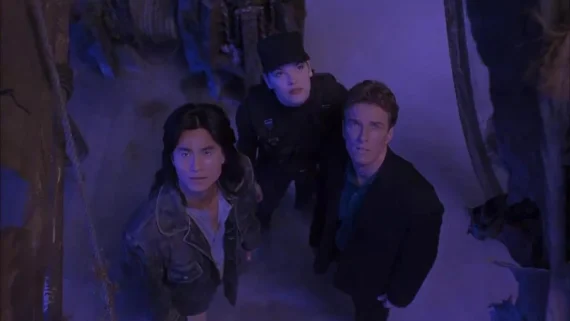
Let’s get something out of the way first – Mortal Kombat is basically a riff on the formula established in the Bruce Lee classic Enter The Dragon. Three warriors travel to an island for an mysterious martial arts tournament, each have their own reason for being there, there’s a big baddie to defeat and he has a massive henchman they must overcome before being able to fight him one on one. Or rather, this is the formula that Ed Boon and John Tobias, the creators of the original Mortal Kombat videogame, aped for their debut arcade hit, a story that Paul W.S. Anderson’s film adaptation sticks remarkably close to.
Sure, there are some changes to the story here and there, from making the mysterious warring ninja Scorpion and Sub-Zero merely henchmen to Shang Tsung, as well as introducing a “chosen one” plot for lead fighter Liu Kang, something that only the later games really adopted, but back in 1995, Mortal Kombat’s faithfulness to its source material set it apart from other videogame adaptations of the era like Super Mario Bros. and Street Fighter. Much of this is in thanks to the story largely focussing on the first game in the series, despite the third game just being released in arcades, while using elements of the later games in the series more sparingly.
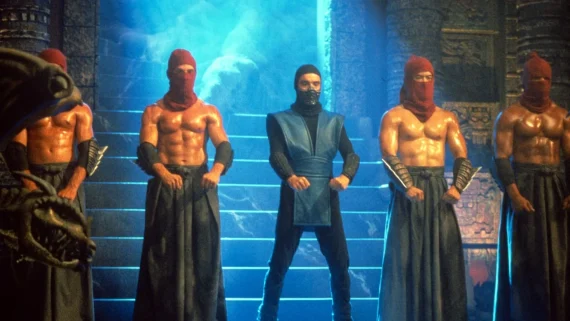
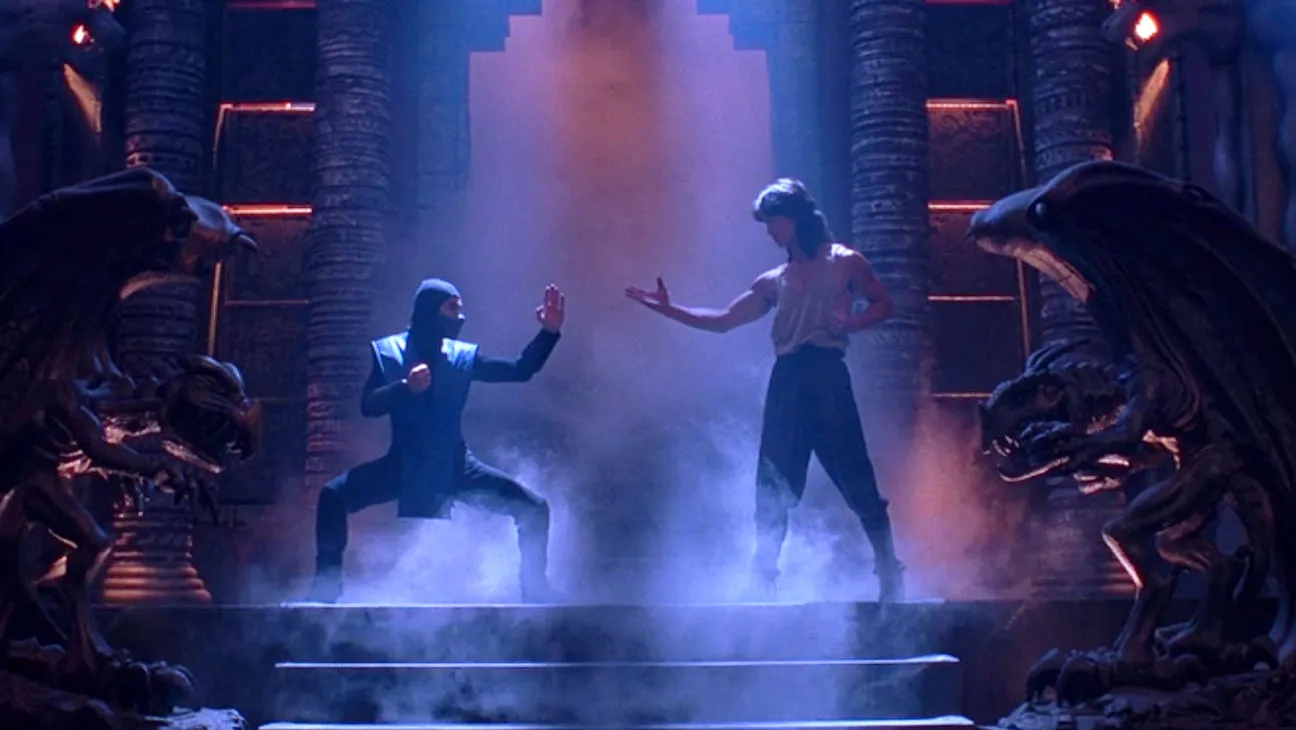
Revisiting it in 2026 it’s also held up remarkably well, its popcorn sensibilities mixing nicely with the sincerity of its story and, despite some ropey CGI in spots, it still looks really good. The production design is what really sets this apart from its peers and, indeed its sequel (we’ll get onto that) with some really excellent sets that combine with matte painting and miniature work to create a really tangible world for our characters to inherit. All this is shot excellently by cinematographer John R. Leonetti, who gives each location in the film a very distinct and unique feel. Standout in the films effects is the character of Goro, a giant, four armed half dragon warrior who is realised here as a wearable animatronic designed by VFX legends Alec Gillis and Tom Woodruff Jr (who is also inside the costume) – it’s still a remarkable technical feat and remains far more tangible than the characters full CGI appearance in the 2021 reboot film.
The characters are also largely remarkably well realised with Robin Shou and Linden Ashby as great standouts in our heroes. Shou’s knowledge of wushu lends a lot of believability to his fight scenes, while Ashby gives Johnny Cage the wit the character needs, often ad libbing a lot of the more humorous dialogue, as revealed in his interview in the bonus features. It’s perhaps only Bridgette Wilson who feels somewhat miscast here, far too snooty as Special Forces agent Sonya Blade, and seemingly wholly uncomfortable with the fight scenes. Christopher Lambert and Cary-Hiroyuki Tagawa meanwhile take it in turns to see who can chew the most scenery as standout ying and yang opposites Raiden and Shang Tsung, while the late Trevor Goddard camps it up as the villainous Kano, sadly underused here. Talisa Soto meanwhile provides the connection to the later games and the sequel film with her small role as Kitana, Shao Khan’s adopted daughter, but equally has little to do.
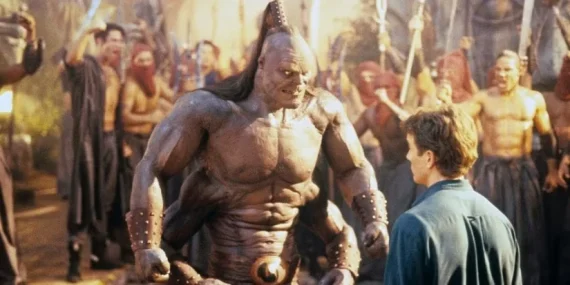
Mortal Kombat is, on the whole, a remarkably fun Saturday night movie with action scenes and a silly story which provides enough entertainment in its just over 100 minute run time. Perhaps a criticism is that it is largely bloodless in comparison to its ultraviolent source material, something that the 2021 reboot made up for with gore, but managed to lose with heart – this is objectively the better Mortal Kombat story, with all the important narrative elements present and accounted for, and its fantastic production design is head and shoulders above the overly CGI, green screen visuals of the recent films.
Bonus features
- 4K restoration of the film from the original camera negative by Arrow Films approved by director Paul W.S. Anderson
- Brand new audio commentary with director Paul W.S. Anderson
- Brand new audio commentary with comic book expert and podcast host Dave Baxter
- Cage Match, a newly filmed interview with with actor Linden Ashby
- Leveling Up, a newly filmed interview with cinematographer John R. Leonetti
- Quarters to Millions, a newly filmed interview with producer Lawrence Kasanoff
- The Heavyweight, a newly filmed interview with designer and suit performer Tom Woodruff
- Mortal Kombat: A Journey Behind the Scenes featurette
- On-set interview bites with the cast and director and B-roll footage
- Theatrical trailers
- Image gallery
Arrow has put together a great selection of bonus features for fans here, with the 4K restoration being the standout. It’s a crisp looking film which elevates the stellar visuals while unfortunately highlighting how primitive the (thankfully sparingly used) CGI is.
The new interviews are a lot of fun to watch, giving some great insight and retrospective into the making of the film, highlighting just how collaborative a process it was between the production team and the actors as a whole.
A great package for a film that’s worth a revisit.
Mortal Kombat Annihilation
Directed by: John R. Leonetti
Written by: Joshua Wexler
Starring: Robin Shou, Talisa Soto, James Remar, Sandra Hess, Lynn “Red” Williams, Brian Thompson, Reiner Schone, Musetta Vander
Year: 1997
Country: USA
Running time: 95mins
BBFC Classification: 15
Shang Tsung is defeated. But, thanks to a loophole in the rules of Mortal Kombat, Shao Khan (Thompson) has led his armies to Earthrealm. While being hunted by Khan’s forces, Liu Kang (Shou), Sonya Blade (Hess) and Princess Kitana (Soto) must rally more allies to their cause and unlock their hidden powers if they stand a chance of beating Emperor Khan and saving Earthrealm from the Outworld threat once and for all.
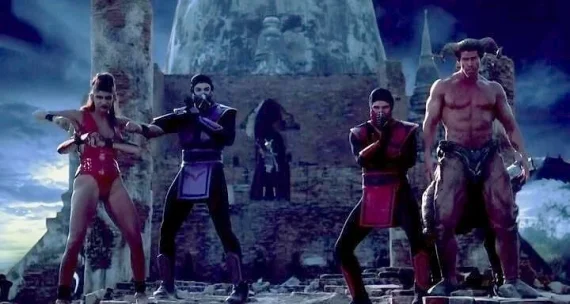
In the pantheon of notoriously bad film sequels, Mortal Kombat Annihilation is right up there with your Superman IV’s and Highlander II’s. Despite boldly opening as a direct story follow on from the first film, picking up exactly where Mortal Kombat left off, Annihilation almost immediately fumbles the catch. Gone is the fantastic sets and production design of the first film, as is a huge chunk of the cast. Bridgette Wilson, Linden Ashby and Christopher Lambert are all out from the original, replaced here respectively by Sandra Hess, Chris Conrad and James Remar. Thankfully we have Robin Shou returning as Liu Kang, taking top billing here, but it’s plain to see that he clearly knows he’s starring in a clanker this time round and his heart really isn’t in the performance.
It’s largely downhill from here as the plot spirals out into more excuses to give the games extended cast an appearance and we scrape the barrel to put characters such as Ermac and Rain who, at the time, were little more than cameos in the games, into central slots as Shao Khan’s generals. The plot itself is pretty much nonsensical, revolving around Khan’s use of Kitana’s mother Sindel (Vander) who he’s resurrected to allow him to access Earthrealm, while Liu Kang toddles off by himself to learn how to unlock his animality, something that is indeed as pointless as it sounds.
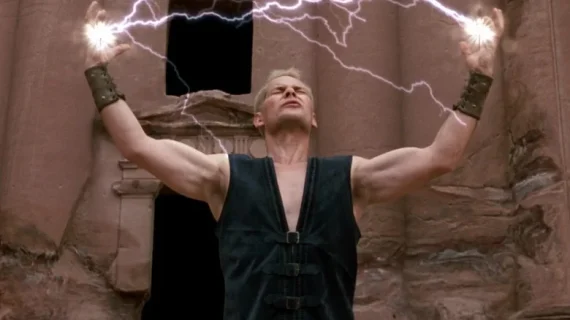
Look, these films are not exactly meant to be high art but Paul W.S. Anderson’s original had a lot of heart and looked great to boot. Meanwhile director John R. Leonetti, the first film’s cinematographer, seems to want to turn everything here into something that wouldn’t look out of place in an underbudgeted episode of Xena: Warrior Princess. Everything looks so cheap, from the costumes to the sets, and even the location shooting just feels like the actors were thrown into a quarry most of the time despite having filmed in locations like Jordan and Thailand. All of this is shot with some weird camera angles, unnecessary close ups and bizarre framing choices that give it an incoherent and rushed feel. Add to this some utterly lousy CGI which is vastly overused in the film and you have an absolutely excruciating and remarkably boring watch.
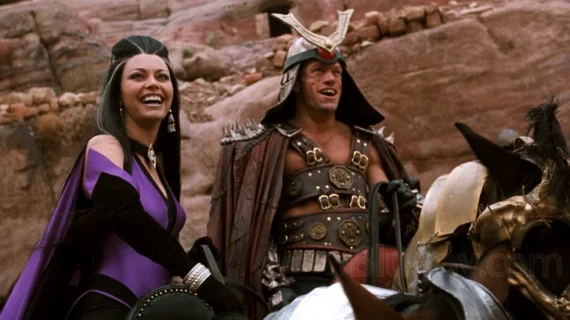
The cast is such a mixed bag this time round with Shou lacking any of the enthusiasm he had in the first film, while Soto’s expanded role as Kitana doesn’t do her seeming lack of acting chops any justice. James Remar as Raiden really doesn’t look like he knows what kind of film he’s in and doesn’t have any of the charisma of Christopher Lambert from the original, while Brian Thompson is wildly miscast as Emperor Shao Khan. Instead of being a menacing and imposing figure, the kind of role that Thompson was made famous for on shows like The X-Files and Buffy The Vampire Slayer, the actor instead decides to camp it up in a performance that’s only amplified by the badly fitting halloween costume he’s forced to wear, coming off less as a tyrant and more as a petulant child.
There are some positives to be had, though, with Sandra Hess turning in a much better performance as Sonya Blade versus Bridgette Wilson, while Lynn “Red” Williams is respectable as the cybernetically enhanced Jax, Sonya’s former Special Forces partner. The fight scenes are also a lot more kinetic this time round, with performers more than comfortable with the stunt work and a bigger stunt team, discussed at length by performer J. J. Perry in the bonus features, while the brief appearance of Sheeva, a character similar to the four armed Goro in the first film, is realised with some great looking prosthetics and animatronics.
Filmed for $30,000,000 it’s hard to see where that money when when watching Mortal Kombat Annihilation. Coming in at #1 in the US box office on release, the film subsequently received a critical panning and it’s not a movie that fits into the “so bad it’s good” category of filmmaking. This is a stinker in every sense of the word and thoroughly killed Mortal Kombat on film until the 2021 reboot.
Bonus features
- 4K restoration of the film from the original camera negative by Arrow Films approved by director John R. Leonetti
- Brand new audio commentary with director John R. Leonetti moderated by filmmaker Gillian Wallace Horvat
- Brand new audio commentary with comic book expert and podcast host Dave Baxter
- The Queen of the Night, a newly filmed interview with actor Musetta Vander
- Techno, Taiko, Orcho, a newly filmed interview with composer George S. Clinton
- The Man of a Thousand Deaths, a newly filmed interview with stunt performer J.J. Perry, who played Cyrax, Scorpion and Noob Saibot
- On-set interview bites with the cast and director and B-roll footage
- Theatrical trailer
- Image gallery
The bonus features on Annihilation feel much more like retrospective interviews with cast and crew rather than anything that digs into the production which is a real shame. It’s been well documented that Annihilation was a rather troubled production, rushed to cinemas with unfinished CGI and featuring a screenplay that had to be dramatically adjusted due to time and budget restraints.
Present on both these discs is a selection of behind the scenes footage which, while fascinating to watch, is presented without any kind of structure. It’s a shame, given the recent editing of vintage BTS footage into a full length documentary which was given to Arrow’s recent 4K release of Nightbreed and it’s hopefully something we can see a bit more of in the future.
Overall
Ultimately your decision on whether to purchase this collection of Mortal Kombat films is going to come down to how comfortable you are spending money on Annihilation. Clearly Arrow agrees and has given this a fairly reasonable price for a two film set. The packaging is as lovely as always, with new artwork for both films and you’ll be getting that usual Arrow premium with solid 4K transfers all round. The first movie is absolutely worth your time, though, so if 4K isn’t so important to you, you may want to consider picking up the slightly cheaper Blu-Ray collection instead.