


 Takashi Miike is a ridiculously prolific director (124 completed credits on IMDB at the moment) who became a popular cult figure in the West during the ‘Asia extreme’ boom of the late 90s and early 2000s. With such a vast filmography, he has ventured into a wide variety of genres over the years, but most people outside of Japan will know him best as a purveyor of shockingly violent and often jaw-droppingly bizarre films.
Radiance Films are looking back at Miike’s most productive years, starting from when he first got noticed in the West, by releasing a trio of Yakuza films made by the director. The set is entitled Underworld Chronicles: Three Yakuza Fables by Takashi Miike, and it contains the following films:
– Fudoh: The New Generation
– Agitator
– Deadly Outlaw: Rekka
Fudoh: The New Generation (a.k.a. Gokudô sengokushi: Fudô)
Director: Takashi Miike
Screenplay: Toshiyuki Morioka
Based on a Manga by: Hitoshi Tanimura
Starring: Shôsuke Tanihara, Miho Nomoto, Tamaki Kenmochi, Marie Jinno, Kenji Takano, Takeshi Caesar, Toru Minegishi
Country: Japan
Running Time: 99 min
Year: 1996
To quote from Radiance’s press blurb, in Fudoh: The New Generation, “Riki Fudoh (Shôsuke Tanihara) is a high school student juggling academic work with a secret life operating as an underworld boss. As the leader of a group of larger-than-life, school-age assassins, Fudoh is waging a campaign of violence against the entire criminal underworld, as part of a revenge plot against his own father (Toru Minegishi), a high-ranking Yakuza in his own right who was forced to murder Fudoh’s brother.”
Fudoh: The New Generation was based on a manga by Hitoshi Tanimura that was actually cancelled partway through. This meant that Miike had the freedom to take the story wherever he wanted. As you might expect, he takes it in some pretty eye-opening directions (though, admittedly, I haven’t read the manga to know what he added). It was originally meant to be a straight-to-video movie, but it ended up strong enough for the distributors to give it a theatrical release. More importantly, it was shown at festivals in Brussels and Toronto, giving Miike his first taste of international recognition.
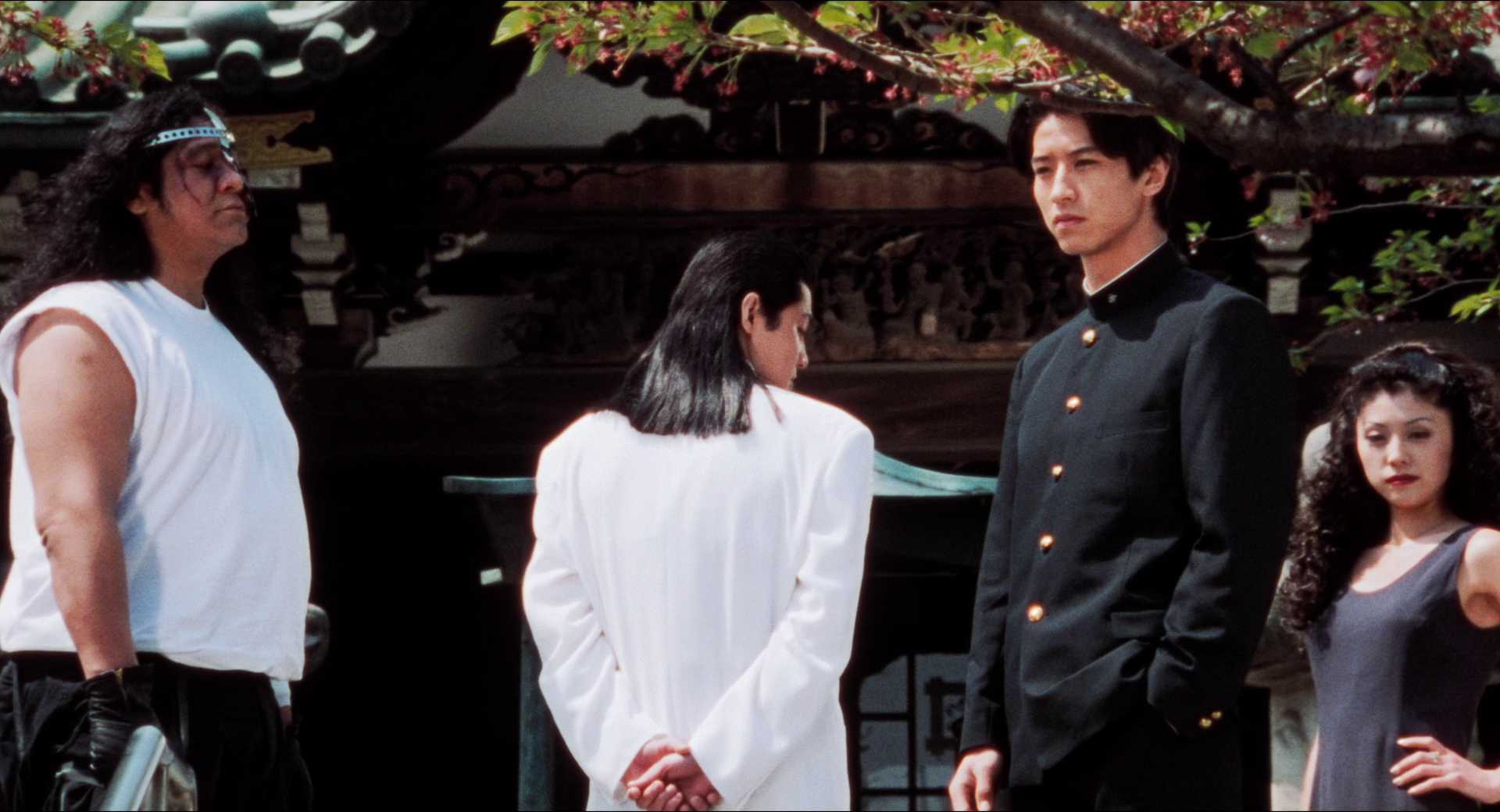
As such, and because he felt the shoot itself was a lot of fun, with a good energy, it’s always been a production close to Miike’s heart. It proved a little divisive among critics, but that was always going to be the case with such an extreme film that has assassin children at its core.
Personally, I enjoyed the hell out of it. The particularly young boy assassins are shocking when they first appear, but the film has enough surreal, pitch-black humour to make it work. Whilst there is some effective drama, particularly with regard to Riki’s relationship with his father and brother, the film thrives in having fun with the concept of the teenage Yakuza gang.
It’s a very stylish film, with some inventive, high-energy set-pieces, sharp editing and a banging soundtrack.

The objectification of a couple of schoolgirl characters feels pretty sleezy, particularly Mika (Miho Nomoto), who works as a stripper in the evenings and fires deadly darts through a pipe inserted into her vagina (?!). This is sadly not uncommon in Japanese films and TV series of the era (well, maybe the dartgun is uncommon, but you know what I mean). There is an interesting twist surrounding Mika later on, though, that adds some layers to the character.
Overall, Fudoh is an ultra-cool, eyebrow-raising manga adaptation. Its sleezier aspects won’t be to everyone’s tastes, but it’s all done in such an unusual fashion that it fits the tone and makes for a fun watch, if you have the stomach for it.
Film: 

Agitator (a.k.a. Araburu tamashii-tachi)
Director: Takashi Miike
Screenplay: Shigenori Takechi
Starring: Masaya Katô, Naoto Takenaka, Hiroki Matsukata, Masatō Ibu, Mickey Curtis, Kenichi Endō
Country: Japan
Running Time: 150 min (theatrical) 200 min (extended)
Year: 2001
Once again quoting from Radiance for my plot summary, Agitator sees “a yakuza (played by Miike himself in a cameo) […] murdered after violently assaulting a hostess on rival turf, providing the catalyst for a gang war between a number of factions seeking a redistribution of power. In this densely-layered gangland drama, the backroom manoeuvring of the senior figures in the yakuza, overseen by Mr Kaito (Hiroki Matsukata, Rapacious Jailbreaker), are juxtaposed against the actions of the street-level mobsters, as the two sides head towards an inevitable collision.”
On top of the theatrical version of the film, Radiance have managed to get the rights to the extended 200-minute version of Agitator for this release, which was long-thought unavailable in the West. It was only available in an SD presentation, but I opted to give it a watch anyway, due to hearing good things about it online.
I won’t lie, I haven’t had a chance to watch the shorter (though still two-and-a-half-hours) cut to compare, but I was very impressed by the longer version of Agitator.

The film is, on the whole, more sober and relatively conventional at first glance than the other films in this set, but it’s not without Miike’s trademark quirks and splashes of offbeat humour. Whilst anchored by a typically complex Yakuza plot, at its heart, it’s a character piece. I imagine this comes to the fore more notably in the longer version, which takes its time to tell its story.
The key relationship in the film is that between Kunihiko Kenzaki (Masaya Katô) and his boss, Yoichi Higuchi (Naoto Takenaka). The latter is somewhat of a father figure for the former, who is a fiery young upstart that wants to use brute force to gain power for his boss, like the ‘good old days’. The pair have a touchingly intimate scene together in the second half of the film, where they go to a spa and have a lengthy heart-to-heart.
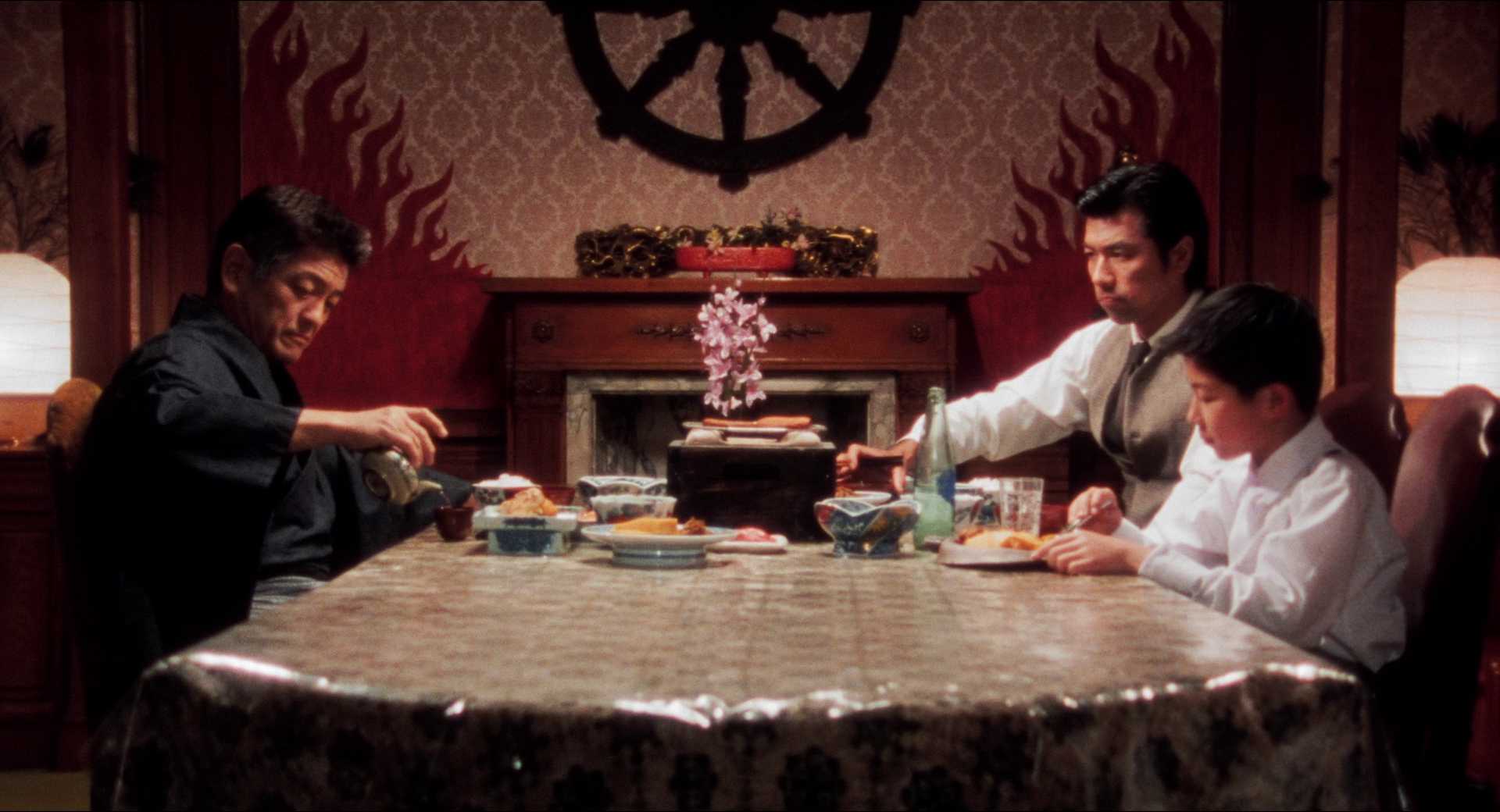
Agitator also often looks at the mundanities and minutiae of Yakuza life – the business-like aspects of the upper-echelon members and the low-key, communal lives of their underlings.

The film was largely shot with natural light or at least without fancy, carefully planned lighting setups. This allowed the crew to get on with filming and the cast to really dig into their roles without too much interruption. It helps give the film a loose, natural feel.
There are some disturbing moments, though, such as when an innocent woman gets violated by a microphone, as well as the usual bloody Yakuza hits and showdowns. It all ends in a brutal, nihilistic bloodbath, as you might expect.
Overall, Agitator is a sprawling but relatively low-key epic that builds in drama as it moves on, and blends classic Yakuza brotherhood with stylistic flourishes, odd quirks and effective character development.
Film:

Deadly Outlaw: Rekka (a.k.a. Jitsuroku Andô Noboru autorô-den: Rekka)
Director: Takashi Miike
Screenplay: Shigenori Takechi
Starring: Riki Takeuchi, Ryôsuke Miki, Ken’ichi Endô, Shin’ichi Chiba, Tetsurô Tanba, Daijirô Harada, Renji Ishibashi
Country: Japan
Running Time: 96 min
Year: 2002
As Radiance describes, Deadly Outlaw: Rekka can be summarised as follows, “Kunisada (played by V-cinema legend Riki Takeuchi) has his world turned upside down after learning of the death of his mentor Sanada (Yuya Uchida, founder of the Flower Travellin’ Band, who also provide the film’s hard-rocking psychedelic soundtrack). Pairing up with his best friend Shimatani (Kenichi Endo, Visitor Q), Kunisada embarks on a rampaging road trip to avenge his fallen father figure, leaving a trail of bullets, blood spatters, and bazooka fire in his wake.”
Deadly Outlaw: Rekka has a similar story on paper to Agitator. However, unlike that earlier film, Deadly Outlaw: Rekka isn’t interested in realism. It throws in plenty of outlandish touches, particularly in the final act. This is Miike cutting loose and having fun again, as with Fudoh.

The action scenes are impressive, too, with effective use made of slow-motion in places. The use of propulsive rock music by The Flower Travelling Band gives the sequences an extra boost.
However, despite the chaos and violence, the film has heart in the brotherhood between Kunisada and his gang members, particularly Shimatani, with whom he shares a close bond. You also get a near-silent yet surprisingly effective romance between Kunisada and Myung-hyung (Mika Katsumura).

I didn’t find the balance of tones quite as effective here, though. The drama felt a little meandering at times. I found the plot particularly confusing, too, meaning I struggled to stay as engaged as I did with the slower-paced but more gripping Agitator. The ending was a little baffling, too, though I liked the final sequence with the retired Yakuza doing his laundry.
So, Deadly Outlaw: Rekka is another stylish ride, but this didn’t gel as effectively as a whole, for me. It’s fun, but needlessly confusing at times and a little uneven.
Film: 
Underworld Chronicles: Three Yakuza Fables by Takashi Miike is out on 23rd March on region B Blu-Ray (and UHD for Fudoh), released by Radiance Films. The transfers are impressive. Fudoh, which is presented on both UHD and Blu-ray (I opted for the former), looks particularly good, with a natural grain and deep blacks without sacrificing detail. Agitator is difficult for me to judge, because I only watched the 200-minute extended version (I only listened to the commentary over the shorter cut). The extended version is sourced from an SD copy, possibly even a VHS, by the looks of things. So, it certainly doesn’t look like Blu-ray reference material, but it’s still wonderful lto have it included. I’ve had a little look at the shorter version, though, and that transfer looks much more impressive, with a thick, natural grain and pleasing colours. Deadly Outlaw: Rekka looks sharp, with pleasing colours and a natural grain, though this is quite heavy in darker scenes. I’ve used screengrabs throughout this review to give you an idea of how the films look, though these have been compressed. The audio on each film is faultless.
BLU-RAY LIMITED EDITION BOX SET SPECIAL FEATURES
– High-Definition digital transfers of each film on three discs, on Blu-ray for the first time in the UK
– Multiformat 4K UHD and Blu-ray presentation of Fudoh: The New Generation
– Standard definition transfer of 200 minute extended version of Agitator, presented in its original two-part form for the first time outside of Japan
– Uncompressed mono PCM audio
– Newly recorded introduction by Takashi Miike on Fudoh (2025, 5 mins)
– Newly filmed interviews with Takashi Miike on Agitator (2025, 24 mins) and Deadly Outlaw: Rekka (2025, 19 mins)
– Audio commentaries on Agitator and Deadly Outlaw: Rekka by Tom Mes (2025)
– Audio commentary on Fudoh: The New Generation with Takashi Miike and Shosuke Tanihara (2003)
– Electric Yakuza, Go to Hell!: documentary on Miike featuring interviews with Kinji Fukasaku, Takeshi Kitano, Shinya Tsukamoto and others (Yves Montmayeur, 2009, 59 mins)
– Archival interview with Takashi Miike (2012, 41 mins)
– Archival interview with Shosuke Tanihara (2003, 16 mins)
– Trailers
– Newly improved subtitle translations
– Reversible sleeves featuring original and newly commissioned artwork by Time Tomorrow
– Limited edition 80 page bound book featuring new writing by Tom Mes and Colin Geddes, and archival writing from Tony Rayns
– Limited edition of 5000 copies, presented in rigid box with full-height Scanavo cases and removable OBI strip leaving packaging free of certificates and markings
Miike and actor Shôsuke Tanihara provide a commentary for Fudoh. This sees the pair have fun reminiscing about the shoot. They occasionally get distracted by watching the film, but it’s an enjoyable track, nevertheless, and they also have some thoughtful discussions about the film and its reception.
Tom Mes provides commentaries for Agitator and Deadly Outlaw: Rekka. On both tracks, he breaks the films down in detail, providing some analysis and insight into Miike’s approach. He often describes what’s happening on screen, which is usually a bugbear of mine, but, with the films having such complicated narratives, it’s quite helpful to have the plot explained so clearly.
Miike provides new interviews to go alongside each of the films (though only a short one for Fudoh, because there’s a lengthy archival interview with him included, alongside his commentary). What I love about these is that Miike has a reputation for making wild and crazy films, and he really churns them out, so you might expect more of a wired ‘character’, akin to Quentin Tarantino or Kevin Smith, but he talks with clarity and intelligence about his work, in a relatively reserved fashion (he’s a fair bit older now, though, of course). This depth and maturity can be seen in a lot of his films, once you look past the more extreme and out-there elements.
Miike also provides a short introduction to Fudoh, in which he relays his thoughts on why it’s an important title in his career. It’s worth a watch and doesn’t spoil anything, in case you’re wondering whether or not to watch it before the film.

There’s an archival interview with Miike on the Fudoh disc, too, as mentioned. This is good, with the director describing his experiences on set and talking about his career. He also lists his three favourite films, which is interesting to hear.
There’s also an archival interview with Shôsuke Tanihara on the same disc. He has some nice anecdotes to tell about his experiences, though the questions are a little bland at times (“how was it working with…”).
Of course, the inclusion of the extended cut is the biggest selling point on the Agitator disc. I’ve talked about this already in my review of the film and in my thoughts on the transfer, but I’ll repeat my note that this is from an SD, possibly VHS source, so it doesn’t look as clean and sharp as the other version. I found it perfectly watchable, though I am known to watch the occasional VHS, so I’m used to it.
There’s a near-hour-long archival documentary about Miike entitled ‘Electric Yakuza Go to Hell’ included on the Deadly Outlaw: Rekka disc. This opens in high-energy fashion, playing to Miike’s reputation at the time and includes interviews with a number of high-profile subjects that aren’t involved with the film, such as Takeshi Kitano, Alejandro Jodorowsky, Shinya Tsukamoto, Kinji Fukasaku and even a young Tony Rayns! The ‘cool’ stylised editing approach of the doc is a little dated, but it’s a strong piece and well worth watching.
I didn’t receive a copy of the book to comment on that, but judging by its length and the calibre of writers involved with it, I’d wager that it’s well worth reading.
So, Radiance have compiled a truly wonderful collection here. Miike fans should pick it up immediately.
Disc/package: