


Director: Grzegorz Krolikiewicz
Screenplay: Julian Kawalec, Grzegorz Krolikiewicz
Starring: Franciszek Trzeciak, Beata Tyszkiewicz, Jerzy Zelnik
Country: Poland
Running Time: 98 minutes
Year: 1977
BBFC Certificate: 15
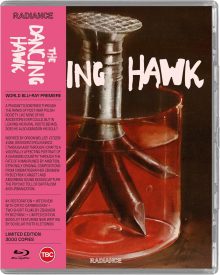
Over the past few years, Radiance Films has unearthed many wonderful and underseen cinematic treats, and for me, one of the most surprising was Grzegorz Królikiewicz’s Through and Through, a deeply troubling and innovative film that has haunted me ever since. When the opportunity came to review something else by this remarkable filmmaker, in this case The Dancing Hawk (due for release on blu ray later this month), I leapt at the chance.
A calm voice intones these lines: “I was born on the 1st of October 1914. I lived for 60 years”. So begins, in the most portentous way possible, the life story of Michal Topolny, (Franciszek Trzeciak) the lead character of The Dancing Hawk. Topolny translates as rustic or rough-hewn but can also refer to those who are “low-born”, and the film depicts his rise from rural peasant to full-time bureaucrat, through the most tumultuous decades of the 20th century, to his eventual downfall. Adapted from Julian Kawalec’s novel of the same name and inspired by a viewing of Orson Welles’ Citizen Kane, Królikiewicz’s film is very far from a rags to riches tale; it might best be described as an autopsy of a society where men like Topolny are corroded both by their careerism and the repressive forces brought to bear upon them.
Put simply, The Dancing Hawk is astounding, a work of cinematic innovation that ignores all the rules of narrative filmmaking and formal structure. What could seem like a freewheeling collage of set pieces and unrelated imagery is clearly at the command of a creator using every weapon at his disposal. This is most assuredly a film that demands your full attention. Królikiewicz conveys the turmoil of Poland with a disorienting array of arresting visuals – a soldier’s arm is amputated as if from the hand’s point of view, a village is buffered by a storm, a bar of soap burns next to an oven – and through the use of some of the most daring sound design in any film I’ve ever seen: axes sound like bells, hedgehogs crash like giants, and the sound of scratching and ticking permeate the film, creating a relentless state of unease. Characters and scenes repeat themselves, and there is a torrent of visual imagery that can only be fully absorbed after multiple viewings.
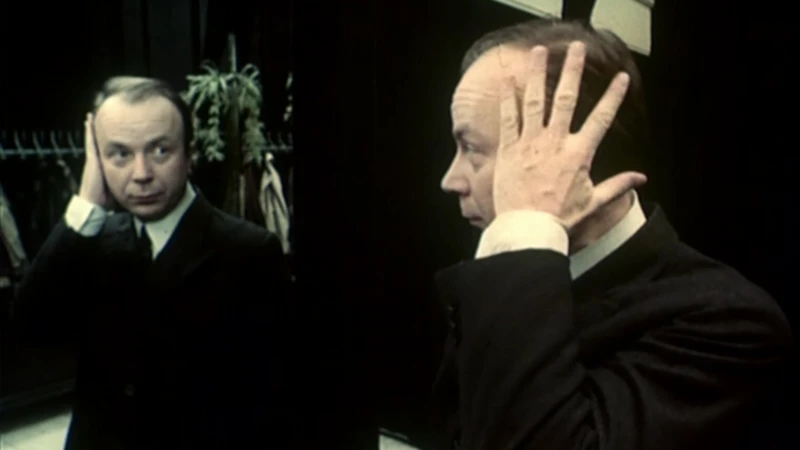
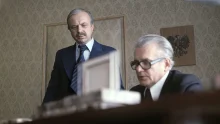
Franciszek Trzeciak brilliantly portrays Topolny as a man selected by those above him to be just one of many to transform post-war Poland and deliver prosperity to the people and the country, even if that means riding roughshod over anyone who raises even the most reasonable objection. With his high forehead and malleable features, Trzeciak’s tragicomic abilities reminded me of Josef Kemr’s performance in Peter Solan’s The Barnabáš Kos Case, recently released by Second Run. Topolny is a man continually out of step with himself: the higher he rises within the Stalinist apparatus, the more he loses of himself. This is best demonstrated in a scene where he looks at himself in a mirror and his reflection moves separately from him. But he also never allowed to forget his “low-born” status; when he strikes his wife’s lover in a fit of rage at a family gathering, it is Topolny who is upbraided for his rudeness at interrupting dinner.
The film does make oblique references to certain historical events: Topolny’s birthdate falls within the deadly Battle of the Vistula at the start of the First World War, and Topolny’s son is accused of being involved with “student riots” which is clearly a reference to major demonstrations that took place in 1976. When the critic Michał Oleszczyk advanced his view that Through and Through was the best Polish film ever made on the special feature of that release, I was astounded, but The Dancing Hawk more than makes the case for Królikiewicz as one of the great directors of the post war era.
BLU-RAY LIMITED EDITION SPECIAL FEATURES
- 4K restoration by Filmoteka Narodowa
- Uncompressed mono PCM audio
- New interview with critic Carmen Gray (2026, 16 mins)
- Two short films by cinematographer Zbigniew Rybczyński: Soup (1974, 9 mins) and Oh! I Can’t Stop! (1975, 10 mins)
- Newly improved English subtitle translation
- Reversible sleeve featuring original artwork by Jerzy Czerniawski and Andrzej Klimowski
- Limited edition booklet featuring new writing by scholar Piotr Kletowski
- Limited edition of 3000 copies, presented in full-height Scanavo packaging with removable OBI strip leaving packaging free of certificates and markings.
The extras may be few on this disc but they’re of very high quality. The interview with critic Carmen Gray is a very informative way to learn a great deal about the life and career of Grzegorz Królikiewicz, especially about his status as an “outller” in Polish cinema, his formative work and the ideas contained within his thesis “Film Space Beyond the Image”, something I would dearly love to read in translation. The shorts by Zbigniew Rybczyński are ridiculously enjoyable, a riot of colour and frenetic energy, and display a man of great talent whose aesthetic choices were clearly in sync with Królikiewicz. The booklet was unfortunately not available for review.