


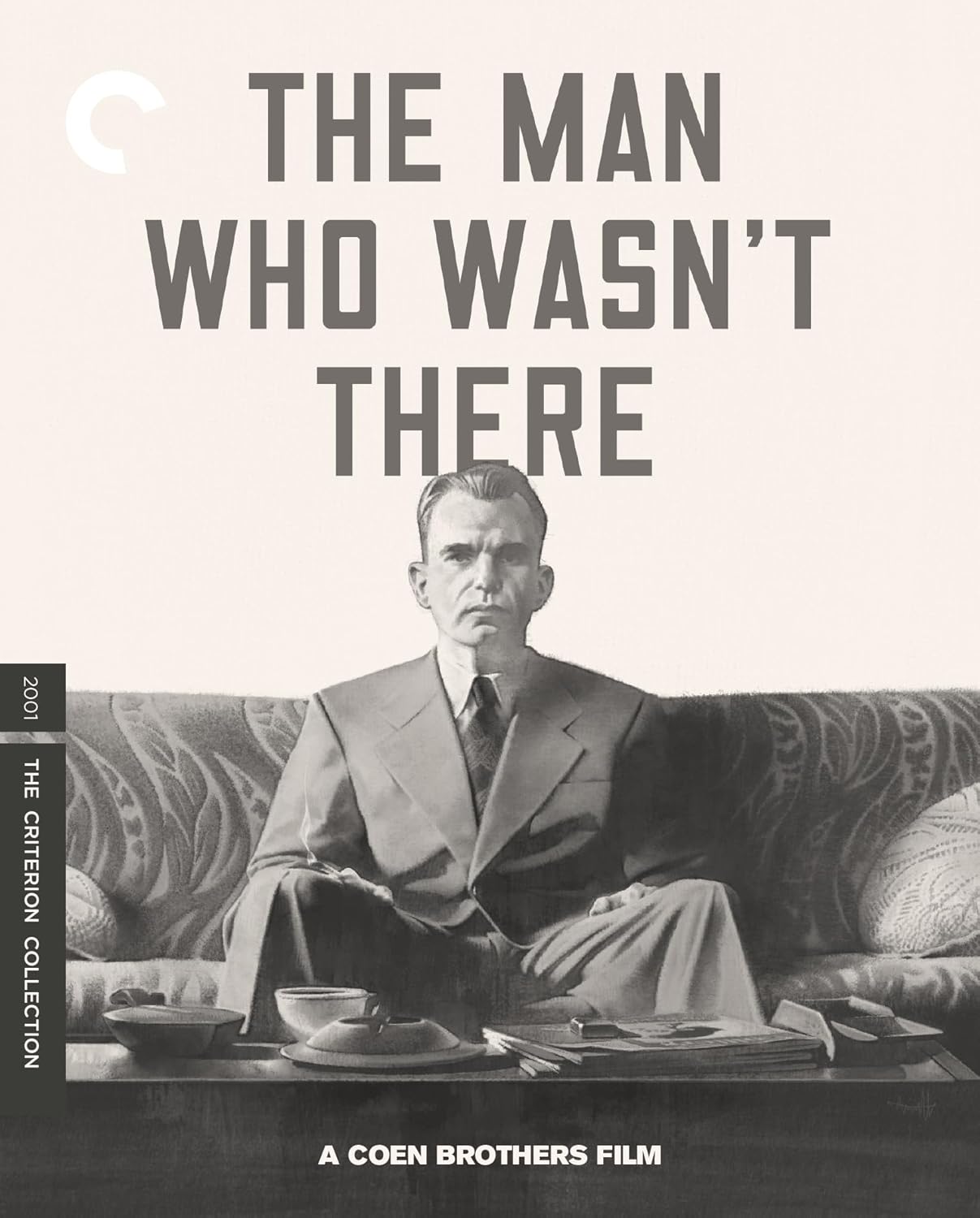
 Director: Joel Coen, Ethan Coen (uncredited)
Screenplay: Joel Coen, Ethan Coen
Starring: Billy Bob Thornton, Frances McDormand, Michael Badalucco, James Gandolfini, Jon Polito, Scarlett Johansson, Tony Shalhoub, Richard Jenkins, Katherine Borowitz
Country: UK, USA
Running Time: 116 min
Year: 2001
BBFC Certificate: 15
I’ve long been a fan of the Coen Brothers. They have been shining lights in the American independent movie-making scene since the mid-80s and, having properly ‘got into’ films sometime in the mid-90s myself, I soon came across them during this formative stage in my life. I fell in love with their idiosyncratic style and, whilst their films have their own distinctive Coen Brothers feel, they rarely fall back on repeating the same formulas.
Fans of the Coens will often lean into titles like The Big Lebowski, Fargo and No Country For Old Men, when asked to list their favourites. However, I’ve always held a special place in my heart for The Man Who Wasn’t There. I don’t know if it’s the film’s sumptuous black-and-white photography, the timing of when it was released (I was 19 and in love with the cinema) or that I connected with its socially inept protagonist, but I adore it.
So, when Criterion announced that they would be adding The Man Who Wasn’t There to their illustrious collection, on UHD and Blu-ray, I was thrilled and immediately requested a copy to review.
My thoughts follow.

Set in 1949, the film follows introverted barber Ed Crane (Billy Bob Thornton). He sleepwalks through life, passing his days in a fog of cigarette smoke and polite disinterest, observing rather than participating. Married to Doris (Frances McDormand), who is having an affair with her boss Big Dave (James Gandolfini), Ed becomes fixated on the idea of partnering with a customer, Creighton Tolliver (Jon Polito), to run a dry-cleaning business.
In order to get the money required to invest in Tolliver’s company, Ed decides to blackmail Big Dave. However, when things don’t go to plan, Ed’s dream spirals into a nightmare.
On the surface, it’s a classic noir setup, albeit with a quirkily ordinary spin (the Coens jokingly describe how they sold the film as being “about a barber who wants to be a dry cleaner”). Like many noir stories, it’s about an everyman who makes a bad decision that spirals out of control, yet the Coens filter this through an existential, blackly comic wringer that turns a genre pastiche into a quietly moving search for something else in life, and an exploration of how the world stands in the way of us discovering it.

It’s not just Ed that’s looking for something better, either. Doris is having an affair with Big Dave because she wants something exciting too, and not just a new man. The relationship was going to help get her the chance to manage her own shop instead of simply working as an accountant. Ed’s actions scupper these plans too.
Later in the story, Ed also tries to help Birdy (a young Scarlett Johansson) begin a path to becoming a concert pianist. This is a different situation, though, as it seems more his dream than hers, making for an alternative spin on the film’s theme.
All of these broken dreams and failed plans make for a film steeped in melancholy, but the Coens infuse their script with enough subtle, dark humour to keep the tone from getting maudlin.

The incredible cast also does a lot to keep the audience engaged. The film features a mix of Coen regulars and newcomers. Billy Bob Thornton, coming off largely more showy roles, including his acclaimed turn in Sling Blade, delivers a performance that is remarkably minimalist and beautifully nuanced. He stands out precisely because he doesn’t fit in, maintaining a subtle, muted tone amongst some more larger-than-life characters.
Frances McDormand is great too, her silent reactions speaking volumes, particularly in a scene where Ed confesses to the murder she’s been arrested for, which her lawyer, Freddy Riedenschneider, simply passes over, being too focused on his own narrative. Speaking of that particular character, Tony Shalhoub is an absolute joy as the fast-talking Riedenschneider. The scene where he unveils his plan for the case is a masterclass in performance, staging, and lighting, turning what could have been bland exposition into a standout scene.
I could praise every performer in the film, but I don’t want to prattle on for too long. I will, however, note the fact that the film features a 14-year-old Scarlett Johansson. Even at this young age, she has quite the presence.

Going back to the themes of the film, masculinity plays a significant role, with the question “What kind of man are you?” repeated by a couple of different characters. The Coens needle and subvert the period’s masculine stereotypes, from the blustering Big Dave to the “pansy” Tolliver, who makes an unexpected, odd pass at Ed, who himself plays an extreme version of the ‘strong, silent type’, who missed out on serving during the war due ot his fallen arches.
The film focuses on hair a lot, too. The tactile nature of Ed’s profession acts as his only real connection to the people around him. This detachment might also be a comment on the era being portrayed, where life wasn’t the rosy view of perfection people like to think it was back at the turn of the 1950s. The film plays out like an ode to the late 40s and early 50s more generally, with the recurring flying saucer motif linking to another fiction trend of the 50s, on top of noir.
It’s a film that can be viewed in numerous ways, then, but it can also be enjoyed at surface value, through how utterly gorgeous it is. Coen Brothers regular and all-around master of the craft, Roger Deakins was the DOP, and he outdoes himself here. He and the directors pay homage to noir’s stylistic tropes but take it to another level. It’s not just pretty either – the visuals are often used to tell the story or to enrich the characters. Take, for example, a shot when Ed walks through the empty department store. His figure is cast in silhouette, to match the mannequins next to him, reflecting his practical non-existence.

The film sounds beautiful, too. Carter Burwell’s score has a sense of yearning to it, mirroring the film’s central theme. Passages from a number of Beethoven’s piano sonatas are also used. This links in with the plot, of course, but the solo nature of the pieces also reflects the loneliness and isolation that’s ever-present in the film.
All-in-all, it’s a quiet, melancholic masterpiece that takes noir fiction on a slow, surreal walk. I still feel it’s the best film the Coen Brothers have made, despite having some stiff competition.
Film: 
The Man Who Wasn’t There is out on 2nd March on 4K UHD & Blu-Ray in the UK, released by The Criterion Collection. I watched the UHD, and it looks gorgeous. It has an incredible level of detail, rich tones in HDR and a sharp yet natural picture. It sounds pristine too.
DIRECTOR-APPROVED 4K UHD + BLU-RAY SPECIAL EDITION FEATURES
– New 4K digital restoration, supervised and approved by director of photography Roger Deakins, with 5.0 surround DTS-HD Master Audio soundtrack
– One 4K UHD disc of the film presented in Dolby Vision HDR and one Blu-ray with the film and special features
– Audio commentary featuring filmmakers Joel and Ethan Coen and actor Billy Bob Thornton
– New conversation between the Coens and author Megan Abbott
– Archival interview with Deakins
– Short making-of documentary and deleted scenes
– English subtitles for the deaf and hard of hearing
– PLUS: An essay by author Laura Lippman
– New cover by Marc Aspinall

Thornton and the Coens have a lot of fun in their archival commentary, reminiscing about the production and providing some wonderful tidbits about it.
There’s also an interview with the great Roger Deakins. He talks fondly about the film and explains his approach to the cinematography. It’s an illuminating piece.
Bringing us up to date is a recent interview with the Coen Brothers, conducted by Megan Abbott. This sees the Coens looking at some of the film’s themes and their directorial choices, which is unusual for the pair, who can often avoid speaking so openly about their work. As such, it’s a highly valuable addition to the set.
There are also a few deleted scenes on the disc. These are worth a watch, with the longest being Freddy Riedenschneider’s complete speech at Ed’s trial, without the voiceover.
I didn’t receive a copy of the booklet, unfortunately.
So, Criterion have put together a strong collection of extras to add to a film I love dearly, along with presenting it in a stunningly beautiful transfer. Highly recommended.
Disc/Package: 