


 Director: Gordon Chan
Screenplay: Gordon Chan, Kin Chung Chan
Starring: Stephen Chow, Sharla Cheung, Man-Tat Ng, Norman Chu, Lam Wai, Wang Chung, Chan Wai Yee, Chan Pak-Cheung
Country: Hong Kong, China
Running Time: 101 min
Year: 1992
BBFC Certificate: 12
Gordon Chan might not be a household name in the West, but he’s a fairly big director in Hong Kong and was behind a number of classic titles, including Fist of Legend, Beast Cops and Thunderbolt. He’s still working today, in fact, though he hasn’t had any big crossover successes in recent years.
Back in the early 1990s, Chan also worked with Stephen Chow on some of his early massive hits; the first two Fight Back to School films and the wuxia comedy King of Beggars. The latter was released in 1992, which was a phenomenal year for Chow. He starred in all of the top 5 earners at the Hong Kong box office that year, managing to beat even the indomitable Jackie Chan, whose Twin Dragons and Police Story 3: Supercop only just scraped into the top 10.
Eureka have already released a couple of the other top 5-ranking films Chow made in 1992, the two Royal Tramp films. Now they’re bringing us the title that sat in between them in the number 3 slot, King of Beggars. Having enjoyed the Royal Tramp films a great deal, I requested a screener and my thoughts follow.

King of Beggars sees Chow play the legendary So Chan (a.k.a. Beggar So), who, in the film, is a naturally gifted martial artist but lazy and spoiled by his wealthy father (Ng Man-Tat). However, he is forced to make something of himself when he falls in love with Yu Shang (Sharla Cheung), a prostitute who agrees to marry him on one condition: that he prove himself as a martial arts scholar.
In order to do so, So enters himself into an imperial martial arts tournament. However, despite his valiant efforts to defeat his opponent, So is unveiled as an illiterate cheat at the last moment by Chiu Mo-kei (Norman Chu). This leads to So and his father being cast out onto the streets, doomed to become beggars for the rest of their lives.
As the pair struggle with this drastic change in lifestyle, they become embroiled in a feud between Chiu and the Beggar Clan (which we discover is led by Yu Shang’s father).

I know the Beggar So figure best as Wong Fei-Hung’s teacher in Drunken Master and other related films, so it was interesting to see this ‘origin story’. In fact, a number of the characters in the film are based on true figures in history, though the way the story plays out in typical Stephen Chow nonsense fashion is obviously fictional.
There are references to Louis Cha/Jin Yong wuxia novels and other classic sources too, with Chan and Chow affectionately poking fun at the genre’s conventions, whilst embracing them at the same time.
There’s a little more drama than usual for a Stephen Chow film, and, on this front, it’s surprisingly effective. Whilst King of Beggars still contains plenty of his trademark mo lei tau (a.k.a. nonsense) humour, there are some sequences, particularly when So and his father first become destitute, that elicit genuine sympathy, without overbaking it.
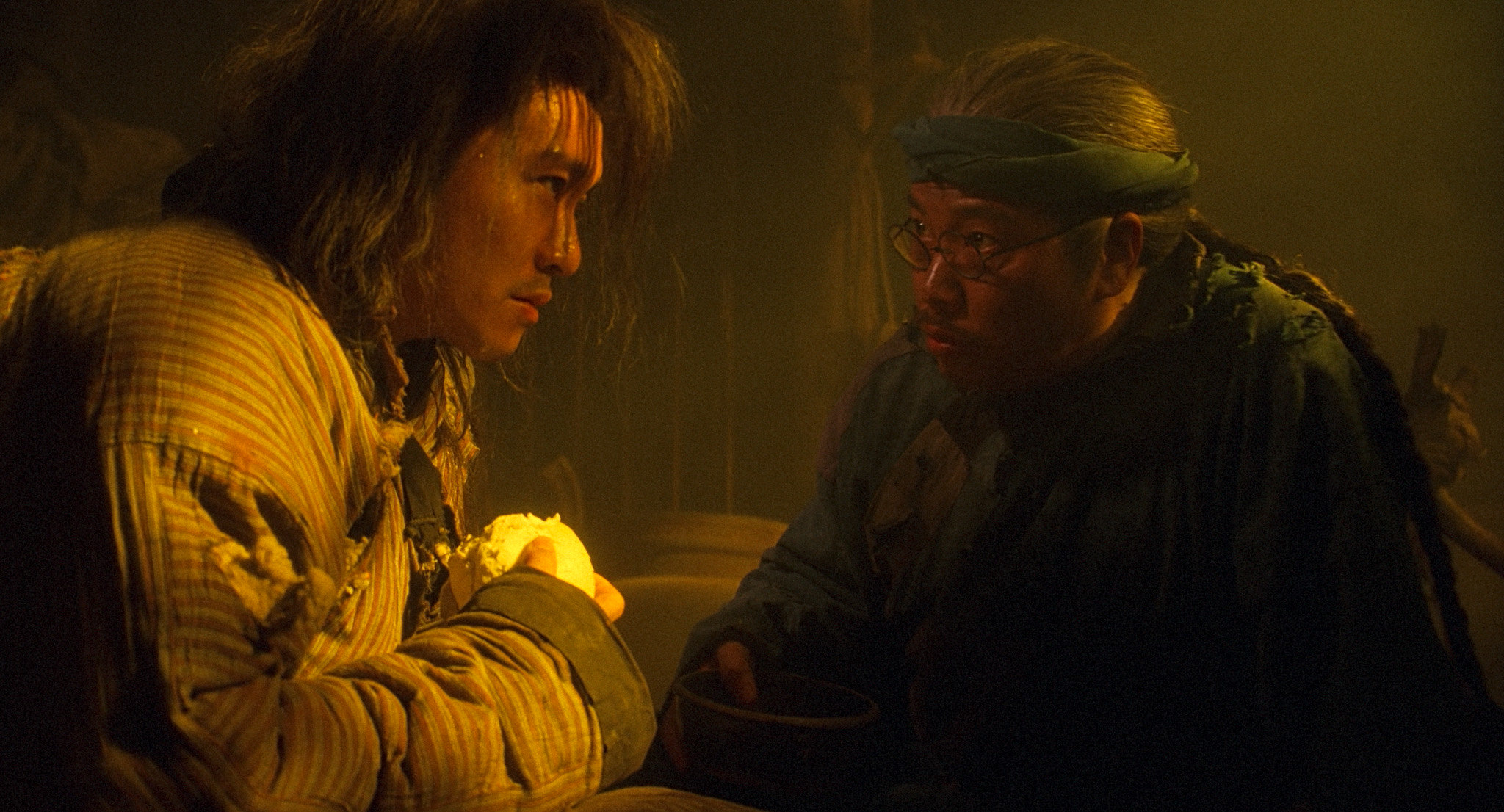
Chow’s character is well drawn, too. He is flawed at first, coming across as lazy and entitled, though this is balanced with enough charm and dashes of kindness to prevent him from being unlikable. Then, later, as his character matures, we grow to respect him.
If you came for more typical Stephen Chow tropes though, there’s plenty to enjoy. There’s some bawdy humour, particularly in the first act (which made me doubt my decision to watch the film with my two relatively young daughters) and lots of goofy visual and verbal gags. It didn’t have as many laugh-out-loud moments as some of the other Chow films I’ve seen, but it’s consistently amusing.
The action is pretty good too. It was choreographed by Yuen Cheung-Yan, one of the famous Yuen family members, who worked on countless classics, like Once Upon a Time in China, The Magnificent Butcher and Iron Monkey, to name but a few. I wouldn’t say his work in King of Beggars reaches the heights of those titles, but the fights are kinetic and inventive. There’s quite a lot of action for a Stephen Chow film too, so wuxia fans will be happy.

The film also looks good, with nice use of colour and some interesting camera angles, courtesy of the great cinematographer, David Chung.
Overall, however, whilst King of Beggars is one of Stephen Chow’s most well-rounded productions, with an effective balance of action, comedy and drama, I didn’t feel it ever pushed things up a notch. Whilst consistently enjoyable, I never found the jokes hilarious or the action mind-blowing. It’s just a really solid film. That’s not a bad thing, but it prevents me from rating it a little higher. Most Stephen Chow fans will be more than happy with it though.
Film: 


King of Beggars is out on 26th January on Blu-Ray, released by Eureka as part of their Eureka Classics series. The transfer is impressive, with rich, bold colours and a clean and sharp image. You get a choice of Cantonese or English dub for the audio. I opted for the former and had no issues.

LIMITED EDITION BLU-RAY SPECIAL FEATURES:
– Limited edition of 2,000 copies
– Limited edition O-card slipcase featuring new artwork by Sam Gilbey
– Limited edition booklet featuring new writing on King of Beggars and director Gordon Chanby Andy Willis
– 1080p HD presentation on Blu-ray from a new 2K restoration
– Cantonese audio (original stereo presentation)
– Optional English dub
– Optional English subtitles, newly translated for this release
– New audio commentary with East Asian cinema expert Frank Djeng (NY Asian Film Festival)
– Beggars and Tramps – new interview with director Gordon Chan
– So Chan and Stephen Chow – new video essay by East Asian cinema scholar Gary Bettinson, co-editor of The Cinema of Stephen Chow
– Original theatrical trailer
Frank Djeng provides a solo audio commentary. He believes it’s possibly Chow’s best film, and he delivers his usual tirade of background information and cultural insight with passion.
There’s also an interview with Gordon Chan. He talks about how he got involved in the project, as well as describing his working and personal relationship with Chow and some other members of the crew.
Gary Bettinson provides an essay on the film and its star. He looks at the connective tissue between Chow’s films and how his tropes win over audiences. It’s more eloquent and academic than you might expect for a piece on Stephen Chow, but it doesn’t feel dry or sound like he’s overreaching with his analyses at any point.
In the booklet, Andy Willis argues the case for Gordon Chan as a ‘metteur en scène’; a skilful, reliable filmmaker without a clear personal signature. It’s a fair assessment of a director who found commercial success in a wide range of genres.
So, Eureka have put together a strong package to support a solid Stephen Chow film that fans should certainly pick up.
Disc/Package: