



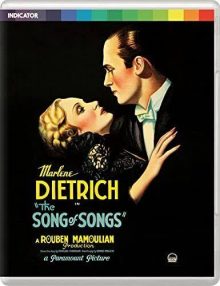
 Director: Rouben Mamoulian
Screenplay: Leo Birinski, Samuel Hoffenstein
Based on the novel by: Hermann Sudermann
Producers: Rouben Mamoulian
Starring: Marlene Dietrich, Brian Aherne, Lionel Atwill, Alison Skipworth
Year: 1933
Country: USA
BBFC Certification: U
Duration: 90 mins
As a big fan of Marlene Dietrich, I jumped at the chance to review Indicator’s new Blu-ray of her early pre-code film The Song of Songs but, in truth, there was another name below Dietrich’s on the cover that really sealed the deal. It was that of director Rouben Mamoulian, who was once such a big deal in Hollywood that he practically shares top billing with his star in the opening credits. You don’t hear Mamoulian’s name mentioned much anymore. He hasn’t really been embraced by auteurist circles and his more famous films, like the excellent Swashbuckler The Mark of Zorro or the classic Horror Dr. Jekyll and Mr. Hyde, are often snobbily pushed aside as mere fodder for lovers of those critically-minimised genres. Mamoulian’s masterpiece, the visually stunning Musical Love Me Tonight, is acknowledged as a gem only by those who have the passion to dig it out of the archives. Given his unique, inventive visual style, it’s hard to imagine why Mamoulian hasn’t been more widely reappraised as one of the greats.
The Song of Songs came right off the back of the double whammy of Dr. Jekyll and Mr. Hyde and Love Me Tonight, and was immediately followed by Queen Christina, which gave Greta Garbo one of her most iconic leading roles. Perhaps amidst such illustrious company, this relatively straightforward, if notably racy for its time, romantic Melodrama pales a little, but it nevertheless provides more evidence of Mamoulian’s distinctive and effective approach. Like some of the Melodramas of Douglas Sirk, the screenplay for The Song of Songs could’ve been a disaster in the hands of a lesser director. While it doesn’t quite scale the heights of Sirk’s greatest films, in Mamoulian’s hands The Song of Songs becomes an effective tragic love story replete with vivid symbolism and memorable scenes. It begins almost like a Fairy Tale, with the newly orphaned Lily (Dietrich) going to stay with a monstrous Aunt (Alison Skipworth, having a ball as a pantomime villain) who runs a bookshop. One day, the sculptor who lives across the road, Richard (Brian Aherne), visits the bookshop and is inspired by a glimpse of Lily’s leg to create something beautiful. With Lily sneaking out at night to pose nude for him, the two quickly fall in love. Unfortunately, one of Richard’s wealthy clients, Baron von Merzbach (Lionel Atwill), has also taken a liking to Lily and means to have her for his wife by any means necessary.
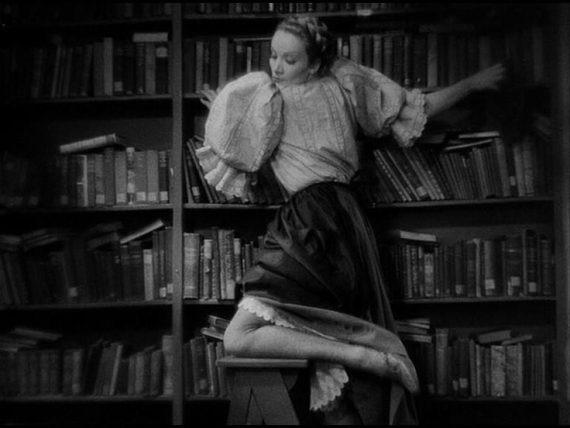
The first act of The Song of Songs in which Lily flits between the bookshop and the studio is my favourite part of the film. It sets up the characters beautifully and Mamoulian creates a real sense of place across his few small sets. The early flirtations between Lily and Richard are witty and the sense of youthful joy emanating from Dietrich as she portrays the innocent Lily is palpable. The subsequent acts in which the film takes a darker turn grow increasingly weaker, as Lily’s shattering life drives her into a state of numbness and finally spits her out the other side as a more recognisably sardonic Dietrich heroine. I still enjoyed The Song of Songs throughout but there’s a sense that it starts throwing in too many plot points, with yet another suitor for Lily complicating matters and pulling focus from the more compelling central triangle. I was also slightly underwhelmed by Dietrich’s celebrated performance. Though she is wonderful as the against-type naïf at the beginning of the film, the screenplay gives her little to work with in delineating her transformation into a broken, world-weary woman. It hops over the process, resulting in a performance that feels stitched together rather than cohesive. I was also a little disappointed with the final beat of the film, which seems to snatch away a potentially satisfying denouement for the sake of audience pandering.
Where The Song of Songs really works is in Mamoulian’s striking visual storytelling. Bolstered by the appealing (uncredited) art direction by Hans Drier, who’s eventual multiple Oscar wins included one for Sunset Boulevard, Mamoulian repeatedly shows without telling, increasing the emotional impact of otherwise underwritten moments tenfold. In one scene, a set of laid-out champagne glasses foretells an imminent atrocity in a manner that proves more disturbing than showing the event actually taking place. A sequence in which Lily removes excessive layers of clothing until she is standing in her undergarments foretells the changes her character will undergo. Most memorable of all is a brilliant sequence in which Lily undresses in silhouette while Richard, attempting to keep his burgeoning feelings in check, erotically caresses the work-in-progress sculpture of her as they converse.

With the arrival of the Hayes Code, scenes like the aforementioned contributed to the withdrawal from circulation of The Song of Songs, perhaps another blow to Mamoulian’s later reputation, but even upon its release many critics dismissed it as a tawdry Melodrama of little worth. While it is great to have it readily available once more, amidst a run of very confident Mamoulian films this one seems like a bit of an outlier. Dietrich was reportedly unhappy not to be working with Joseph von Sternberg, the director with whom her early career is so inextricably linked, and she returned to him for two subsequent films following this one. But, while its underworked screenplay ultimately failed to give her enough to work with, the role of Lily feels like an important one in broadening Dietrich’s considerable range, focusing on her beauty and sexuality in a far more subtle manner than Sternberg’s adoring lens had previously allowed. For fans of Dietrich, The Song of Songs is a fascinating film and for fans of Mamoulian it’s an essential further piece in the puzzle of a still-underrated director.
The Song of Songs is released on Blu-ray by Indicator on 24 July 2023. Special features are as follows:
-High Definition remaster
-Original mono audio
-Geoff Andrew on ‘The Song of Songs’ (2023): the writer and critic assesses the film and its place within the career of director Rouben Mamoulian
-Lux Radio Theatre: ‘The Song of Songs’ (1937): radio play adaptation of the film’s screenplay, featuring returning cast members Marlene Dietrich and Lionel Atwill, and Douglas Fairbanks Jr
-Original theatrical trailer
-Image gallery: promotional and publicity materials
-New and improved English subtitles for the deaf and hard of hearing
-Limited edition exclusive booklet with a new essay by Rick Burin, archival articles, an overview of contemporary critical responses, and full film credits
-UK premiere on Blu-ray
-Limited edition of 3,000 copies for the UK