


 Director: Mitchell Leisen
Screenplay: Preston Sturges
Starring: Barbara Stanwyck, Fred MacMurray, Beulah Bondi, Elizabeth Patterson, Willard Robertson, Sterling Holloway
Country: USA
Running Time: 94 min
Year: 1940
BBFC Certificate: PG
When they were solely writers in Hollywood, both Preston Sturges and Billy Wilder were publicly angry with director Mitchell Leisen for not following their scripts to the letter and were soon after spurred on to direct their own work. So, even if he didn’t direct any cast iron classics, Leisen could possibly be credited with kick-starting the directorial careers of two of Hollywood’s finest.
However, Leisen did direct some wonderful films, so deserves more credit than he receives. One such title that marks the director out for praise is Remember the Night, which was written by Sturges, his last screenplay before striking a deal with Paramount to allow him to direct his own scripts.
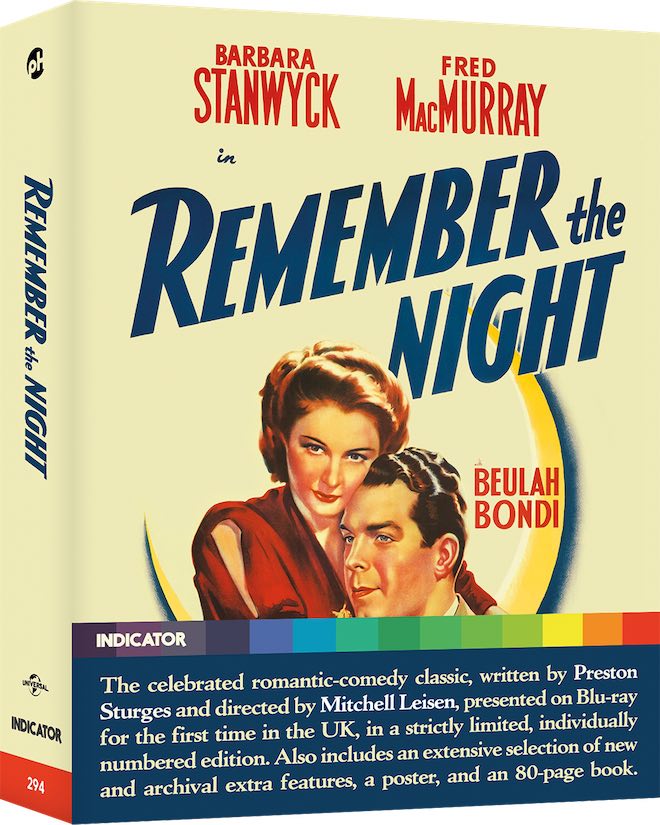
Remember the Night was a success on release, garnering both critical praise and box office returns. Sadly, possibly due to the less famous name behind the camera, the film isn’t as well remembered as a lot of similarly successful films of the era. Hoping to address that balance, Indicator are releasing Remember the Night in a lavish limited edition box set.
I got my hands on a copy and my thoughts follow.
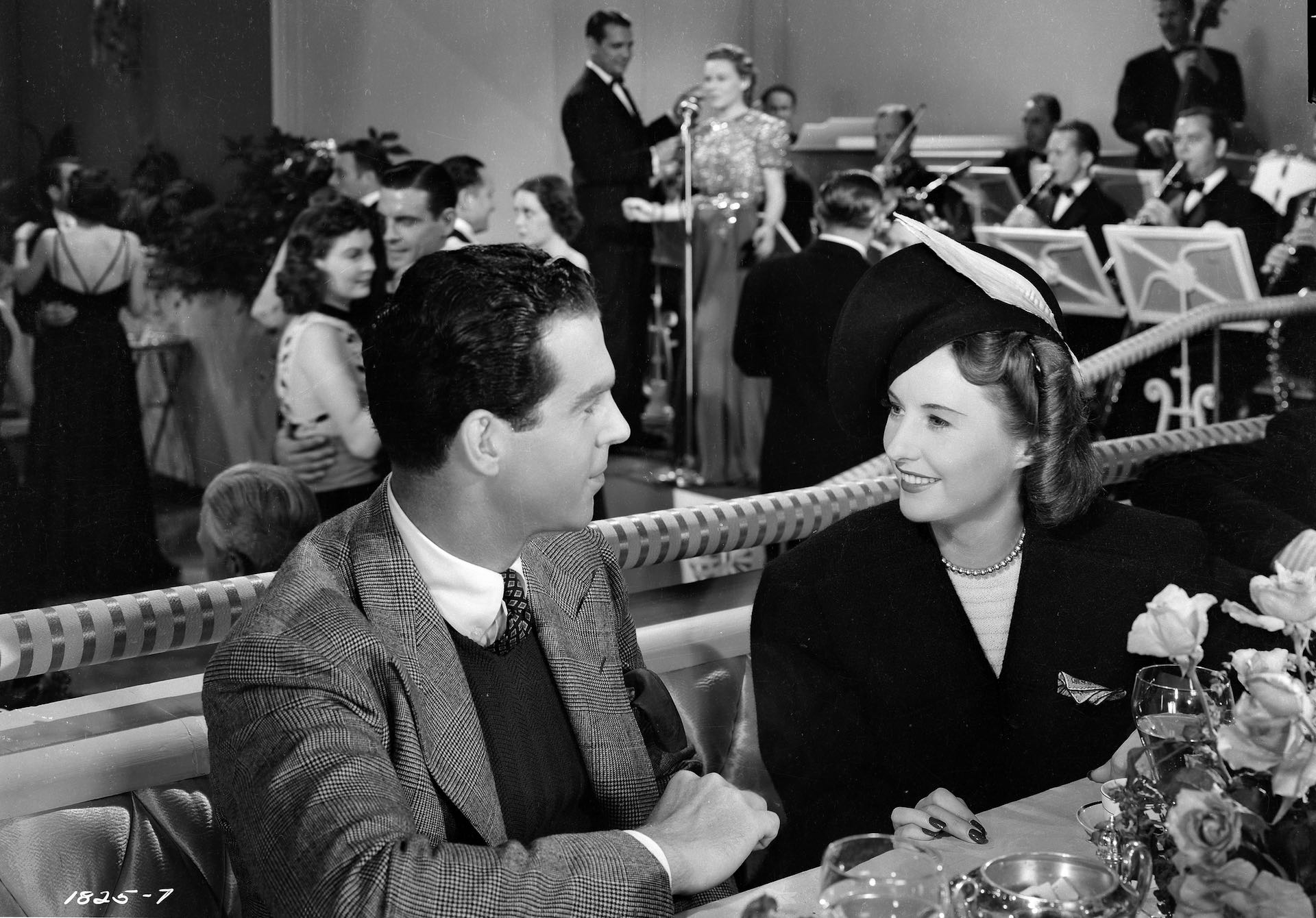
The film opens with Lee Leander (Barbara Stanwyck) getting caught trying to steal an expensive bracelet. She’s put on trial and, if found guilty, it will be her third offence so she’s likely to go to jail. Her defence attorney (Willard Robertson) flamboyantly lays claim that Lee was hypnotised into committing the crime. With the trial taking place close to Christmas, the prosecuting attorney John Sargent (Fred MacMurray) is worried the Christmas-spirit-imbued jury will be lenient on Lee, so uses the defence’s wild claims to his advantage, calling for a postponement so the court has time to bring in a doctor to examine whether Lee might have been temporarily out of her mind.
This plan works, but John soon realises the postponement will leave Lee in prison over the Christmas holidays whilst she awaits trial. Imbued with his own dose of festive spirit then, John pays the bail bondsman to let her out during the interim period.
The bondsman misinterprets this though and sends the released Lee up to John’s apartment. During their awkward meeting there, John learns that Lee, like him, is from Indiana but has nowhere to go during the holidays. So, John agrees to take her with him back to their home state.
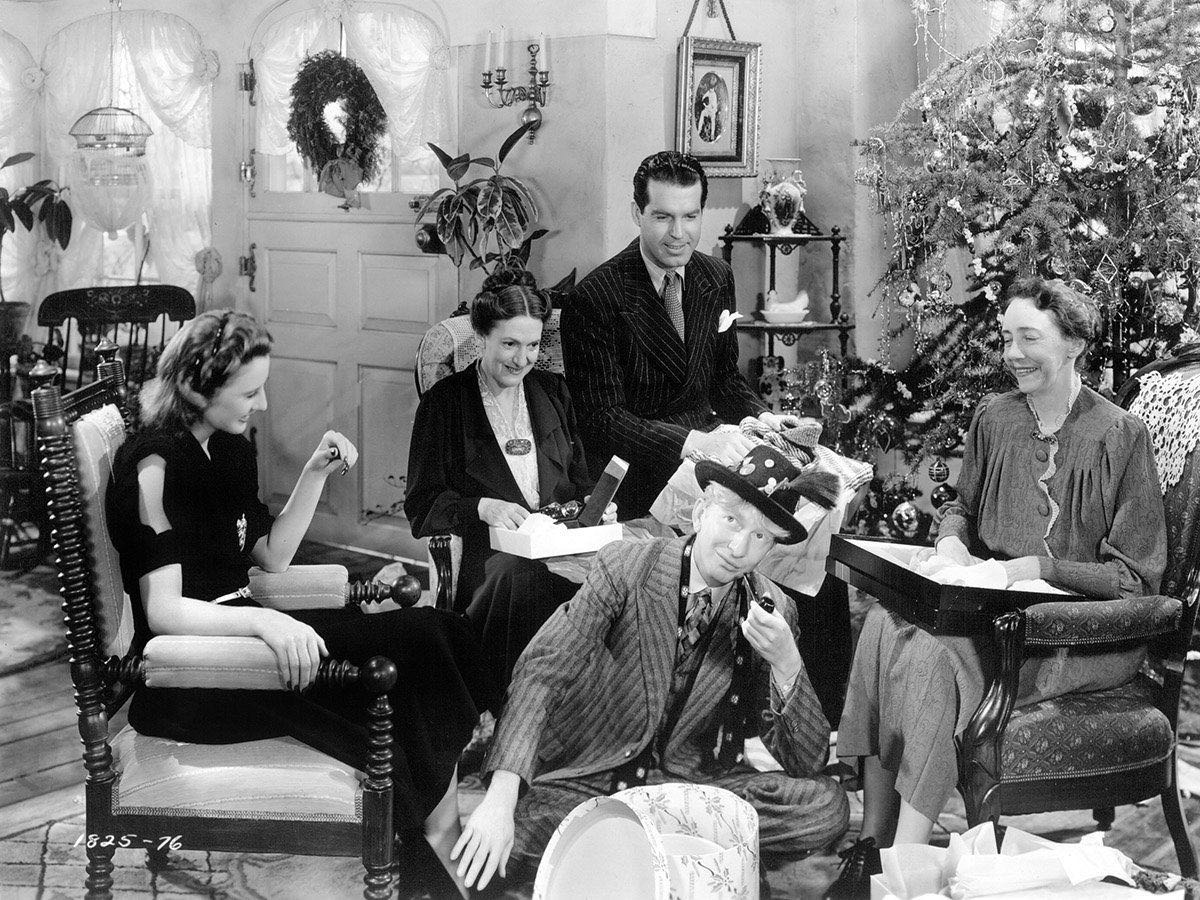
However, when John drops Lee off at her mother’s house, he sees that she’s not welcome there, so invites her to spend Christmas with him and his family.
The setup feels very much like that of a screwball romantic comedy and, indeed, that seems to be the case for a short while. The courtroom scene is particularly amusing, with a show-stealing turn from Robertson, and the witty banter when Lee first arrives in John’s apartment is razor-sharp. However, that acerbic, fast-paced feel gradually fades and disappears completely by the end.
I must admit, this shift knocked me back a bit when I realised what was happening. I was fully expecting a film more akin to His Girl Friday but got something quite different. However, once I knew what I was in for, I got fully on board.
As you might expect from this tonal shift, it’s not as cynical or satirical as a lot of Sturges’ work. Perhaps it’s Leisen’s influence but the characters here seem warmer than usual. They’re all given nice moments of drama too, even many of the minor players, allowing for a touching and very human story.
There’s perhaps a little satire. The culture of consumerism and the concept of kleptomaniacs who can’t help but steal these ‘shiny’ must-buy items was quite a new idea and on the minds of audiences of the time. So, having this female thief who likes to swipe the finer things, rather than the essentials, makes it a very contemporary piece. However, once we move to John’s family in Indiana, this aspect of the story is little to be seen and we gently bask in the pleasures of old-fashioned, simple, loving family life.

Yes, this portion of the film could be viewed as corny and sentimental, but Leisen manages to tread that line without fully drowning in it. This balancing act is helped by some of Sturges’ winning dialogue as well as the ever-present spectre of Lee’s impending trial.
Though the ultimate denouement might not be particularly surprising, the story often shifts in surprising directions too, dropping one situation for a very different one. It also shifts in tone a few times and the film balances these different moods very effectively. Again, this can be attributed to Leisen rather than Sturges.
Also pivotal to the success of the film and changes in tone though is Stanwyck. MacMurray is a solid, likeable lead but Stanwyck is something else. Her richly drawn character allows her to show a great range and depth of emotion. It’s her shoulders that carry the weight of the most powerful scenes and she pulls it off beautifully.
Overall then, Remember the Night is a touching romance that uses some sharp humour to reel you in and then a powerful central performance to hold you there. It becomes more of a gently unfolding melodrama than I expected but it never lurches too far into sentimentality, instead taking a fairly low-key approach, albeit with some very sweet moments and a little heartstring-tugging at the end.
It’s a Christmas treat that is laced with melancholy but still goes down well, like a glass of mulled wine.


Remember the Night is out on 19th December on Region B Limited Edition Blu-Ray in the UK, released by Indicator. It looks fantastic, with a wide tonal range and clear details. The audio is very strong for the film’s age too.
There are quite a few special features included in the Limited Edition package too:
– High Definition remaster
– Original mono audio
– Audio commentary with film historian Adrian Martin (2022)
– You May Laugh, You May Weep (2022, 26 mins): author and programmer Geoff Andrew revisits Remember the Night, exploring the contributions of writer Preston Sturges and director Mitchell Leisen
– Outsider Status (2022, 26 mins): critic Pamela Hutchinson assesses the life and career of the iconic silver-screen star Barbara Stanwyck
– Lux Radio Theatre: ‘Remember the Night’ (1940, 55 mins): radio adaptation which finds Fred MacMurray and Stanwyck reprising their roles from the film
– Lux Radio Theatre: ‘Remember the Night’ (1942, 54 mins): second radio adaptation, pairing MacMurray with Jean Arthur
– Hollywood Victory Caravan (1945, 20 mins): short promotional film starring Stanwyck and many other Hollywood names, including Humphrey Bogart, Bing Crosby, Bob Hope, Betty Hutton, and Alan Ladd
– Original theatrical trailer
– Image gallery: promotional and publicity material
– New and improved English subtitles for the deaf and hard of hearing
– Limited edition exclusive 80-page book with a new essay by Rick Burin, archival interviews with cast and crew, articles on the careers of director Mitchell Leisen and screenwriter Preston Sturges, an overview of contemporary critical responses, writing on Hollywood Victory Caravan, and full film credits
– Limited edition exclusive poster
– UK premiere on Blu-ray
– Limited edition of 3,000 copies for the UK
In his commentary, Adrian Martin stands up for Mitchell Leisen, pointing out his skills at economic storytelling and his ability to effortlessly shift between tones. He also discusses the qualities of Sturges’ script. It’s an excellent track.
Geoff Andrew adds to this in his illuminating essay, which is equally recommended.
Pamela Hutchinson’s piece looks at Barbara Stanwick’s life and career. It’s a fascinating story so well worth hearing.
‘Hollywood Victory Caravan’ is a war bond-promoting short from the era, of which there were many. The difference here is that it’s actually quite entertaining and star-studded. It even has a couple of decent song and dance numbers. I particularly enjoyed the stunning piano skills of Carmen Cavallaro, playing Gershwin.
You also get a pair of radio adaptations of the film. A 1940 version has the film’s leads repeating their performances and a 1941 version replaces Stanwick with Jean Arthur and also contains guest appearances from Bob Hope and Rita Hayworth. They’re fun extras.
The booklet is excellent, as always. It’s heftier than usual, running to 80 pages, taking in essays and articles on the film in general as well as on Sturges and Liesen. There are some fun period pieces too and a handful of archival reviews of the film.
So, Indicator have paid a fine tribute to this poignant classic. The set comes highly recommended, particularly the Limited Edition release with the indispensable booklet.
Disc/package: 