



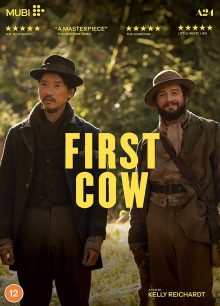
Director: Kelly Reichardt
Writer: Kelly Reichardt, Jonathan Raymond (based upon Jonathan Raymond’s novel)
Starring: John Magaro, Orion Lee, Toby Jones, Ewen Bremner, René Auberjonois
Year: 2019
Duration: 122 mins
Country: US
BBFC Certification: 12
It feels like Kelly Reichardt’s films have been hovering in my peripheral vision for a long time. Like many, I first became aware of her due to Old Joy, released all the way back in 2006, which I remember getting lots of good press and word of mouth at the time, although I never actually got round to seeing the film myself. I found myself in similar situations over the coming years. Reichardt’s films continued to garner significant praise, with movies such as Night Moves, Certain Woman and Meeks Cutoff seemingly heralding the arrival of a major new auteur. Yet still (admittedly, writing this now, to my slight embarrassment) I never got round to seeing any of Reichardt’s work. I have always been meaning to, of course, so when the opportunity arose for me to review Reichardt’s new film for its home video release, I jumped at the chance. Finally one of her films would swing clearly into view after all this time and I would be able to see just what all the critics and film fans have been going on about.
From what I have read about Reichardt’s earlier work, First Cow doesn’t seem to stray too far from an established template. Set in rural Oregon and focusing on the development and evolution of a friendship, it seems hark back to both Old Joy as well as Reichardt’s earlier period piece, Meeks Cutoff. The story itself is very simple. Cookie (John Magaro, whom you may recognise from Orange is the New Black) has travelled West with a group of fur trappers. Unpopular with this group, he manages to strike up a friendship with King-Lu (Orion Lee), a Chinese immigrant. The two soon go into business together making delicious pastries, their successes fuelled by Cookie’s talent at baking mixed with King-Lu’s savvy business instinct and ambition. Yet there is a snare in their plans – Cookie’s recipe relies on milk, which they have been stealing from the Chief Factor’s (Toby Jones) cow, which is the very first, and only cow, in the whole territory.
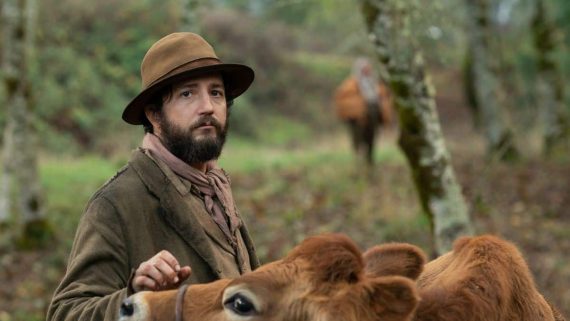
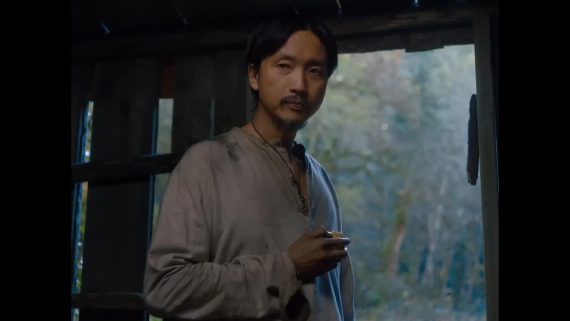
The first thing to strike you about First Cow is how remarkably authentic it feels. Reichardt doesn’t paint the past in golden, nostalgic hues. This is a world that feels lived in, muddy and raw. It is an environment that Reichardt luxuriates in, offering a fantastic sense of detail both in its characters and its setting; Cookie and King-Lu continually lay out their wares on a barren, muddy patch of earth in the town square, buildings are made out of fraying pieces of timber, seemingly liable to fall apart at any moment, clothes feel sweaty and lived in, while character’s hands are frequently covered with dirt and grime. Apart from a few isolated instances, a perpetual grey sky hangs over this world, adding to the earthiness of its setting and underlining the gently melancholic tone that hovers over the entire film.
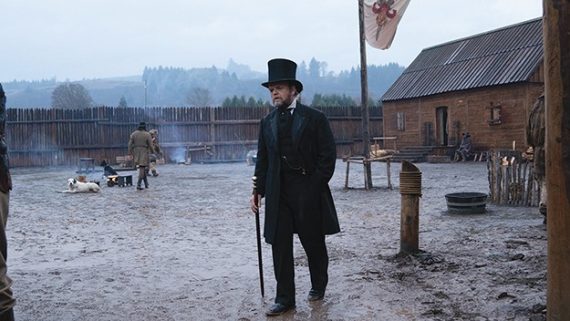
Much of the film’s success in attainting this authenticity is due to cinematographer Christopher Blauvelt, who captures the world of First Cow using a beautifully natural colour palette that shows off the splendour of the Oregon locations as much as it brings a gritty reality to the film’s sets and interiors. Together with Reichardt, they often create the unreal sense that they have gone back in time to capture these images.

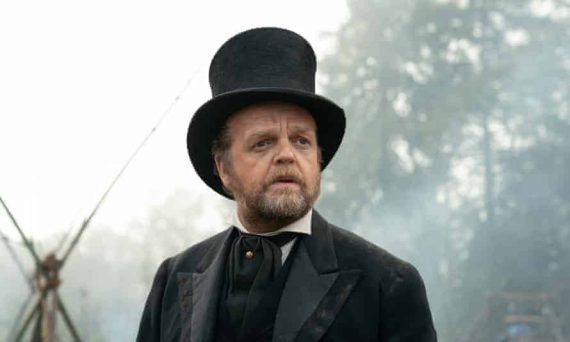
The film’s cast are as absorbed into this world as intrinsically as the age worn sets. All the performances here are quiet and subtle, where a glance or a smile can mean as much as a shout or a scream. John Magaro provides Cookie with a reserved, intimate vulnerability which is nicely offset against Orion Lee’s wry, quiet confidence. Their relationship is built and maintained as much by what is unsaid as what is said, with gaps left to be filled by the audiences’ imagination. Both Magaro and Lee are ably supported by great turns from both Ewen Bremner (who is an actor we should always see a lot more off!) and the ever brilliant Toby Jones, whose Chief Factor bristles with arrogance, guileless and menace.
For those unfamiliar with Reichardt’s work, it may be worth noting that her films have often been associated with the’ slow cinema’ movement and in this sense First Cow certainly fits the bill. It takes a good hour for the plot to fully blossom and come to life, with the first part of the film devoted to a gradual establishment of place and character. In this sense, the mediative, reflective pace, minimal dialogue and mostly static 4:3 camera work will not be to everyone’s taste. The film, like many others labelled slow cinema, require more effort from the audience to in order to reap the rewards. Quite often though, those rewards can be great.
This is absolutely the case with First Cow. What Reichardt has created here is a quietly powerful study of the simplicity of friendship and the beauty that can come with it. Haunted by an air of melancholy (thanks to a somber, present day opening) it ends suddenly yet poignantly, its characters and images lingering days after the final credits have rolled. In the end, it reminded me of Midnight Cowboy, another film where two souls, rooted unflinchingly in a specific time and place, find each other and try and make their way in the world. While First Cow may not achieve the longevity of that Sixties classic, it is certainly one of the most interesting and effecting films I have seen so far this year.
It seems Reichardt’s fans were right all along.
Mubi is releasing First Cow on Blu Ray, DVD and digital. I reviewed a DVD copy of the film. The picture quality is fine for the most part, although there were a few compression issues in night time scenes. I would imagine that the Blu Ray would fair better in this respect. Audio was fine, with dialogue clear and legible throughout.
The disc’s only extra is a 25 minute making off featurette. The film’s key players discuss everything from the differences between the book and the film, shooting in 4:3, how the DoP and Reichardt attempted to make everything as authentic as possible – there is even a section where everyone talks about how much they loved the cow! This is an interesting and informative documentary and is well worth a watch. It is a shame, however, that the disc doesn’t offer more, such as a commentary.