


Director: Shohei Imamura
Screenplay: Shohei Imamura and Koji Numata
Starring: Shōichi Ozawa, Sumiko Sakamoto, Haruo Tanaka, Masaomi Kondō
Country: Japan
Running Time: 128 minutes
Year: 1966
BBFC Certificate: 18

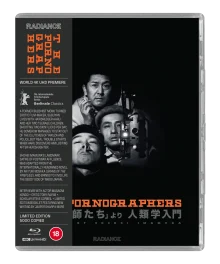
The storied career of director Shohei Imamura is one of the most fascinating in post-war cinema in Japan, a singular talent who was responsible for some of the most garlanded films of recent decades, most notably as two-time Palme D’Or winner with The Ballad of Narayama (1983) and The Eel (1997), shared with Abbas Kiarostani’s Taste of Cherry. The Eel was recently released on blu ray by Radiance Films, and has now been followed up by the release on blu ray and 4K of one of Imamura’s most important works, The Pornographers, known in Japan by the title ‘An introduction to anthropology through pornographers‘.
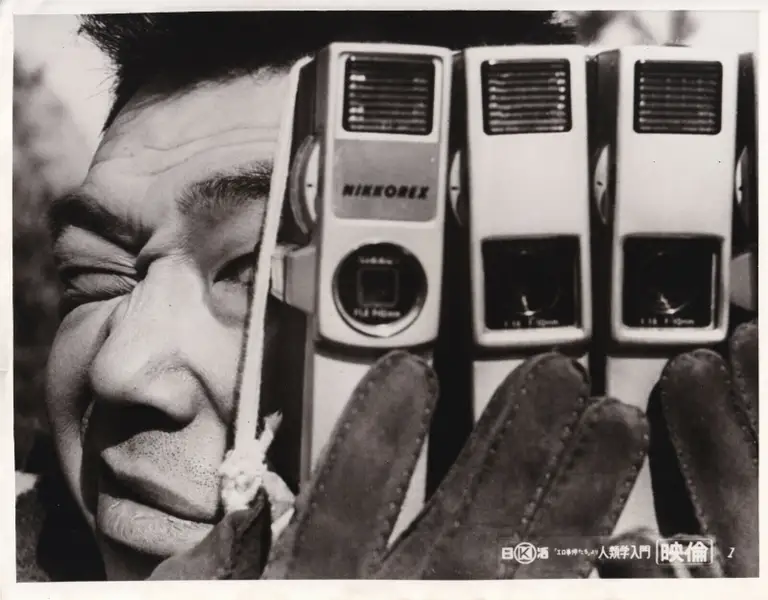
Imamura once famously stated: “I am interested in the relationship of the lower part of the human body and the lower part of the social structure on which the reality of daily Japanese life supports itself”. That relationship is at its most raw and exposed in this acerbic and darkly comic film. Shōichi Ozawa stars as Subuyan Ogata, a man trying to make ends meet by creating erotic films and photos with his buddies Banteki (Haruo Takana) and Kabo (Shinichi Nakano), filming in the scrublands and rundown spaces on the outskirts of Osaka. Ogata occupies a space between the emergent middle class customer base that has risen up via the economic boom, and the twin dangers of organised crime and an ever-vigilant police force, negotiating between these competing forces with charm and no small amount of skill, with the toll on his already complex personal life taking time and all those around him to their various breaking points.
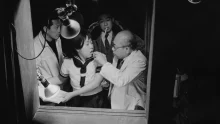
His landlady and lover Haru (Sumiko Sakamoto) has to deal with two unruly teenage children with their own ideas about their future, as well as the physical attentions of Ogata, whilst also firmly believing that her recently deceased husband has been reincarnated as a giant carp. This surreal detail has is absolutely crucial to the unfolding narrative, where the pressures of modern life under capitalism are no impediment to superstitious beliefs. Charms, prayers and talismans abound in this hypermodern tale where the exchange of money renders everything from educational advancement to emotional encounters to a financial transaction.

The Pornographers is not a sex film by any means: it dwells on the bureaucracy of exploitation, the sheer effort it takes to co-ordinate illicit activity, the expense of technology and the coercion of their onscreen stars. Everyone is in on the act of duplicity, from Ogata and his crew to his loathsome customers. As an indictment of the misogyny at the heart of Japanese society, it is second to none. That misogyny is played for very bleak laughs as everyone is complicit in their own exploitation. When Ogata is asked to procure a virgin for an elderly client, he simply consults a brothel madam for her most innocent looking girl. Even Haru attempts to palm off her teenage daughter Kumiko onto Ogata for sexual pleasure. This remarkable scene involves three protagonists separated only by a thin blanket, and is filmed with only two camera movements, and is just one of the many extraordinary moments of pure cinema contained in this film.
Shōichi Ozawa is brilliant is as the resolutely amoral Ogata, his sweat-soaked gruffness is merely a thin veil for the guilt ongoing transgressions. As Haru, Sumiko Sakamoto absolutely steals the show. Her descent from caring ‘wife’ and mother into the deranged creature she becomes is a genuine tour de force, aided greatly by a surreal set piece moment reminiscent of the master of fantastique, Jean Rollin. Produced for Nikkatsu Studio in 1966, The Pornographers now seems like a harbinger for the taboo-breaking ‘pinky violence’ films that the studio would specialize in for next decade, without every showing anything graphic at all. It’s a parade of delusion and alienation that takes some beating. As a first taste of what Shohei Imamura’s cinema is all about, this was a hugely impressive introduction.
4K UHD & BLU-RAY LIMITED EDITION SPECIAL FEATURES
- New 4K restoration from the original camera negative
- 4K UHD and Blu-ray presentation of the feature; world premiere on 4K UHD
- Uncompressed mono PCM audio
- Interview with actor Masaomi Kondo (2026, 21 mins)
- Interview with Steve Corbeil on Akiyuki Nosaka (2026, 25 mins)
- Interview with critic Tony Rayns (2026, 47 mins)
- Trailer
- Newly improved English subtitle translation
- Reversible sleeve featuring original and newly commissioned artwork by Time Tomorrow
- Limited edition booklet featuring new writing by Jasper Sharp
- Limited edition of 5000 copies, presented in full-height Scanavo packaging with removable OBI strip leaving packaging free of certificates and markings
The special features on the disc are, as ever with Radiance releases, elements that I really look forward to viewing. The interview with Masaomi Kondo, who played the clingy mummy’s boy Koichi in The Pornographers is a poignant one, as the elderly actor practically re-enacts his audition with Imamura when asked about how he got the role. He still seems astonished that he got the part all these years later. He shares some memories of the convivial working environment whilst shooting the film, and of his contentment in retirement.
The interview with Steve Corbeil delves into great detail about the life and works of author and cultural polymath Akiyuki Nosaka. Writer, singer, TV personality, friend to the stars, he is a fascinating figure, and Corbeil provides a great contextual overview of his place in the cultural of that era. The interview also contains footage of an incredible real-life scuffle between Nosaka and the film director Nagisa Oshima which took place at Oshima’s 30th wedding anniversary party.
The interview with Tony Rayns is as authoritative as you might expect from someone with an unsurpassed level of expertise. As a career overview it is outstanding, possessing a quality that places it amongst the very best special features on any Radiance release.
The accompanying booklet contains an essay by Asian cinema expert Jasper Sharp entitled ‘Flesh and Blood’. Sharp is effusive in his praise for both Imamura and this film, providing excellent explanations of the ‘flesh literature’ genre and detailing some of the key differences between the book and the film, describing both as ‘witty critiques of a phallocentric society’. I couldn’t agree more.
The trailer for the film contains two immortal taglines: MEN ARE PATHETIC CREATURES. WOMEN ARE MAGNIFICENT MONSTERS. Both are better suited to a John Waters film than this sardonic slice of duplicity, but are fun nonetheless.