


 Director: Sidney Gilliat
Screenplay: Bryan Forbes
Based on the novel by: Kingsley Amis
Producers: Leslie Gilliat
Starring: Peter Sellers, Mai Zetterling, Virginia Maskell, Richard Attenborough
Year: 1962
Country: UK
BBFC Certification: PG
Duration: 106 mins
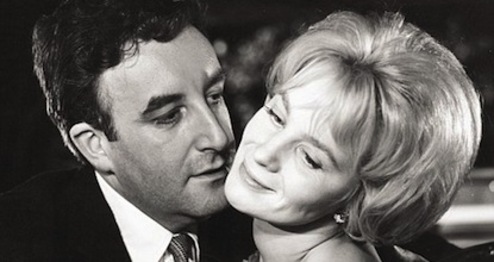
One of the most interesting periods in Peter Sellers’ filmography is the early 60s, just before the double whammy of The Pink Panther and Dr. Strangelove shot him to international stardom. Here is where we find films like the proto-Porridge prison comedy Two-Way Stretch and the bizarre, ambitious satire of Heavens Above! We see Sellers as the vicious crook Lionel Meadows in Never Let Go and the chameleonic paedophile Clare Quilty in Stanley Kubrick’s Lolita. Amidst these roles comes another of Sellers’ best performances in Sidney Gilliat’s Only Two Can Play, often described as a sex comedy but far more tonally fascinating than that description would suggest. Adapted from a novel by Kingsley Amis, Only Two Can Play follows the story of John Lewis, a struggling librarian with a wife and family to support, whose financial troubles seem secondary in his mind to his burning desire to commit adultery with one of the attractive women who seem to make eyes at him wherever he goes. While considering applying for a promotion, John meets Elizabeth Gruffydd-Williams, the wife of a local councillor whose offer to help John with his career opportunity comes with the kind of strings that could help him address both of his preoccupations simultaneously.
If Only Two Can Play sounds like a misogynistic precursor to the Confessions series, it is actually nothing of the sort. While the film is certainly raunchy for its era (it received an X certificate, not least for the fleeting glimpse of star Mai Zetterling completely naked but shot from behind), this is not the sort of production that combines close up shots of cleavages with the sound of slide whistles and twanged rulers. Instead, Only Two Can Play combines wry character comedy with the kind of kitchen sink drama associated with the contemporary Woodfall Film Productions. Only in the middle of the film, in which John makes several thwarted attempts to consummate his budding affair, does Only Two Can Play become an outright farce. These scenes are very funny, particularly John’s faltering escape from his lover’s house when her husband arrives home early, but Gilliat manages to blend them with the more grounded scenes that surround them to create a satisfying vision of an ordinary world disrupted by the neuroses of one of its inhabitants.

Crucial in keeping Only Two Can Play’s delicate tonal balance in check is an excellent screenplay by Bryan Forbes, a stalwart of the British film industry and then recent recipient of an Oscar nomination for his script for The Angry Silence. Forbes does not take the easy route of making Sellers’ character likeable by saddling him with the stereotypical shrewish wife and nightmare children. Neither does he stick Virginia Maskell’s Jean with the humiliation of being oblivious to her husband’s indiscretions. At no point is Jean unaware of what’s going on and the subsequent confrontations, muted and melancholy rather than melodramatic, are an interesting glimpse of the era’s attitudes to adultery. In making Jean so relatable, Forbes, Maskell and Gilliat emphasise the element of tragedy in Only Two Can Play, a facet completely missing from other contemporary sex farces. Sellers’ tightly-wound performance manages to make John understandable but he is rarely sympathetic. He is at his most likeable when we see him with his family, covering for his daughter to help her avoid a scolding, and it makes the viewer all the more perturbed by his indiscretions. While the film arguably lets John off a little too easily for the sake of a nice ending, there’s something satisfying in its closing scene that openly acknowledges his redemption as a work in progress rather than a miraculous turnaround.

Only Two Can Play is well cast all round. The notoriously difficult Sellers apparently objected to Maskell’s performance and tried to have her replaced by a real Welsh actor, but it is only the accent that lets down what is otherwise a finely judged dramatic counterbalance. To be fair, Sellers own Welsh accent wavers too, but his restrained physicality for much of the runtime is perfectly judged in order to capitalise on the moments when he does unleash a madder register. Zetterling is every bit Sellers’ equal in their abortive love scenes, unleashing a teasing sexuality that has something of Joan Greenwood’s classic Ealing performances about it. She and Sellers have strong chemistry and she is the perfect foil in comedic moments too, such as the film’s most overtly daft scene that takes place in a field of cattle. Kenneth Griffith is extremely good as John’s downtrodden colleague, Richard Attenborough has fun as a pretentious playwright and Graham Stark has a brilliant one-scene cameo as a peculiar library customer.

While it may be easy to see how such an unusual film got lost in the shuffle of Sellers’ more instantly accessible fare, Only Two Can Play is one of the star’s hidden gems. A big hit at the time, it has aged far more gracefully than other contemporary examinations of adultery and sexual frustration. For those who, like me, found Billy Wilder’s The Seven Year Itch to be a crass and unpleasant disappointment, Only Two Can Play is a fantastic alternative that offers a more layered and much funnier experience.
Only Two Can Play is released by Studiocanal’s Vintage Classics line on 26 January 2026. It is available on DVD and Blu-ray and special features are as follows:
-Featurette with Vic Pratt and Peter Lydon
–Behind the Scenes: Only Two Can Play – with Mai Zetterling, Bryan Forbes, Sidney Gilliat, Roy Boulting
-Extract from BEHP Audio interview with Sidney Gilliat
-Behind the Scenes stills gallery
As usual with the Vintage Classics line, the extras are enjoyable and informative without being overwhelming. There are some nice assessments from critics and cast members that provide a more rounded view of the film and its production and can comfortably be watched at the end of an evening’s viewing.