


 Director: Istvan Szabo
Screenplay: Istvan Szabo, Peter Dobai
Starring: Klaus Maria Brandauer, Armin Mueller-Stahl, Erland Josephson
Country: Hungary
Running Times: Mephisto: 146 minutes/Colonel Redl: 151 minutes/Hanussen: 118 minutes
Year: 1981, 1985, 1988
BBFC Certificate: 15
The film collaborations involving the great Hungarian director Istvan Szabo and the Austrian actor Klaus Maria Brandauer were amongst the first films in a foreign language that I first saw and were captivated by as a budding cinephile in the early 1990s. These late-night television screenings were critical to my interest in Eastern European cinema, and it is a very great pleasure to revisit them once again thanks to this splendid blu ray box set released by the esteemed boutique label Second Run.
Whilst not a trilogy in the strictest sense, Szabo regarded these three films as a means by which to explore ‘the struggle of the individual amid the storms of history’, created with a cohort of high calibre creative forces: screenwriter Peter Dobai, cinematographer Lajos Koltai, and Klaus Maria Brandauer in the leading roles.
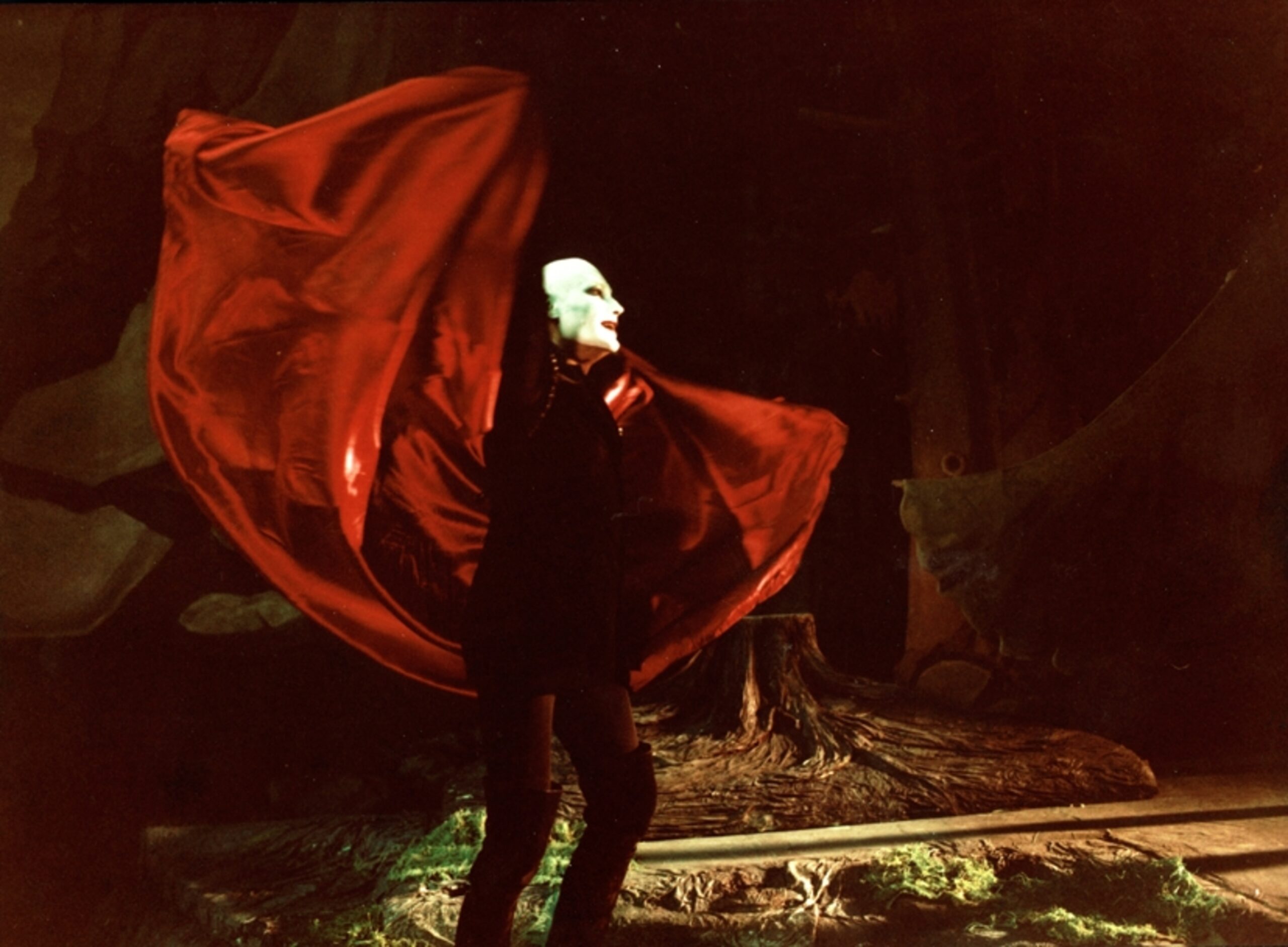
Closely modelled on the life and career of the German actor Gustaf Grundgens, “Mephisto” is adapted from the author Klaus Mann’s novel of the same name, and is the tale of Hendrik Hofgen, a charismatic and cunning actor in Hamburg post-World War One. His professional ascent from local stage celebrity to national theatre sensation is matched by his gradual moral descent and degradation over time into a notorious collaborator with the Third Reich. At the heart of the film is Klaus Maria Brandauer’s astounding performance as the seductive and utterly ruthless Hofgen. He is in virtually every shot and carries each scene with such verve and dexterity that Hofgen always remains human to us – his decisions are despicable yet comprehensible.

Szabo surrounds Brandauer with some of the best actors of the era, notably Krystyna Janda in a radiant performance as Hofgen’s wife Barbara Bruckner, Karin Boyd as his lover and muse Juliette Martens, the only woman to sees right through him, and The General, a thinly-veiled reference to the Nazi leader Herman Goring, performed with a cold-eyed immensity by the brilliant Karl Hoppe. At what point in the film does Hofgen cross the rubicon? It could so easily be the first scene of the film where he flatters an actress who he clearly believes is inferior to his talents. His transformation from active leftist to Nazi avatar is never shown as inevitable, and that is Hofgen’s real tragedy. It is Brandauer’s film, and he dominates the film as assuredly as any leading actor in the history of cinema.
Brandauer is one of those actors whose work deserves to be re-evaluated and celebrated. He was such a prolific screen presence in the 1980s in such high-profile films as the “counterfeit” (and really enjoyable) Bond film “Never Say Never Again” as the villain Maximillian Largo, and starred alongside Meryl Streep and Robert Redford in Sydney Pollack’s prestige drama “Out of Africa”, winning a Golden Globe for his performance. His turn towards theatre in recent decades (he is currently Professor at the Max Reinhardt Seminar) should not obscure the remarkable contributions that Brandauer has made to modern cinema. Likewise, Istvan Szabo can often be overlooked as a cinematic giant, but he most definitely should be regarded as such. As a film-maker, he isn’t a true stylist with an obvious cinematic signature, but that counts in his favour. I would compare Szabo to a director like Fred Zinnemann, a flexible and innovative film-maker who served the material in front of him, summoning up a series of extraordinary films that have stood the test of time.

As a complete contrast to “Mephisto”, “Colonel Redl” is a bitterly austere drama about the rise and fall of a military officer in the Austro-Hungarian Empire in the year leading up to the First World War. Based once more on a real-life figure – the real Redl was tried for espionage on behalf of the Russian Empire and took his own life – Szabo once more transforms mere biography by adapting John Osborne’s controversial play ‘A Patriot For Me’, itself about the Redl case, into a deeply troubling mood piece of a film. As Redl, Brandauer is both constrained and restrained, befriending the aristocratic Kristof Kubinyi (Jan Niklas) and rising ever more perilously through the ranks of the Army despite his humble background. Devoted to the military, monarchy and empire, Redl is at once the embodiment of esprit de corps but also dismayed at his fellow officers’ lack of these virtues – as he sees them. But he too hides a secret. This is clearly an empire in decline – Lajos Koltai’s camera fills each frame with the coldest of blue tones and bottomless greys. Interior light is sparing and artificial.
Redl enters the inner circle of the Hapsburg Empire, and the paranoid heir to the throne (clearly Archduke Franz Ferdinand), portrayed here with cigar-chomping gusto by the wonderful Armin Mueller-Stahl. In their scenes together, Brandauer and Mueller-Stahl provide a two-handed acting masterclass that is truly breathtaking. Redl’s loyalty to the Empire blinds him to the fate that awaits him at the hands of those who he had entrusted not just with his life, but his entire identity. Brandauer’s performance pares everything down to anguished expressions and panicked gestures. It might be his most impressive onscreen performance. “Colonel Redl” was nominated for Best Foreign Language Film in 1985, but lost out to “The Official Story” by Luis Puenzo, although it did win the Jury Prize at the Cannes Film Festival that year.

“Hanussen” is yet another story based on a real-life figure, this time the celebrity clairvoyant Jan Erik Hanussen, and is a return to the era of the Weimar Republic. But once again, Szabo subverts our expectations. Hanussen was born Klaus Schneider, and we see Schneider rebuild himself from a wounded and traumatized soldier at the close of World War One into the famed and feared “prophet” who entranced audiences across Germany prior to the rise of the Third Reich. In contrast to the real-life Hanussen, whose association with the Nazis is a matter of historical record, Brandauer portrays Hanussen as a man of rigour and sensitivity, a man apart seemingly burdened with the ability to predict the future, which he delivers calmly, and with the utmost seriousness. He is helped immeasurably by his military doctor Dr Bettelheim, played by the Swedish actor Erland Josephson, who recognizes the significance of his ‘gift.’ The addition of Josephson, a truly heavyweight actor with a stellar filmography including classics by Bergman and Tarkovsky is another remarkable feat of casting. He lends a sombre, fatherly gravitas to the role of Bettelheim that contrasts with Brandauer’s displaced, almost alienated performance as Hanussen. The certainty with which he delivers his predictions is completely unnerving, sending shockwaves through everyone surrounding him, including those who seek to silence him (law enforcement), those who want to turn him into a modern Cassandra (the media) and later most fatefully, those who wish to co-opt him – the Third Reich. In that sense, “Hanussen” is deeply pertinent and disquieting film that feels more relevant than ever. The film was nominated for Best Foreign Language Film 1988, but lost out to Bille August’s “Pelle the Conqueror”.
• Mephisto (1981), Colonel Redl (1985) and Hanussen (1988) presented from 4K restorations by the National Film Institute Hungary – Film Archive, supervised and approved by cinematographer Lajos Koltai.
• Four of István Szabó’s acclaimed but rarely seen short film works, newly remastered in HD by the National Film Institute Hungary – Film Archive:
– Variations on a Theme (Variációk egy témára, 1961)
– You (Te, 1963)
– Concert (Koncert, 1963)
– City Map (Várostérkép, 1977).
• István Szabó – The Director Answers: A filmed interview with the award-winning filmmaker.
• Remembrance of József Romvári:
Filmmaker Sophy Romvari’s tribute to her grandfather, the production designer József Romvári, with narration by Szabó.
• Szabó’s Central Europe: A look at Szabó’s Hungarian films.
• Trailers
• Individual booklets each with new writing by Hungarian cinema experts John Cunningham, Peter Hames and Catherine Portuges, plus journalist Stephen Lemons on the real-life Erik Jan Hanussen.
• Hungarian and German audio options.
• New and improved English subtitle translations.
• UK premieres on Blu-ray.
• Region-free Blu-rays (A/B/C
The special features are superb additions to this remarkable box set. The shorts films are imaginative and playful, especially Concert, Szabo’s thesis film which won a prize at the Oberhausen Short Film Festival in 1963, and City Map, Szabo’s beautiful visual tribute to Budapest from 1977. Szabo’s Central Europe is a brief but congratulatory summary of the director’s cinematic career, and Sophy Romvari’s Remembrance of Joszef Romvari is a touching piece dedicated to her grandfather, production designer supreme and close friend of Szabo, who provides a heartfelt narration in English with the film-maker. The booklets are full of information and acute prose – in the booklet for “Mephisto”, John Cunningham explores the themes of ‘Mitteleuropa”/Central Europe in Szabo’s films, Peter Hames expertly details the themes of Jewish identity and antisemitism running through “Colonel Redl”, and for “Hanussen”, journalist Stephen Lemons uncovers the real Jan Erik Hanussen whilst Catherine Portugues examines Szabo’s rendering of Hanussen for the silver screen.
In what has been a banner year for Second Run, the label has truly surpassed itself with this outstanding blu ray box set, and it is an indispensable addition to the canon of home cinema for all devotees of Eastern European cinema.