



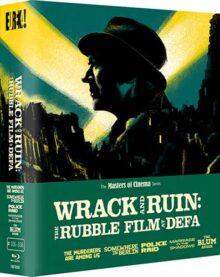
 Director: Wolfgang Staudte, Kurt Maetzig, Gerhard Lamprecht, Werner Klingler, Erich Englel
Starring: Ernst Wilhelm Borchert, Hildegard Knef, Arno Paulsen, Erna Sellmer, Harry Hindemith, Hedda Sarnow, Charles Brauer, Paul Bildt, Friedrich Naumann, Elly Burgmer, Paul Klinger, Ilse Steppat, Alfred Balthoff, Hans Christian Blech, Ernst Waldow, Paul Bildt
Country: Germany
Running Time: 84m, 83m, 94m, 102m, 111m
Year: 1945-1948
This is a fascinating set, probably one of the most important to have been released in some time, and not just because of the films. Indeed, this isn’t one just for film nerds. The extra material is as important as the films.
We know how important German filmmaking is and to even discuss it seems churlish. Without German cinema, there is no cinema as we know it. These particular five examples are important because they provide a glimpse into Germany’s cinematic landscape in the aftermath of World War II. They showcase a range of styles, from pure expressionism to more realistic and sentimental portrayals of the era.
I was reminded more than once of a strong contrast with Ealing. They occasionally featured a bit of London rubble and the famous British stiff-upper lip, softened by our trademark ironic humour. That era of a pervading sense of rolling your sleeves up and saluting the Queen. Or the classic British war film, full of stout, cheerful fellows, even when they were getting shot. 80 years on, images of Spitfires roaring across the skies are still leveraged to evoke memories of, what’s the word? Pluck, that’s it. Rule Brittania, and all that. Some of us have grown up with this as background noise and a shared, inherited narrative continues to pervade.
But, we won. “We” of course was a long while ago and “won” is a stretch. What this incredible set from Eureka! demonstrates -or reminds us of- is that normal lives were shattered. And Germans especially had to come to terms with their immediate past and an uncertain future. It’s as potent an anti-war message as any and that these little films are restored and available is a gift. And that’s before we get to the extra features.
First of all, let’s talk about the actual films. The Murderers Are Among Us is the best of the bunch and the most satisfying. It’s also probably closest to what we expect from classic Expressionism. Noir-ish shadows, plots and Dutch angles. It’s a little rough, but the cinematography and direction has a real spark. Tight, innovative framing, close-ups so close, the focus can blur. The mood, atmosphere and style is invigorating. Despite the steady pace, the story is full of dread and paranoia. Set in the ruins of Berlin, it exemplifies the intention of the set. Police Raid isn’t as accomplished but has a similar theme and a decent pot-boiler of a crime thriller plot.
The image isn’t so sharp, but neither is the tone in Marriage In The Shadows. The brighter, wider rural landscape and jolly music lend this film a positive vibe for a while. It almost becomes a chamber piece, discussing how Germany might reinvent itself. A more cynical tone emerges before the end, but this remains the least noirish. It’s an excellent example of German filmmakers trying to explore styles despite limited resources.
The Blum Affair is the least interesting film in the set. Certainly the least ambitious with a plot isolated to various rooms. I don’t mean this as a backhanded compliment, but it is important to see a rather pedestrian piece. It demonstrates a film industry trying to get their numbers up as quickly as possible.
Somewhere In Berlin stood out as another favourite for me. A bright, lively film that brings in a child’s perspective. And it makes you wonder, how did that younger generation see the rubble? It’s a simple film with powerful, effortless imagery. Sentimental? Perhaps, but importantly so. Honestly, the most unassuming film might be the most vital. It dares to be funny too.
In all the films, and perhaps most starkly with the kids, the actors are playing roles that directly mirror their own reality. They’re trying to rebuild their lives, their careers, their homes. That these films were able to be produced reflects the resilience, honesty and determination of the German film industry at the time.
VIDEO
Image quality varies as you’d reasonably expect. Indeed, there are various warnings about inconsistencies, but generally, all the transfers are strong and clean.
EXTRAS
Each film is accompanied by thorough audio commentaries. All are entertaining and enlightening listens, but I really enjoyed Elizabeth Ward’s for Somewhere In Berlin.
Taking a leaf out of the BFI’s book, Eureka! have stuffed the set with fantastic archive and documentary material. The history of DEFA is covered, as well as exploring the profound effect on Germany of the war. Death camp Sachsenhausen might just stop you in your tracks though. An incredible piece of work, not least for when and why it was made.
- Limited Collector’s Edition Box Set [2000 copies]
- Limited edition hardcase featuring new art by Carly A-F [2000 copies]
- Limited edition collector’s book featuring new writing on the films in this set by German film historians Tim Bergfelder, Daniel Jonah Wolpert, Brad Prager and Mariana Ivanova [2000 copies]
- Reversible inner sleeve artwork featuring new designs for each film by Scott Saslow
- Optional English subtitles, newly revised for this release
- New commentary on The Murderers Are Among Us by crime cinema expert Sergio Angelini
- New commentary on Somewhere in Berlin by East German cinema scholar Elizabeth Ward
- New commentary on Police Raid by crime cinema expert Sergio Angelini
- New commentary on Marriage in the Shadows by DEFA historian Seán Allan
- New commentary on The Blum Affair written by Rolland Man and presented by David Melville Wingrove
- From the Rubble – new interview with socialist cinema expert Claire Knight on the founding of DEFA and its early productions
- Confronting the Past – new interview with Jewish studies scholar Sue Vice on Marriage in the Shadows and The Blum Affair
- Crimewave – new video essay by DEFA historian Sebastian Heiduschke on DEFA’s crime cinema
- Rebuilding Berlin (1946) – DEFA documentary on the post-war rebuilding of Berlin
- Rebuilding Potsdam (1946) – DEFA documentary on the post-war rebuilding of Potsdam
- Death Camp Sachsenhausen (1946) – DEFA documentary on the Holocaust and Sachsenhausen concentration camp
- The Eyewitness 1946/01 – archival newsreel featuring DEFA’s first animation, Underground Scare
- The Eyewitness 1946/08 – archival newsreel featuring a report on the making of The Murderers Are Among Us
- The Eyewitness 1947/53 – archival newsreel featuring a report on the making of Marriage in the Shadows