


 Director: Howard Hawks, Richard Rosson (co-director – handled the censored ending)
Screenplay: Ben Hecht, Seton I. Miller, John Lee Mahin, W.R. Burnett, Fred Pasley (uncredited), Howard Hawks (uncredited)
Based on a Book by: Armitage Trail
Starring: Paul Muni, Ann Dvorak, Karen Morley, Osgood Perkins, C. Henry Gordon, George Raft, Vince Barnett, Boris Karloff
Year: 1932
Country: USA
BBFC Certification: TBC
Duration: 94 min
Howard Hawks’ adaptation of Armitage Trail’s book Scarface (which itself was loosely based on the life of Al Capone) was the last of three key movies made in the early 1930s that helped shape the gangster movie as we know it. Held back for a while due to battles with the censors and theatre owners who were troubled by the subject matter, it was released in 1932, a year after the other two classics of the genre, Little Caesar and Public Enemy.
Whilst these three seminal gangster movies went down well at the time with audiences and often critics, the genre was forced to retreat to the shadows after the Production Code Administration came into play in 1934 and introduced harsher restrictions than the initial Hays model. This prevented what was seen as the glorification of the criminal lifestyle.
The gangster movie came back with a vengeance though in the late 60s, after Bonnie and Clyde struck gold at the box office and later, in the 70s, The Godfather became a global phenomenon. These films and those that continue to follow all owe a great debt to the initial 30s titles that inspired them though.

Indeed, Scarface was even remade in 1983 by Brian De Palma. That version of the story has since overshadowed its predecessor in popularity, aided by its iconic poster, famous quotes and bombastic finale.
Looking to address the balance and remind cineasts that De Palma didn’t get there first, The Criterion Collection are releasing Hawks’ original version of Scarfaceon 4K UHD & Blu-ray. I got hold of a copy and my thoughts follow.
The film is set in the “roaring twenties” and follows the rise and fall of Tony Camonte (Paul Muni), a ruthless and ambitious gangster who dreams of becoming the king of Chicago’s criminal underworld. He begins to ascend the ranks after helping his gang’s lieutenant Johnny Lovo (Osgood Perkins) knock off his boss and take the territory for himself.
Though initially invaluable to Lovo, Tony begins to get a little big for his boots, taking out rivals without consulting his boss. The fiery Tony gets results though and commands the respect of his fellow gangsters.
Further straining the relationship between Tony and Lovo is the fact that the former takes a shine to the latter’s girlfriend, Poppy (Karen Morley). Being accustomed to simply taking what he wants, Tony wastes little time in wooing Poppy, despite the ramifications.

There’s another woman in Tony’s life too, and that’s his sister, Cesca (Ann Dvorak). He loves her very much but is awfully controlling of her, aggressively reprimanding his sister for going out with men, visiting nightclubs or wearing alluring clothes. When Cesca takes a liking to Tony’s right-hand man Rinaldo (George Raft), there might be trouble ahead.
I’d seen Hawks’ version of Scarface a long time ago and remembered liking it but this rewatch pushed it to another level for me. Though the director had made a couple of well-regarded films prior to this, it feels like Scarface is where he found his style that would help form the raft of classics that would follow.
Chiefly, the film is tightly edited, telling its story concisely whilst injecting energy, thrills and laughs whenever possible. Hawks knew how to entertain an audience and Scarface is a genuine pleasure to watch, over 90 years after it was initially released. Also, whilst not as fast-talking as the screwball comedies he would master later in the decade, you still get some of the rat-a-tat dialogue Hawks’ films are known for. Osgood Perkins delivers the most rapid-fire lines and the script is peppered with witticisms, largely from the pen of the great Ben Hecht, though multiple writers were reportedly involved.
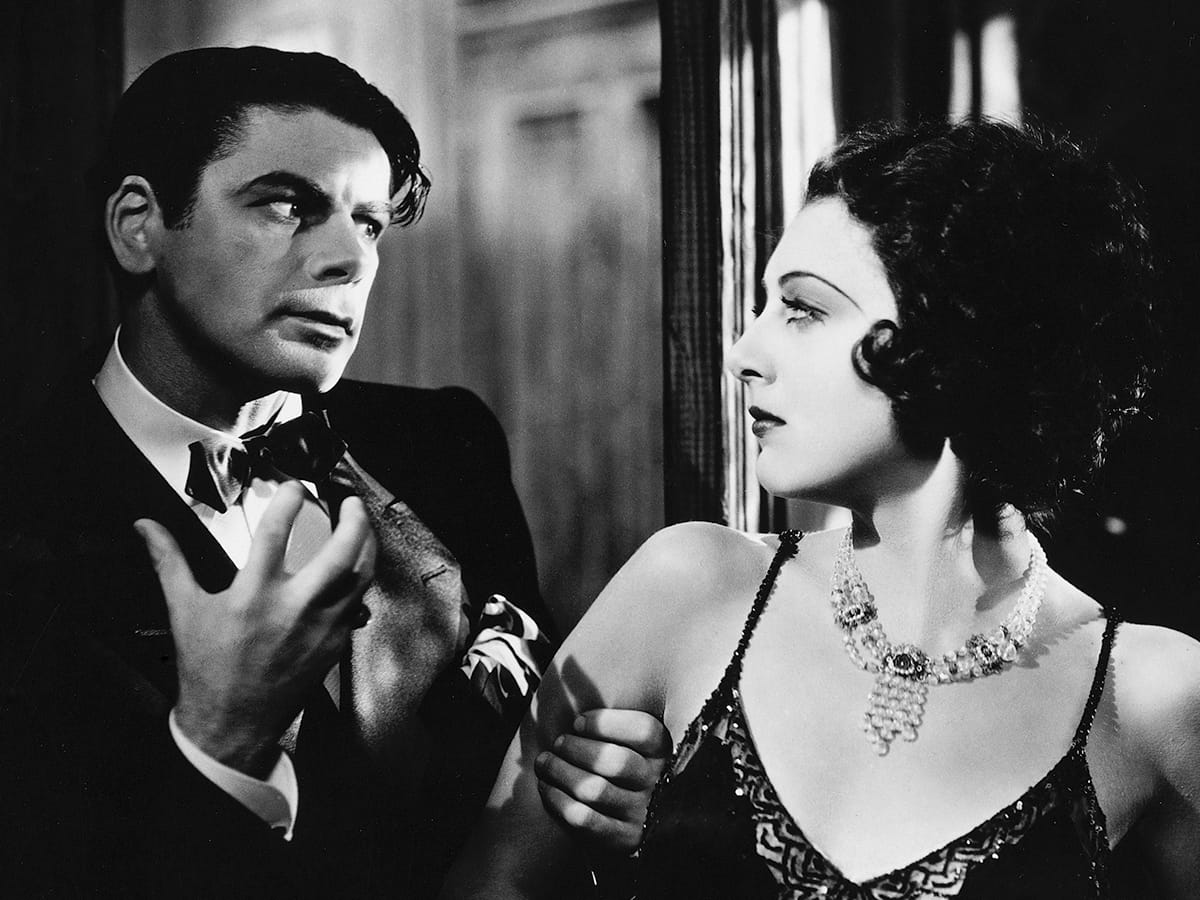
The characters and performances are also key to the success of the film. Muni, playing the title character, is superb, frightening and charming in equal measure. He plays Tony like some sort of man-child. He’s having a blast shooting everyone and everything up, then spending the rewards and living the high life. He has no thoughts about others or the repercussions of his actions until it all goes wrong.
There are a pair of great female characters at the heart of the film too. Karen Morley’s Poppy is no pushover, showing no fear in initially calling out Tony as an idiotic and tactless goon, even if she does warm to his charms as the film moves on. I love the interplay between the pair. Even later on, Poppy laughs at one of Tony’s comments and he’s oblivious to the fact it’s at him and not with him.
It proves to be Tony’s sister Cesca who’s more important to him than Poppy by the end though. There’s a touch of incest suggested in their relationship. This was reportedly intended by Hawks and Hecht but they did a good job of keeping it subtle, to get past the censors. Ann Dvorak is great in the role of Cesca too. She perfectly captures the character’s rebellious attitude, coming across as a younger, female version of her brother.

Dvorak’s scenes with George Raft are particularly good and he’s another actor who deserves a mention here. His character doesn’t say a great deal but gets a lot across through body language and mannerisms, including his famous coin-flipping habit. He became a big star following this and it’s not hard to see why.
I also enjoyed Vince Barnett as Tony’s dim-witted assistant, Angelo. He initially seems like annoying comic relief but his schtick is genuinely funny in places and the character gets a devastatingly poignant close to his arc by the end.
Oh, and I didn’t even mention the fact Boris Karloff is in this. His British accent sticks out like a sore thumb but he’s still very effective as a rival boss who gets caught in Tony’s sights.
On top of these strong characters and performances, the witty script and tight construction, you have some striking cinematography. There are two men credited under ‘photography’, Lee Garmes and L. William O’Connell. The former had previously shot a number of films for Josef von Sternberg and the film is thick with atmosphere, with great use made of light, shadows and silhouettes.
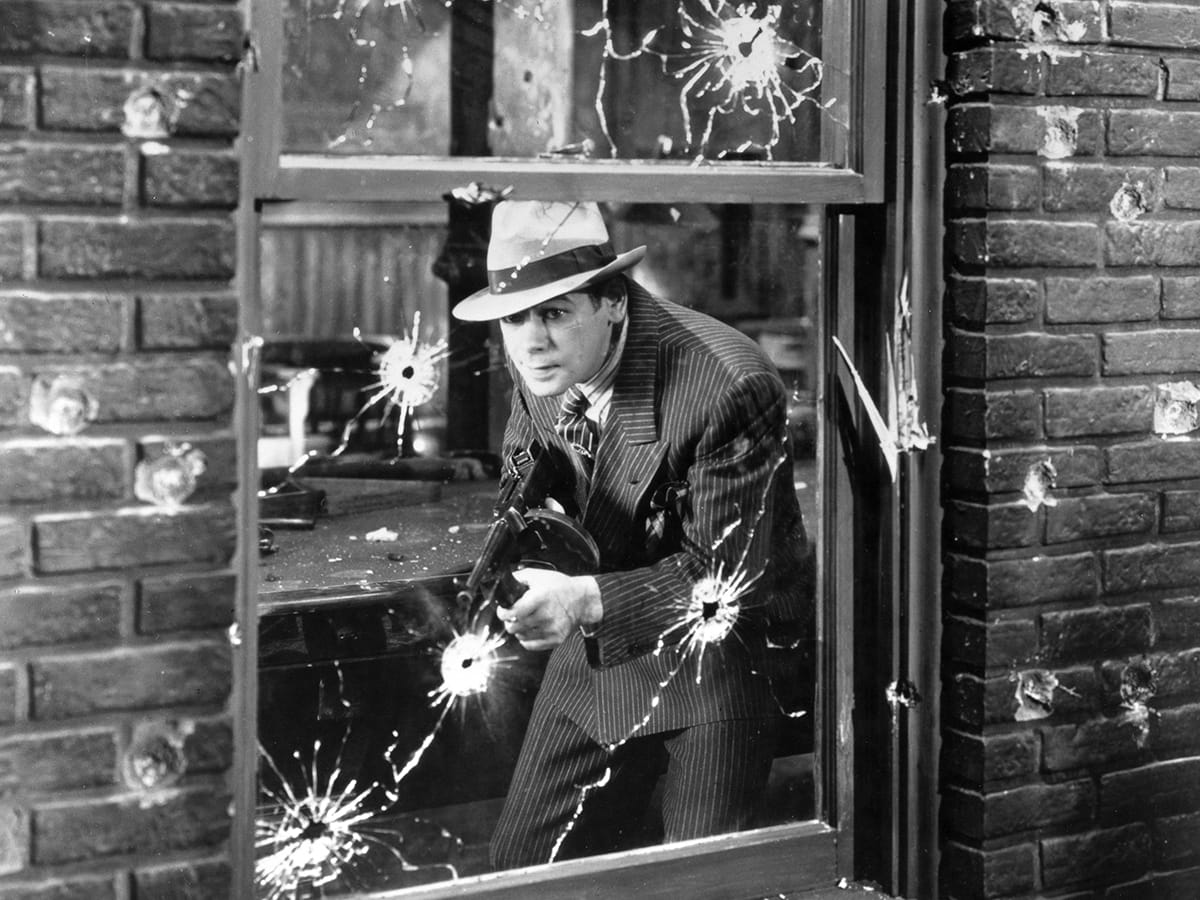
With the film being ‘pre-code’, there’s some racy content for the era too. The violence isn’t as graphic as that of gangster movies of the 70s and beyond, but the often off-camera killings, done using sound, shadows and other implied visual representations, remain pretty shocking. A sequence that’s clearly imitating the infamous St. Valentine’s Massacre is particularly brutal, even without showing any blood.
So, watching the 1932 version of Scarface now is like having one of the ‘original gangsters’ show us how it’s done. Lean, mean and delivered with style, energy and character, it’s Golden Age Hollywood at its best.
Film: 
Scarface is out on 18th November on 4K UHD & Blu-Ray in the UK, released by The Criterion Collection. I watched the Blu-ray disc and found the image quite soft. This suggests the restoration was sourced from a print rather than a negative, but don’t quote me on that as I couldn’t find any proof of this. It’s listed as a new 4K restoration though, so I’m guessing this is as good as it’s going to look, unless new material is discovered. It’s pretty clean though, the thick grain is quite well-handled and the contrast is pleasingly balanced. As for audio, there’s some hiss in places but considering how old the film is, it sounds pretty good.
4K UHD & BLU-RAY SPECIAL EDITION FEATURES
– New 4K digital restoration, with uncompressed monaural soundtrack
– One 4K UHD disc of the film and one Blu-ray with the film and special features
– Alternate ending, from the censored version of the film
– New conversation between author Megan Abbott and actor Bill Hader
– New interview with film scholar Lea Jacobs on director Howard Hawks’s innovative use of sound and editing
– English subtitles for the deaf and hard of hearing
– PLUS: An essay by critic Imogen Sara Smith
– New cover by Mark Chiarello
Included on the discs is an alternate ending, directed by Richard Rosson at the behest of the studio to keep the American censors happy (Hawks refused to revise the film). It swaps Tony’s final moments for a flat courtroom insert and a hanging scene (featuring a stand-in actor). It’s obviously a far cry from the suitably explosive original ending.
Megan Abbott and Bill Hader have a 38-minute conversation about the film in another special feature. They’re both big fans of Scarface and its director and talk about what makes the film so special. They also discuss how it has inspired later films, particularly those of Martin Scorsese. It’s an entertaining analysis.
Lea Jacobs talks about the film’s groundbreaking use of sound and editing. Hawks perfectly balanced the rhythm of dialogue and sound effects, and played with the accents on different sides of the gang war. Jacobs also describes the sometimes surprising reactions of critics to the introduction of sound to cinema, particularly dialogue.
I didn’t receive a copy of the booklet, unfortunately.
So, it’s not one of Criterion’s more loaded packages, but what’s here is of value. The film is so good though, that I still wouldn’t hesitate to recommend it to anyone.
Disc/Package: 
