



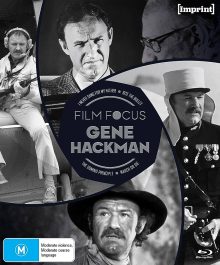
 Gene Hackman is a fascinating actor who made a name for himself starring in some of the biggest films of the 70s. Given a plum role like Popeye Doyle in The French Connection or Little Bill in Unforgiven, Hackman can give performances of such realism and impact that they enhance the writing considerably. He can be a convincing hero (The Poseidon Adventure) or charismatic villain (Superman) and his underrated comedy touch ranges from the dry wit of The Royal Tenenbaums through the straight-man reaction acting of The Birdcage to the full-on slapstick of his cameo in Young Frankenstein. At his best, Hackman is a performer who can disappear into a role but given the wrong material he is also an actor who can just disappear. His subtlety and the lack of apparent ego in his performances mean if he’s given a dull character, he assumes that dullness a little too readily. This new boxset in Imprint’s Film Focus series offers the chance for fans to catch some of the more obscure films from the decade that made Hackman a star. While I applaud the release of these lesser-known works instead of yet another reissue of The Conversation or The French Connection, for the most part the films in this set represent Hackman at his least effective.
I NEVER SANG FOR MY FATHER
Director: Gilbert Cates
Screenplay: Robert Anderson
Based on the play by: Robert Anderson
Producers: Gilbert Cates
Starring: Gene Hackman, Melvyn Douglas, Estelle Parsons, Dorothy Stickney
Year: 1970
Country: USA
BBFC Certification: PG
Duration: 92 mins
I Never Sang for My Father, making its debut on Blu-ray, is by far the best film in this set. A raw, psychologically complex examination of a difficult father/son relationship, it boasts exceptional central performances and an excellent screenplay. But while some may expect that to be enough to secure a film classic status, I Never Sang for My Father is a textbook example of how important every aspect of the filmmaking process is to the overall quality. With its grotty sets, haphazard editing, dull direction, odd sound design and intrusive music, I Never Sang for My Father looks like nothing so much as a cheap TV movie that has lucked into a great screenplay. Robert Anderson’s writing often manages to evade these distractions through its sheer power and the central performances by Gene Hackman and Melvyn Douglas are riveting, as is a supporting turn by Estelle Parsons. But moments of detrimental overkill keep breaking up the flow. Dramatic monologues are smothered in mawkish music which robs them off their emotional impact by pushing too hard for a reaction. In a film that is largely grittier than it is sentimental, this seems like a particularly odd choice. Worse still, a couple of sequences in which Hackman’s character looks round some insalubrious care facilities push so hard for us to be horrified by the disproportionately mild images that they just become funny. These moments are shot and scored like a Horror film and it is utterly ridiculous.
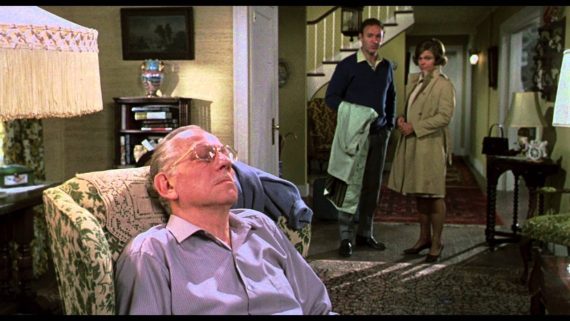
It’s a shame to have to come in so hard on I Never Sang for My Father because when it is working it really is very good. This is entirely down to Anderson’s script and the performances, with perhaps a nod to Gilbert Cates’s direction of his actors which appears to be significantly better than his handling of everything else. Melvyn Douglas creates an incredibly real character in the elderly Tom Garrison, essaying a sort of manipulative emotional abuse which is subtle enough that it refuses to be stoked into Melodrama. Hackman, still an up-and-coming actor but already securing his second Oscar nomination (bizarrely for Supporting Actor), is equally subtle and compelling as the son attempting to break free from his father’s manipulative imprisonment. Estelle Parsons as his sister should surely have been considered for an Oscar nomination alongside her two nominated male costars. The work of the three actors in creating an understated, completely realistic family dynamic was almost enough to push me to a four star rating but then I Never Sang for My Father follows a great climactic confrontation between its leads with a goofy freeze frame and a cheesy, anticlimactic voiceover narration (which must, in all fairness, be recognised as the one major weakness of Anderson’s screenplay) and the bumps in the road just felt too prominent and numerous to ignore. It’s a real shame because with this script and these actors I Never Sang for My Father could easily have been a truly remarkable film. Instead it’s a good film trying to extricate itself from dire execution.


BITE THE BULLET
Director: Richard Brooks
Screenplay: Richard Brooks
Producers: Richard Brooks
Starring: Gene Hackman, Candice Bergen, James Coburn
Year: 1975
Country: USA
BBFC Certification: PG
Duration: 131 mins
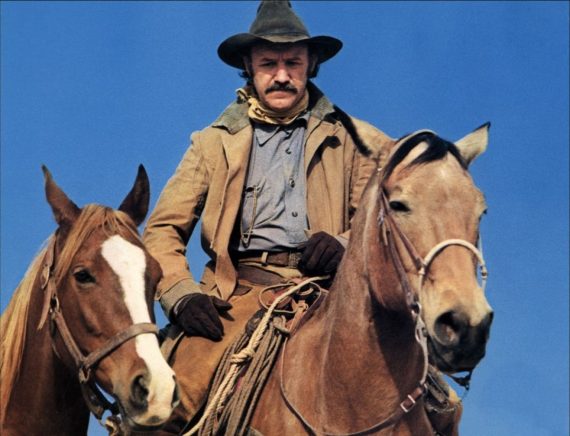
Bite the Bullet was a film I was looking forward to watching a great deal. A Western about a 700 mile cross country horse race, the film was based on a similar real-life event that took place from Wyoming to Colorado in 1908. The film was written and directed by Richard Brooks, who had form in the Western genre with 1966’s excellent The Professionals, and has a strong cast in Hackman, Candice Bergen, James Coburn, Ben Johnson, Ian Bannen and Dabney Coleman. Unfortunately, Bite the Bullet turned out to be one of those 70s films like Robert Aldrich’s Emperor of the North, which has a great premise and cast but is so muddily executed that its tone and appeal get lost amongst unclear intentions. Hackman seems miscast and the majority of the film’s characters are so thinly drawn that the viewer has to work hard to remember who we’re following from scene to scene. This is a problem in a film that is teeming with characters and flits quickly between them, as they need to be more vividly established in order to prevent the film becoming dull. For me, this was not the case and I struggled to care much about the race or the racers, which sucked the life out of the experience and made for a very long 131 minutes.
THE DOMINO PRINCIPLE
Director: Stanley Kramer
Screenplay: Adam Kennedy
Based on the novel by: Adam Kennedy
Producers: Stanley Kramer
Starring: Gene Hackman, Candice Bergen, Mickey Rooney, Richard Widmark
Year: 1977
Country: USA
BBFC Certification: 15
Duration: 97 mins
Though I like to think I’m an open-minded film buff, I do have certain preconceptions that sometimes get in the way of me proving this to be the case. I tend to back away from certain genres more than others, even though I’ve seen masterpieces in all of them. So, though I love 2001: A Space Odyssey for example, the reductive side of me might still be tempted to make the statement “I’m not much of a Sci-Fi guy”, if only for its pleasing climactic triple rhyme. I wanted to preface this review with a brief discussion of how reductive I can be regarding genres because there is a relevant example of my preconceptions that is even dafter involving titles. There is a strand of Conspiracy Theory Thrillers that were popular in the 60s and 70s and many of their titles have a similar structure and rhythm which triggers a Pavlovian buffoonishness in me. The Eiger Sanction. The Parallax View. The Odessa File. The Quiller Memorandum. I can feel myself getting bored the minute I hear those titles and, to be honest, I’ve only seen two of them and I’m not 100% sure they are all Conspiracy Thrillers. The bigot in me goes “Well, they sound like one” and my reasoning just shuts down. I loved Marathon Man. That’s a Conspiracy Thriller but it doesn’t sound like one. Conspiracy Thrillers can be great but it seems that they need to be titled with the surreptitious care of an actual conspiracy to get past my dunderhead’s radar. Had Marathon Man been called The Marathon Inquisition I probably never would’ve seen it. I’ve never seen The Ipcress File. I’m an idiot.
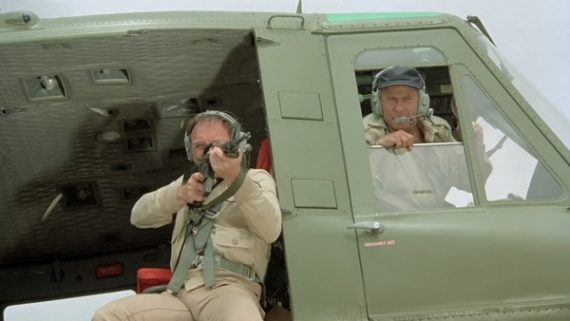
I’m not saying all Conspiracy Thrillers are masterpieces either. Although my own inability to follow some of the labyrinthine plots is a factor, I flatter myself that I can attribute at least some of the responsibility for this to the quality of filmmaking. If a film holds my attention with good characters, dialogue and direction, I can generally follow the plot sufficiently (although The Big Sleep proves this isn’t always the case) but I often find Conspiracy Thrillers to be blandly televisual, putting too much confidence in their twistiness above all else. The Domino Principle is undoubtedly one of the worst examples of the genre I’ve seen. From its cheesy, Troy McClure-esque voiceover prologue to its cheap look and overripe dialogue (less of Mickey Rooney talking about “pussy” would be much appreciated), it’s a dog for sure. Perverse then that I should have followed it so easily. The film is notorious for having confused audiences and even some of the actors, Hackman included. But knowing this in advance and being prepared for something unintentionally daft, I found myself more tuned into the film than I was with some of its more revered contemporaries. The Domino Principle is not so-bad-it’s-good but it is silly and misjudged enough to be vaguely fascinating, if only one time though. It may also be of interest to fans of director Stanley Kramer, a Hollywood legend whose politically and socially engaged films of the 50s and 60s were once taken very seriously but quickly became unfashionable. I still love many of Kramer’s films but even the director himself, along with several of his stars, denounced The Domino Principle as a late-era misstep.
MARCH OR DIE
Director: Dick Richards
Screenplay: David Zelag Goodman
Producers: Jerry Bruckheimer, Dick Richards
Starring: Gene Hackman, Terence Hill, Max Von Sydow, Ian Holm, Catherine Deneuve
Year: 1977
Country: USA
BBFC Certification: PG
Duration: 104 mins
It is often noted that Gene Hackman turned down roles in Jaws, Close Encounters of the Third Kind, One Flew Over the Cuckoo’s Nest and Apocalypse Now in order to make The Domino Principle and March or Die. It’s the sort of vaguely interesting but also slightly annoying fact that is bandied about by those who want to derisively laugh at someone for something they couldn’t possibly have foreseen. It’s like that oft repeated story of Elvis Presley receiving a bad grade in music at school, in which the teacher is routinely belittled under some delusional assumption by the storyteller that Elvis was, at this early stage, already bedecked in full Vegas regalia and belting out Suspicious Minds. We like to think as film lovers that we’d recognise a blockbuster like Jaws as a hit in waiting just by looking at the screenplay but with the benefit of hindsight on our side there’s just no way of knowing that for sure. So, while Hackman reportedly chose the films he did for the entirely valid reason that they offered a bigger pay cheque, there’s every reason why he may have also envisaged the perfectly decent screenplay of March or Die to be the basis of an epic hit (I can’t really defend his choice of The Domino Principle in the same way!).

As it turned out, March or Die was a commercial flop and has since accrued a reputation for being a crashing bore. I was quite pleasantly surprised to discover then that March or Die is a perfectly adequate, often even entertaining, Epic/War/Adventure film squeezed into an agreeably short runtime, handsomely lensed and competently written. The biggest disappointment is that the film fails to live up to the promise of its frankly incredible cast. Gene Hackman, Catherine Deneuve, Max Von Sydow and Ian Holm all in the same place seems to promise a classic but unfortunately, perhaps due to the lacklustre direction of Dick Richards, they are all performing well below their abilities. Holm’s committed performance may be the exception, except for the fact that no amount of enthusiastic thesping can make him convincing as a vicious Arab leader. It’s one of those era-specific casting choices that part of me wants to look past but a bigger, better part of me simply cannot. A big problem in terms of the casting is Terence Hill as the charming thief who evades arrest by joining the French Foreign Legion. Hill is given more screentime than anyone else but he lacks the charisma to really carry off this role. Hackman, meanwhile, struggles to get a handle on his tough, traumatised Major, once again underperforming according to the specifications of the underwritten script.
There is apparently a longer TV version of March or Die that some say is better because it gives clearer motivations for the characters. Still, having spent 104 minutes with March or Die, I don’t especially think the problem with it is that it needs to be longer. In fact, the concise runtime is one of the things I found most appealing. If audiences were bored by March or Die, it’s because the actors largely seem quite bored too, and the film ends up being a reasonable story in an attractive wrapper but with no beating heart to keep the blood moving.
Film Focus: Gene Hackman (1970 – 1977 was released on limited edition Blu-ray by Imprint on 26 July 2023. While the films themselves have their problems, Imprint offers its usual range of excellent video essays from experts, along with a couple of full length commentaries. The special features in full are as follows:
THE DOMINO PRINCIPLE
* NEW Audio Commentary by film historian Howard S. Berger
* NEW Stanley Kramer: Man Out Of Time – video essay by Howard S. Berger
* NEW The Devil’s Advocate – actress Karen Sharpe on Stanley Kramer
* The Manipulators: Behind the Scenes on The Domino Principle – vintage featurette
* Theatrical Trailer
MARCH OR DIE
* NEW Audio Commentary by film historians Howard S. Berger and Steve Mitchell
* NEW Of Blood & Time: The Weary Worlds of Dick Richards – video essay by Howard S. Berger
* NEW Marched and Died – interview with actor Paul Sherman
* Theatrical Trailer