


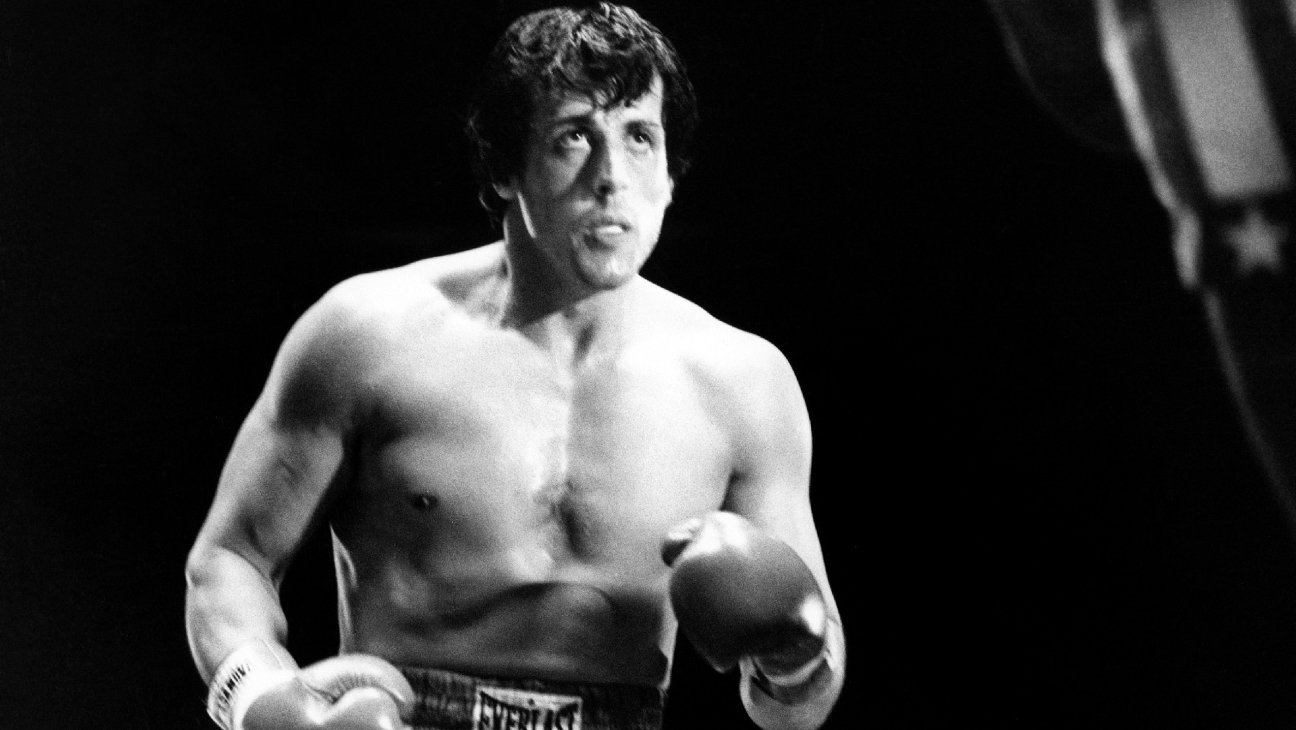
Think of Rocky and it’s difficult not to think of boxing. The grey tracksuit, the pounding training montage, Bill Conti’s music and those famous steps have become inseparable from the film. Yet go back to Rocky fifty years later and something feels slightly strange. The film we remember isn’t quite the film Sylvester Stallone actually wrote.
For much of its running time, Rocky isn’t particularly interested in boxing at all. It’s interested in a lonely man wandering the streets of Philadelphia, his awkward relationship with Adrian and the possibility that one unexpected opportunity might give his life some meaning. The fight with Apollo Creed gives the story its destination, but the journey there is far quieter and more personal than decades of pop culture would have us remember.
So how did a small character drama about a man looking for self-respect become remembered as one of the definitive boxing movies?
The answer may lie within the later sequels, especially the third and fourth entries.
Rocky II managed to retain the dramatic aspects of the original while expanding Rocky and Adrian’s relationship. We see them get married, move in together and try to make ends meet. The sequel still focuses on Rocky’s ordinary life, particularly once the money from his brief taste of fame begins to run out and he struggles to find his place outside the ring. Ultimately, that all leads to Rocky facing Apollo Creed again and eventually winning the world heavyweight championship.
Rocky III and Rocky IV are where things drastically changed. The fight choreography became more of a priority, while Rocky’s opponents became a much bigger part of the central challenge. Rocky III still explores Rocky’s psychological state, particularly his fear of Clubber Lang and his grief following Mickey’s death, but the overall spectacle was substantially heightened. There was still some focus on Rocky and Adrian’s relationship, with both films making it clear that Adrian remained Rocky’s main source of support and one of the most precious people in his life. But there was now far more emphasis on training montages, the fights themselves and the larger-than-life personalities of Clubber Lang and Ivan Drago.
It was around the time of those two sequels that the Rocky series really began to embrace the larger-than-life boxing spectacle with which it would become linked with. The original film became increasingly lumped in with that image, even though it was actually a very different film from much of what followed. Aside from the second film, perhaps the heavily panned Rocky V and 2006’s Rocky Balboa are as close to the first film as we are ever likely to get.
It wasn’t just the 1980s sequels that changed the way we see the first film. Memorabilia consisting of items such as replicas of Rocky’s title belt, video games and boxing gloves bearing the character’s image have all helped reinforce Rocky’s identity as a boxing icon, despite the original film having very different priorities.
Certain phrases from the sequels have also been affectionately embraced by fans. Ivan Drago’s “If he dies, he dies” is frequently used online as an expression of love for the fourth film. “Eye of the Tiger” by Survivor was specifically written for the third movie and was later used again to close Stallone’s director’s cut of Rocky IV. The song became shorthand for determination, training and competition. Even the World Boxing Council now describes it as a song heard in sporting arenas and associated with fighters’ ring walks.
South Park directly recreated the Rocky III scene in which Clubber interrupts Rocky’s public appearance, with Bat Dad taking the Clubber role. It also parodied Rocky admitting to Adrian that he’s afraid of Clubber. Then there’s Hulk Hogan’s Thunderlips. That’s interesting because Rocky III started blurring fictional boxing with the extravagant showmanship we’d associate with 1980s sports entertainment.
Family Guy, meanwhile, recreated the snowy Rocky IV training sequence with Stewie training Brian. The film itself became such convenient shorthand that Family Guy later made an episode called “Petey IV”, culminating in Peter fighting Vladimir Putin in a spoof of Rocky fighting Drago.
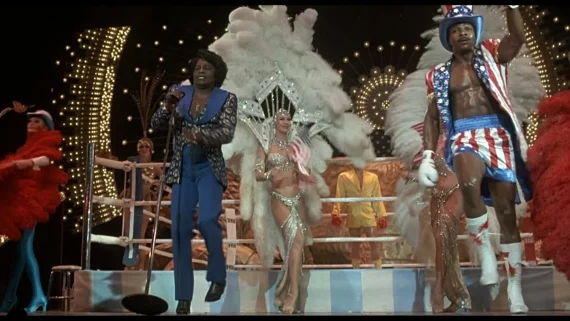
And we shouldn’t overlook Apollo’s entrance to “Living in America”. James Brown performs while Apollo enters the arena surrounded by dancers in an absurdly elaborate patriotic spectacle. That’s almost the polar opposite of the modest world of the first Rocky.
It would be almost a sin if I didn’t mention the Rocky statue, which still stands in Philadelphia today. Originally commissioned for Rocky III, the statue was donated to the city after filming and eventually became one of Philadelphia’s best-known tourist attractions. In 2026, it was moved to the top of the famous Rocky Steps at the Philadelphia Museum of Art.
Perhaps the statue is the perfect symbol of what happened to Rocky in the years that followed. The quiet story of a lonely, struggling man who simply wanted to prove that he wasn’t another bum from the neighbourhood gradually became something much bigger. The sequels gave us championships, larger-than-life opponents, spectacular training montages and some of the most recognisable imagery in popular culture. In the process, they also helped reshape how we remember the film that started it all.
Fifty years later, Rocky remains one of the most famous boxing films ever made. Yet watch it again and boxing almost seems beside the point. Rocky doesn’t need to beat Apollo Creed. He needs to prove something to himself, and when the final bell rings, his first thought isn’t about the result. He’s looking for Adrian.
Perhaps that’s the Rocky we’ve gradually forgotten.