


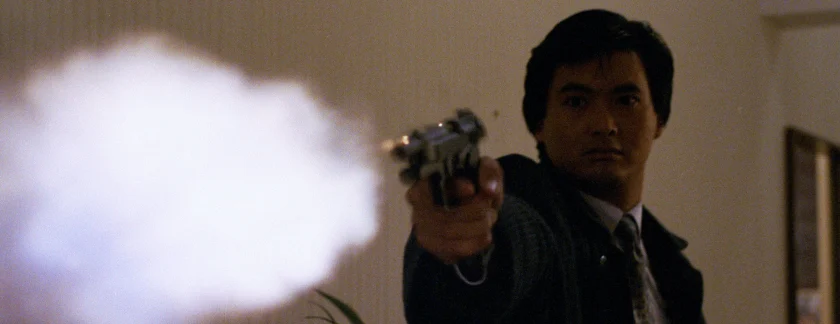
A BETTER TOMORROW
 Directed by: John Woo
Written by: Chan Hing-Ka, Leung Suk-Wah
Starring: Chow Yun-Fat, Ti Lung, Leslie Chung, Waise Lee
Year: 1986
Country: Hong Kong
Running time: 95mins
BBFC Classification: 18
Infusing a true gangster crime saga with a cinematic style that is all his, A Better Tomorrow set the blueprint for Woo’s identity for years to come. The tale of two likeable crooks (Ti Lung and Chow Yun Fat) trying to keep their heads above water and the cop brother of one of them (Leslie Cheung) torn between his loyalty to the force and his love for his brother, A Better Tomorrow has lost none of his frenetic charge and infectious energy. A career defining moment for both Woo and a star-making performance for a, here, supporting Chow Yun-Fat.
Teaming up with Tsui Hark via his Cinema City outfit, Woo’s A Better Tomorrow still hits as hard now as it did when it was first released.
Ti Lung (very much the star in this instalment) is Sung, a gifted counterfeiter who along with his partner Mark (Chow Yun-Fat) are at the top of their game: in so much they’re even (cockily) training a recruit for their outfit, Shing (Waise Lee). Sung’s younger brother Kit played by Leslie Cheung, is making his way through the police academy, his brother’s criminal activities seemingly unbeknownst to him. When a deal Sung is involved with in Taiwan goes terribly wrong, Sung is sent down for five years while Mark finds himself with a serious gunshot inflicted injury (which ultimately sees him end up living on the streets) after he takes revenge on those who set up Sung.
Five years later, Sung is out and trying to make amends with Kit, now a supercop in his own right and wanting nothing to do with his criminal brother. It also transpires Shing has risen to the top of the crime world and puts Sung in a compromising position: forcing him to take on a job or his brother’s police career will be jeopardised. Loyalty and brotherhood are stretched to their limits as Sung and Mark attempt to keep Kit out of harm’s way but as Shing tightens his grip.
Woo would go to the craft bigger, better, and more celebrated scenes of balletic gunplay action (the finale shootout in this film’s sequel, A Better Tomorrow II, being one of them) but the original stills hold its own not least in the fierce impact of the action scenes. A genre defining classic.

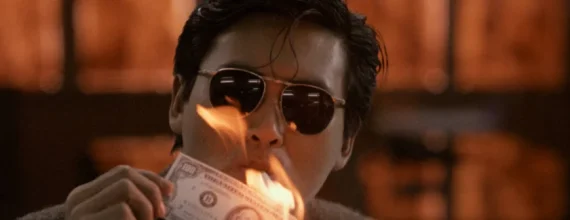
A BETTER TOMORROW II
Directed by: John Woo
Written by: Tsui Hark, Chan Hing-Ka, Leung Suk-Wah
Starring: Chow Yun-Fat, Ti Lung, Dean Shel
Year: 1987
Country: Hong Kong
Running time: 105 mins
BBFC Classification: 18
Released the following year, after the great success of the original, A Better Tomorrow II is bigger, flashier, and come the second half packed with the type of action that would cement Woo as the undisputed king of gunplay action. Some regard it as superior to the first instalment; some see it as a messier re-hash that is saved by its incredible finale. The latter is what Woo certainly used to regard it as, his vison compromised by forced upon edits and his well-known struggles with producer Tsui Hark.
This is evident in the slightly choppy nature of the final film, the narrative not continuing in the way one might expect. Sung (Ti Lung) is behind bars after the events of the first film, his policeman brother Kit (Leslie Cheung) now going undercover to get close to shipping magnate (and Sung’s former mentor) Lung (Dean Shek), who is being pressured by gangsters to turn a blind eye in his shipyard when they bring their illegal wares in. When Lung is framed by said gangster and his daughter slain (who Kit was cozying up to in order to get close to Lung), Sung agrees to work with the police so he can be released and aid his possibly in-over-his-head younger brother. Meanwhile, Lung is sent to the States in hiding where he swiftly begins to lose his mind after the death of his daughter and an attempt on his life. It’s here he’s saved and rehabilitated by Ken Gor, the twin brother of the first film’s Mark who is played by a returning Chow-Yun Fat. Ken helps Lung recover and the two bond and thus agree to return to Hong Kong to help Sung and Kit who are now being targeted by the gangster who set up Lung.
Woo may not be a fan of the released version of A Better Tomorrow II and was certainly reluctant to make a sequel to the genre defining original, there is no doubt the film was a massive influence on his, Yun-Fat’s, and Hark’s careers, and the action genre (Hong Kong and otherwise) as a whole. And the gun blazing finale is still just as thrilling, holding up as some of Woo’s best action. Not as a satisfying experience as the first film, though undeniably influential in the genre and brining Woo international attention, the film is still an enjoyable ride through Hong Kong gangster and action tropes and is saved by the a Woo’s newly uncovered workprint cut that fills in a lot that was originally cut: see more on that below.

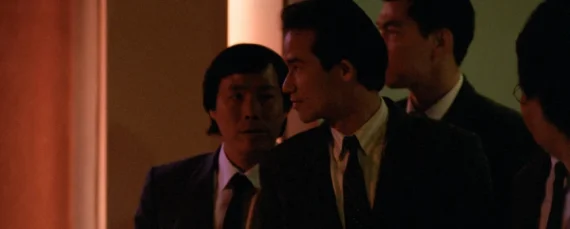
A BETTER TOMORROW III: LOVE & DEATH IN SAIGON
Directed by: Tsui Hark
Written by: Tsui Hark, Leung Yiu-Ming, Foo Ho Tai
Starring: Chow Yun-Fat, Anit Mui, Tony Leung Fai-Leung
Year: 1989
Country: Hong Kong
Running time: 111 mins
BBFC Classification: 18
Woo didn’t return to direct the third part in the franchise he started, instead the reigns taken up by his producer Tsui Hark. The two had famously clashed over the making of Woo’s The Killer leading them to part ways. Woo did write a treatment/screenplay for a Part 3 but took that script and re-tooled it as arguably one of his masterpieces, Bullet in the Head.
Tsui Hark meanwhile forged ahead with this perhaps unnecessary prequel, also part set in Vietnam much like Bullet in the Head, that saw the return of Chow Yun-Fat’s Mark from the original A Better Tomorrow. It essentially sees the genesis of the Mark character, how he became the cool, gun toting, anti-hero of the original film. Mark and his cousin Cheung (Tong Leung Ka-Fai) travel to a still war-torn Vietnam intending to reunite with and bring back their uncle to Hong Kong. However, they fall under the spell of the beautiful and enigmatic Chow (Anita Mui) who inadvertently sucks the cousins into her dangerous gangster lifestyle. Her unstable gangster lover Ho (Tokito Saburo) thus kills the cousin’s uncle and has them deported in retaliation for messing with his missus but the two hence return seeking revenge.
The switching of Woo to Hark makes this instalment much different in tone and execution compared to Woo’s two previous action masterpieces. Tsui Hark is a great and inventive filmmaker in his own right but in attempting to mimic the success of the previous two films all the while jettisoning everything that made those two films great, means his Part 3 (while competently made) is a lacklustre finale to the original trilogy. Grungier, clumsier, and lacking the intensity of Woo’s films, A Better Tomorrow III is certainly buoyed by the return of Chow Yun-Fat as Mark and a couple of decent action scenes. However, it just lacks the theatrical melding of drama and action that made Parts I and II so watchable.
However, Anita Mui makes for an alluring and visually striking anti-heroine and the concept of her teaching Mark how to use guns gives the familiar trudge through (male) gangster tropes a novel approach. And while proceedings aren’t as soaked in intricate gun action as the other films in the series, Hark (known for staging exciting action scenes also) does manage some decent firefights, not least one that sees Yun-Fat diving through the air wielding twin M16 machine guns!
Yet with the similar plot trappings and setting as Woo’s much superior Bullet in the Head (along with his go to star of the time, Yun-Fat), A Better Tomorrow III is unfortunately stuck in the shadow of preceding two A Better Tomorrow’s. Not bad if seen as a companion piece, and somewhat what of a marmite film as some seem to really like it or loathe it but perhaps not a film that was really needed, other than to cash in on the A Better Tomorrow fever of the time.
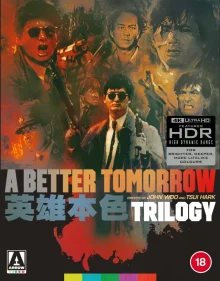
LIMITED EDITION BLU-RAY CONTENTS
- Reversible sleeves featuring original and newly commissioned artwork for each film by Tony Stella – not available at time of review.
- Double-sided foldout poster featuring original and newly commissioned artwork by Tony Stella – not available at time of review.
- Collectors’ perfect-bound booklet featuring new writing on the films by critics and Hong Kong cinema experts Victor Fan, Camille Zaurin and David West, archival writing by critic Julien Dupuy and an excerpt from an interview with John Woo conducted by Stéphane Moïssakis – not available at time of review.
DISC ONE – A BETTER TOMORROW
- High Definition (1080p) Blu-ray presentation
- Original lossless Cantonese mono and lossless English mono audio
- Optional English subtitles for the Cantonese soundtrack and English subtitles for the deaf and hard of hearing for the English soundtrack
- Brand new audio commentary by Hong Kong cinema experts Frank Djeng & FJ DeSanto
- Brand new audio commentary by film critic James Mudge
– fact packed and interesting audio commentaries from some the best experts on Asian cinema. - Isolated score track
– Jospeh Koo’s excellent and rousing score to enjoy over the film without audio and dialogue featuring the iconic heroic theme so associated with the first two films. - Brand new interviews with director John Woo, producer Terence Chang, writers Chan Hing-Ka and Gordon Chan, filmmaker Gareth Evans and author Grady Hendrix
- Archival interviews with John Woo and actors Kenneth Tsang, Waise Lee and Ti Lung
- Archival UK featurette
- Introduction to the film by John Woo, filmed at Beyond Fest at the American Cinematheque in 2025
– interesting collection of interviews dissecting and celebrating the film with Woo in particular going into detail about the making of the film. - Alternate English credits – English only credits in different, larger font.
- Theatrical trailers – fun mix of retro trailers advertising the film on its original release.
- Image gallery – nice collection of promotional and behind the scenes stills and posters.
DISC TWO – A BETTER TOMORROW II
- High Definition (1080p) Blu-ray presentation of the theatrical cut
- Original lossless Cantonese mono and lossless English mono audio
- Optional English subtitles for the Cantonese soundtrack and English subtitles for the deaf and hard of hearing for the English soundtrack
- Brand new audio commentary by Hong Kong cinema experts Frank Djeng & FJ DeSanto
- Brand new audio commentary by film critic James Mudge –
– fact packed and interesting audio commentaries from some the best experts on Asian cinema. - Isolated score track
– Jospeh Koo’s excellent and rousing score to enjoy over the film without audio and dialogue. - Brand new interviews with John Woo, Frank Djeng and Grady Hendrix
- Fantasia Festival 2022 Artist Talk and Q&A with John Woo
- Archive interview with Tsui Hark
– interesting collection of interviews dissecting and celebrating the film with Woo in particular going into detail about the making of the film. Fascinating to hear Hark talk of the film also in his archival interview. - Deleted and extended scenes from the workprint – collection of the scenes cut from the original release. All can be seen incorporated in Woo’s original workprint cut, which is included in this release and highly recommended to watch.
- Alternate English credits – English only credits in different, larger font.
- Theatrical trailers – fun mix of retro trailers advertising the film on its original release.
- Image gallery – nice collection of promotional and behind the scenes stills and posters.
DISC THREE – A BETTER TOMORROW II WORKPRINT CUT
- High Definition (1080p) Blu-ray presentation of the recently unearthed extended Workprint Cut, viewable either in raw unrestored form or with inserts from the restored Theatrical Cut, via seamless branching – Perhaps the best extra feature, is John Woo’s original cut, a cut that is far superior to the originally released version. Forced to cut out a huge chunk of drama, character beats, and even some action to get the film down to a more lucrative under two hours runtime, Woo has gone on record saying he doesn’t favour the theatrical version of Part 2: save for the epic action finale. While the theatrical will always be a mixed bag, beloved by some, frustrating others, Woo’s original cut is the cut to go with: a rich crime drama that culminates in some of the director’s most finely staged action.
- Original lossless Cantonese mono audio
- Optional English subtitles
DISC FOUR – A BETTER TOMORROW III: LOVE & DEATH IN SAIGON
- High Definition (1080p) Blu-ray presentation of the Hong Kong theatrical cut
- Original lossless Cantonese mono and lossless English mono audio
- Optional English subtitles for the Cantonese soundtrack and English subtitles for the deaf and hard of hearing for the English soundtrack
- Brand new audio commentary by film critic David West
- Brand new audio commentary by Hong Kong cinema experts Frank Djeng & FJ DeSanto
- Brand new interviews with writers Jason Lam Kee-To and Lau Tai-Muk, Grady Hendrix and historian Aurélie Basha i Novosejt
interesting collection of interviews dissecting and discussing the film at length. - Deleted and extended scenes from the Taiwanese cut
collection of the scenes cut from the original release. All can be seen incorporated in Hark’s original workprint cut, which is included in this release. - Alternate English credits – English only credits in different, larger font.
- Theatrical trailers – fun mix of retro trailers advertising the film on its original release.
- Image gallery – nice collection of promotional and behind the scenes stills and posters.
DISC FIVE – A BETTER TOMORROW III EXTENDED CUT
- High Definition (1080p) Blu-ray presentation of the extended Taiwanese preview cut
- Original lossless Mandarin mono and lossless English mono audio, plus newly assembled hybrid Cantonese/Mandarin mono audio
- Optional English subtitles
- This workprint cut is perhaps not as vital as the once for A Better Tomorrow II, it really just extending some scenes and fleshing out some of the drama. It doesn’t drastically change the film, like the workprint for Part 2 does, but certainly fleshes out the romantic drama angle Hark was going for.